

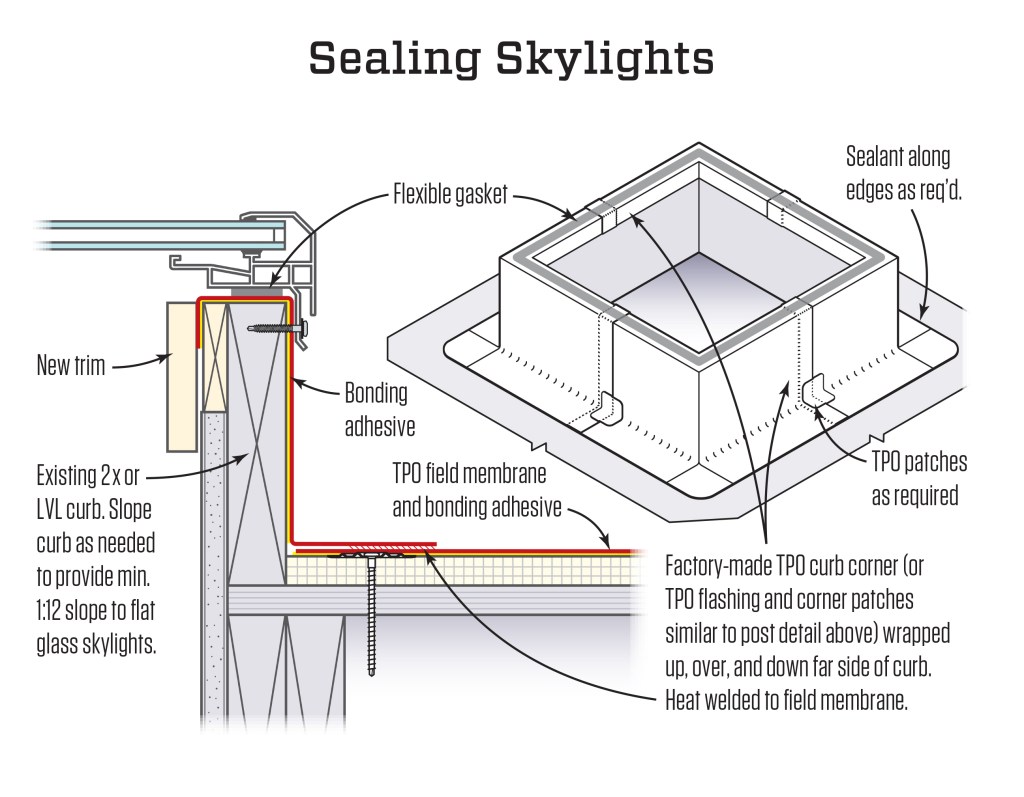
Q: How should a skylight be installed on a flat roof?
A: Jim Carlson responds: A skylight opening on a low-slope or flat roof must have a raised curb to allow for proper flashing and counterflashing unless you are installing a curved-top skylight, such as a Velux CurveTech unit, which drains rainwater and comes with it’s own PVC curb.
For a roof 3:12 or less, the International Residential Code requires a curb that’s at least 4 inches above the roof deck. A 2×6 is typical for the curb framing, but in regions with snowfall, I recommend to use a 2×10 or LVL that’s over 8 inches above the finished roof surface.
Flat-glass skylights will need a pitched curb that provides at least 1:12 slope. A slope above 3:12 (15 degrees) is preferred.
Depending on the roofing material, you may need to install a cant strip at the base of the curb. A cant strip provides a more gradual transition for the roofing membrane to turn up from horizontal to vertical.
The field plies of the roof membrane should be turned up the vertical face of the curb, above the head of the cant strip. However, the turned-up field plies are not adequate curb flashing by themselves. To properly flash the skylight curb, membrane base flashing should be installed before the skylight is set in place. The base flashing reinforces the membrane at the curb-to-roof intersection.
Base flashing can be made from strips cut from rolls of the roofing material, or from membrane flashing stock, depending on the roof system you are using. Feather the base flashing plies onto the field of the roof, with the uppermost ply extending approximately 4 inches beyond the base of the curb or the toe of the cant strip.
Once the curb has been flashed, the skylight and counterflashing can be installed. Most manufactured skylight assemblies have a metal flange that serves as counterflashing. Or it can be fabricated from sheet metal. If fabricated, it should be wide enough to extend over the base flashing a sufficient distance to keep out wind-driven rain and snow. Depending on the specific climate, you may need to insert an additional metal “counterflashing skirt” to extend the pre-made flange.
In all climates, it’s important to air-seal between the skylight unit and the curb. Depending on the wind direction, wind can create a negative pressure situation that may pull water in under that flashing. Diligent air sealing will prevent this.


