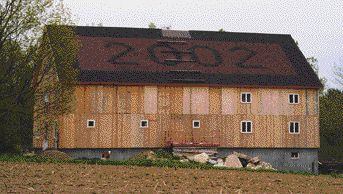
Bennington, Vermont, is located at the southern edge of a historic slate-quarrying region that stretches along more than 50 miles of the VermontNew York state line. Slate roofs are common on older buildings of all kinds throughout the area, so when Bennington businessman Duane Greenawalt decided to build a timber-framed retail building patterned after a traditional dairy barn, he intended to cover it with a distinctive slate roof.
But as the structure neared completion, Greenawalt realized that the project budget couldn’t be stretched to cover the cost of slate. Rather than give up on his original vision, he hired local builder Tim Clark to create a decorative slate-like roof with three-tab asphalt shingles.
To plot the initial layout, Clark had a draftsman with a local engineering firm create a patterned grid with an AutoCad program. The first attempt, based on modules representing full-sized shingles, was too crude. “The 2s looked like the letter Z,” Clark says. A second version, based on the sizes of individual tabs, yielded smoother, better-looking curves. This change made it necessary to cut single tabs from some of the shingles making up the letters, but because it had no effect on the field shingles, it added relatively little labor.
The original concept called for using light gray numbers within the brown field and black border, but Clark recommended a more subtle two-color approach. He mocked up several options with colored pencil, Greenawalt agreed, and Clark and a helper got to work.
Most of the eight-week project, Clark reports, was spent preparing the existing SIPs deck for the new cold roof. This involved nailing down 2×4 sleepers, plywood, and felt and installing the rake, eaves, and soffit trim. Before beginning to shingle, Clark marked color transitions and other key reference lines with tightly stretched nylon strings nailed to the deck.
Laying the 50 squares of shingles needed to cover both of the 83×30-foot roof planes actually took less than two weeks and went off without a hitch, despite the early onset of winter.
“As it got into December, we still had half the roof to shingle,” Clark recalls. “People started asking us if we’d have to change the date to 2003 if the weather kept us from finishing by the end of the year.” Despite some snowy days toward the end, the job finished on time. In addition to serving as a landmark to motorists driving along U.S. Route 7, the dated roof should also make it easy to tell if the 20-year shingles live up to their rated life expectancy.