Download PDF version (894.8k) Log In or Register to view the full article as a PDF document.

Image

Image

Image

I’ve worked on a lot of natural slate roofs in my 20 years as a roofer and general contractor, but it wasn’t until last year that I got my first synthetic-slate job. The client was building a new home in northern New York state, and he wanted to use Authentic Roof slates (Crowe Building Products, 888/533-3358, authenticroof.com). After carefully reviewing the product literature and grilling a roofer who provides manufacturer-sponsored training, I felt confident that there wouldn’t be much difference between installing the natural and synthetic materials.

Authentic Roof slates weigh about the same per square as high-quality 30-year architectural shingles and about one-fourth as much as real slate. That weight difference appealed to me, but an even bigger advantage on this project proved to be the fact that these slates are much easier to work with than stone slates. Besides being large (40 squares), my client’s roof was complex, with a big masonry chimney, a barrel-vaulted porch roof, and five valleys. Moreover, it had an extensive photovoltaic system with dozens of aluminum standoffs that we had to cut around and flash (see Figure 1). It made the job a lot more appealing to know that we’d be able to easily drill the slates and cut them with a utility knife, shingle cutter, jigsaw, or table saw without worrying about damaging them.

Image

Image

Figure 1. Because synthetic slate is so much easier to cut than real slate, it’s also faster and easier to install. That made it a good choice for this 40-square roof, which features a barrel-vaulted front porch (top) and dozens of solar-panel roof standoffs (bottom).

Since completing the project, I’ve recommended Authentic Roof slates to several customers. And I’m installing another synthetic slate roof this spring. At about $450 per square (materials only) — compared with $130 per square for architectural asphalt shingles — synthetic slate is definitely a premium roofing material. But it’s a good fit for the harsh Adirondack climate where I work, because it resists wind and ice damage and mold growth.


Product Characteristics

Authentic Roof slates are made from a proprietary thermopolymer olefin compound that consists mostly of recycled postindustrial waste from auto-industry products. The shingles taper from about 1/4 inch thick at the butt end to 1/8 inch thick at the top, and measure 12 inches wide by 18 inches high. They’re available in three standard shapes and six standard “color-through” hues and come packaged in 25-slate bundles that weigh about 42 pounds apiece. It takes roughly 185 slates to cover 100 square feet when the exposure is 6.5 inches (recommended for roof slopes between 7/12 and 9/12).

A square of Authentic Roof shingles weighs between 280 and 330 pounds, depending on the exposure; by comparison, 1/4-inch-thick natural slate roofing weighs at least 800 pounds per square. Roof framing for synthetic slate shingles is the same as for asphalt and metal roofs.

Because Authentic Roof slates are made from plastic, they can be cut, hammered, and walked on with little risk of damage. They have a Class 4 impact resistance (the highest rating), Class A “stand-alone” fire rating (not dependent on the underlayment), and a 110-mph wind resistance rating. They’re also UV-protected and come with a 50-year warranty. The company has a 20-year track record.

Cuts can be made with a utility knife by first scoring the shingle and then snapping it on the score line (Figure 2). For repetitive cuts, we used a Shingle Shark asphalt-shingle cutter (800/231-5647, qualcraft.com). Both methods work fine for straight cuts, but a jigsaw worked better for curved cuts around the tubular skylights and L-shaped and rectangular cuts around the photovoltaic mounting blocks. We even used a portable table saw to cut some slates.

Image
Image
Image

Figure 2. Authentic Roof slates can be scored with a utility knife and snapped (left), or cut with a jigsaw (center). A Shingle Shark makes quick work of repetitive cuts (right).

Layout and Starters

When we arrived on site, the roof deck was already sheathed with Zip System roof sheathing (800/933-9220, huberwood.com). This 5/8-inch-thick sheathing has an integral waterproof top layer, and the seams are sealed with a special tape. The product is meant to be watertight without an underlayment, but for added protection and to satisfy Authentic Roof’s installation instructions, we opted for a layer of Grace Ice & Water Shield (866/ 333-3726, graceconstruction.com) at eaves and valleys and around penetrations.

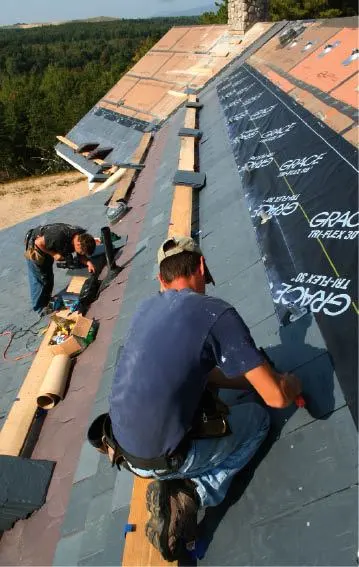
Everywhere else, I used Grace’s Tri-Flex 30, a synthetic roof underlayment. I prefer it to felt because it resists tears better and doesn’t wrinkle when it gets wet. I also like that it’s packaged in lightweight 10-square rolls. We used painted 26-gauge galvanized drip edge and flashing per Authentic Roof’s recommendations.

The company warns installers to mix slates together from the 25-piece bundles and from every pallet they’re shipped in, as inherent color variation could show up as unintended patterns in the finished roof. Our pallets arrived on a tractor trailer without a boom, so we had to hump all the material onto the roof ourselves. The way the shingles are packaged, I can’t see how you could store them on a steep roof anyway, so be prepared for the extra time that unpacking, mixing, and stocking the slates will require. I used a rope and a milk crate to get them onto the roof (Figure 3).

Image

Figure 3. The slates weigh about the same per square as asphalt shingles, but they’re much bulkier. Here, the author uses a milk crate to stock the roof a dozen pieces at a time.

Starter shingles are made by removing 6 inches from the top of the company’s standard 12-inch-by-18-inch slates. The manufacturer suggests several ways to do this, but the fastest way I found was to use a portable table saw equipped with a rip fence. Before installing the starters, I snapped a chalk line so that they would overhang the drip edge by one inch. Once I’d checked that my planned layout would have reasonably sized pieces of shingle at the rakes, I snapped a pair of vertical layout lines as well.

Shingle Installation

The first shingle course is placed over the starters with the joints lapped halfway. Unfortunately, Authentic Roof slates can’t be installed with a roofing nailer, since the nail has to be placed in the exact center of the molded nail hole, with the nail head flush with the surface of the slate. This holds the relatively temperature-stable slates in place while allowing the roof deck underneath to expand and contract with changes in temperature. We used 1 1/2-inch hot-dipped galvanized nails; copper and stainless roofing nails can also be used.

Authentic Roof slates also have spacing tabs that project from the edges and automatically gap the shingles 3/16 inch apart (Figure 4). Each slate has an exposure guide on the face. Exposures can be adjusted from 6 to 7 inches, although the company recommends a 6-inch exposure for high-wind areas. Using blue chalk to prevent staining, we snapped a line for every course.

Image

Figure 4. The slates have tabs that keep them spaced 3/16 inch apart and a built-in exposure index. During installation, the author snaps a chalk line for each course.

Valleys

Authentic Roof recommends using W-shaped valley flashings, which have a rib down the center (Figure 5). I use W-shaped — rather than V-shaped — valley flashings on most roofs anyway, because they’re better at preventing water and melted snow from getting under the shingles that line the valley. That’s an important benefit during our harsh North Country winters.

Image
Image

Figure 5. Valleys are lined with peel-and-stick underlayment before the 26-gauge galvanized metal W-flashing is installed; the slates butt directly against the rib in the flashing (left). Since they can’t be installed with a pneumatic nailer, the slates are hand-nailed (right).

I nailed each valley flashing over a layer of Ice & Water Shield, then sealed the edges to the roof deck with additional strips of the membrane. A layer of synthetic underlayment laps over everything.

At the valleys, I cut and installed the slates so that they butt up against the rib. This detail — which minimizes the appearance of the valley — is one that I’ve used successfully with real slate roofs.

Decorative Shingles

In addition to standard slate-look shingles, Authentic Roof makes decorative Beaver Tail shingles (with rounded corners) and Mitered Edge shingles (with clipped corners). My client’s roof had decorative bands of red Beaver Tail shingles integrated into the design (Figure 6).

Image
Image

Figure 6. Like natural slate, synthetic slates have slight color variations, so bundles must be mixed before installation (left). To keep the decorative rounded slates in alignment with the field slates, the author uses a spacer block (right).

Inexplicably, the Beaver Tail shingles are slightly narrower than the square shingles. As a result, I couldn’t rely on the molded spacing tabs if I wanted to maintain the vertical layout. Instead, I made spacer blocks a little thicker than the tabs. We inserted them between shingles so we could match the layout on the square slates. Other than the spacing issue, the decorative shingles install just like the square-cut version.

Curves. The barrel-vaulted porch on this house was originally supposed to have a soldered copper roof, but this was eliminated from the budget. Luckily, Authentic Roof slates can be warmed up with a heat gun and shaped to conform to a curved surface. It was pretty easy to mold the slates to follow the porch roof’s convex and concave curves (Figure 7).

Image

Figure 7. Authentic Roof slates can be heated up and molded to fit such curved shapes as barrel-vaulted roofs.

Hip and Ridge Caps

The manufacturer’s cap slates look a lot like standard slates except that they have a crease molded into the back. Once the shingles are heated with a heat gun, the shingle can be folded along the crease to match the roof’s pitch. By late October — when we were capping the ridge — the mornings were quite cool, so to save time we’d preheat a stack of shingles with a torpedo heater and finish up by heating individual shingles with the heat gun (Figure 8).

Image

Image
Image

Figure 8. In cold weather, the slates are stored in a warm area and heated to above 50°F so they’re easier to cut (top). Cap slates — which have a ridge channel molded into the back — are warmed with a heat gun, then bent into shape (bottom left) and nailed into place at a hip or the ridge (bottom right).

The caps can also be installed over a ridge vent, as long as longer nails are used. The manufacturer recommends shingle installations over vented roofs only.

Winter Installation

Cooler temperatures complicate Authentic Roof slate installation. The manufacturer suggests keeping the slates at a minimum temperature of 50°F, but sometimes that’s just not possible.

When the thermometer dropped below 40°F, the slates were tough to cut, so we took to warming a stack with a kerosene space heater. I would then make a few cuts at once while the shingles were still warm enough to cut easily. This became especially important for the many cuts required at the hipped cornice returns that flanked the gable ends.

I had figured that the job would take about four weeks if I worked with one or two helpers. It ended up taking about twice that long. This was partly because we were working with a new product; but also, the early-winter weather slowed us down. Twice, the half-completed roof was buried in snow. It was critical that we waited for the roof to dry because the shingles are extremely slippery when they’re wet or snowy.

On my next synthetic-slate roof installation, I’m assembling a bigger crew to speed installation and we’re making the starters and caps ahead of time. I charge about $240 per square to install synthetic slate — about $80 more per square than I charge to install architectural asphalt shingles, but as much as $160 less per square than real slate.

Roger Ouimette is a general contractor in Champlain, N.Y.