-
Q.
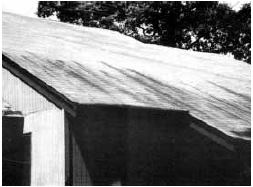
The photo below shows unsightly black staining on asphalt roof shingles. This staining appears to be caused by a mildew or fungus. It is common in this area of eastern Virginia, which is rainy and humid in the spring, hot and humid in the summer, and warm and humid in the early fall.
I have made several observations about the problem in this area: 1) affected roofs are of a light color ( perhaps the problem just doesn’t show on darker roofs); 2) affected roofs are in areas with trees nearby, but not necessarily shaded; 3) it appears on older roofs, perhaps more than ten years old, but the roofs do not appear to be deteriorated; 4) staining is more common on lower parts of roofs than upper parts; 5) roof pitch does not seem to be a factor; 6) not all roofs of the same age and color have the same problem.
I have asked several roofing contractors about cleaning off the stains, but none have tried. How can the stains be removed and/or prevented? A. The discoloration is actually caused by a pigment produced by a species of blue-green algae known as Gloeocapsa. It appears throughout the U.S. in warm, humid climates, but it thrives in the Gulf states, along the Eastern Seaboard, and in the Northwest. It exists on darker roofing, too, as you guessed it might, but the stain is not as visible as it is on white and pastel roofs. Despite its unsightly appearance, algae growth will not affect the durability of the shingles.
Algae discoloration is difficult to remove from roofing, but it may be lightened with a solution of one part chlorine bleach to three parts water, with some trisodium phosphate added. This treatment will lighten the staining, but it will not completely remove or prevent the algae from returning.
The solution should be applied with a soft brush to avoid dislodging the granules. During application, this solution will make the roof slippery and hazardous, so work from ladders or scaffolding. The roof should be rinsed with a gentle spray from a hose after 20 to 30 minutes. Beware the solution and rinse water will kill grass and landscaping plants, so the water from downspouts should be collected and the landscaping covered with plastic during the treatment. Rinse the gutters and downspouts, as well.
The Ringer Corporation (9959 Valley View Rd., Eden Prairie, MN 55344; 800/654-1047) makes a product called “Safer Moss and Algae Killer” made for exterior use. I have had no experience with it, but it is advertised as being biodegradable and should reduce the problems of getting the solution on lawns and gardens.
New “fungus-resistant” shingles are available in most parts of the country where this is a problem. These shingles have zinc mixed into the ceramic-coated granules. The zinc coating slowly dissolves, and the metal prevents algae growth. Any of the heavy metals, such as lead and copper, will work, but zinc seems to be the most economical. The effect of the metal is dramatically visible on some roofs, where the areas below the lead, zinc, or copper flashings are unstained, while the rest of the roof is darkened by the algae. The scattering of gray granules in the shingles is not noticeable in most shingle colors and patterns. Of course, these shingles are more expensive because of the cost of the zinc granules.
To prevent staining on existing roofs, try slipping a narrow strip of zinc under the ridge row of shingles, so about 3/4 inch is exposed. A second strip can be installed about halfway down the roof. This will have essentially the same effect as the zinc granules. A similar installation of a strip of copper will control moss and mildew growth on wood shingles.
Q&A: Removing & Preventing Asphalt Shingle Stains
3 MIN READ