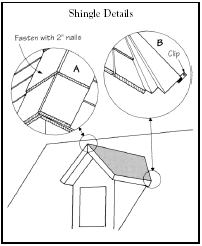
- Q. How should we detail wood shingles on dormers? Are the ridge shingles clipped on the same way as asphalt shingles? Is there a trick to getting the valley flashing to lie flat? What other details are important?
A. The ridge shingles should be attached with alternate overlaps, similar to the way a woven corner is detailed on a wall. The exposure should equal that of all regular courses of shingles. Note that longer nails will be necessary for the ridge shingles. Shingles on the sides of dormers need not be clipped at the top.
To keep the metal valley flashings lying flat, do not nail them directly to the roof sheathing. Instead, fasten them with clips nailed to the sheathing and locked into the rolled edge of the flashing. This allows the flashing to move with temperature changes. The shingles should not be nailed through the metal. Valley flashing should overlap 6 inches at end joints, and flashing sheets should be no longer than 6 feet.
The most critical part of installing a wood shingle roof, other than the flashing, is the nailing. Each nail should be driven not more than 3/4 inch in from the edge of the shingles and no more than 1 inch above the exposure line. The nail heads should be driven to the surface of the shingle, not indented into the shingle fibers. The shingles should overhang the rake edge 1 inch and the fascia a minimum of 1 1/2 inches. If gutters are used, the shingle may overhang by 1 inch. The slots between shingles should be 1/4 inch to 3/8 inch wide, and offset from the slot in the course below by at least 1 1/2 inches.
Q&A: Wood Roofs on Dormers
1 MIN READ