
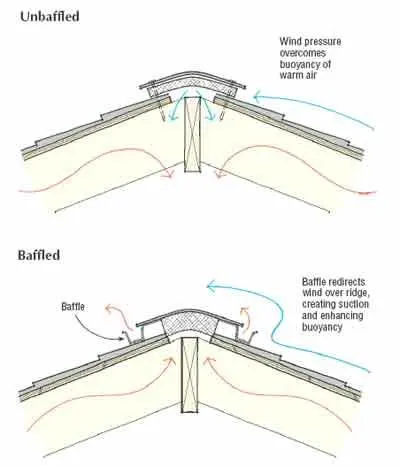
Q: Wouldn’t a single-sided ridge vent be more effective than a standard ridge vent for a home built on a windy site? It seems that with openings on both sides of the ridge, a standard vent would simply short-circuit when the wind blows rather than draw air from the eaves vents.
A: Paul Fisette, director of Building Materials and Wood Technology at the University of Massachusetts Amherst, responds: In order for a ridge vent to exhaust, you need a pathway and a reliable driving force. Both a single-sided and a double-sided ridge vent provide a pathway, so the important question is this: What is the main driving force that pushes attic air up and out of the ridge vent?
While wind direction can induce roof venting — and it’s been shown that even soffit-only venting can draw air out of roofs — most often the answer is the buoyancy of the attic air. If there is a fair amount of heat loss from the house into the attic, then the buoyancy of the warm air rising causes it to escape at the highest point, the ridge.
However, a more energy-efficient house experiences less heat loss, so in that case buoyancy becomes less of a driving force. Based on some tests I’ve run, I think it’s important to install ridge vents that have an external baffle, like ShingleVent II (Air Vent Inc., 800/247-8368, www.airvent.com). As wind passes over the roof ridge, the airstream jumps over the vent’s baffle, causing suction as the air lifts upward — the same way an airplane wing works (see illustration). Called the Bernoulli effect, this driving exhaust force works regardless of wind direction. Without an external baffle, either a single- or a double-sided roof vent can allow outside air to come in and short-circuit the venting process.


