
Up until now, remodelers have been able to sidestep most of the EPA’s lead paint rules — including the pre-renovation education provision in effect since 1999 — as long as they weren’t “abating,” or permanently eliminating, lead-based paint hazards. But beginning next year, projects that disturb more than 6 square feet of potentially contaminated surface inside a building or 20 square feet outside will be subject to the EPA’s 2008 Lead Renovation, Repair, and Painting rule.
Most of the provisions of the new rule take effect April 22, 2010, when remodelers who work on homes or “child-occupied” businesses (such as schools or daycare centers) built before 1978 will need to be registered with the EPA and undergo certified lead-safety training. Work-practice and record-keeping procedures will also fall under the EPA’s jurisdiction, though the program may actually be run by state agencies.
Phase-in of the new rule was launched back in December 2008, when renovators had to start giving property owners and occupants the updated EPA pamphlet “Renovate Right: Important Lead Hazard Information for Families, Child Care Providers and Schools” before beginning work. Starting next year, contractors will also have to get signatures from owners or occupants acknowledging receipt of the pamphlet, and notify them in writing of the scope, location, and expected starting and ending dates of the planned project.
The new rule is the result of a four-year-long EPA study showing that renovation work — including weatherization, window replacement, hvac modifications, demolition of interior plaster walls, and drilling and sawing into painted wood and plaster — exposes both occupants and workers to the same kind of hazards as lead-paint abatement. And even though painting isn’t considered a renovation or remodeling activity, it too is subject to the new regulations if the surface to be painted is disturbed by sanding, scraping, or other activities that cause dust.
Certification and Training
The EPA says that firms should start applying in October 2009 for certification to conduct renovations. Under EPA rules, a “firm” can be any company, partnership, corporation, sole proprietorship, or individual that performs renovations for compensation. By next April, this EPA certification — essentially a license — will be required of everyone performing renovations in pre-1978 housing, whether he or she is a self-employed contractor or an employee of a large remodeling company. Initial firm certification costs $300 and must be renewed every five years (for information and forms, go to
epa.gov/lead/pubs/renovation.htm.)
Training. At least one renovator from each firm needs to be trained and certified in the eight-hour course Lead Safety for Renovation, Repair, and Remodeling, which was developed jointly by the EPA and HUD. The course fee is determined by the individual trainers who administer the test. Contractors who have already taken a lead-safety course from HUD/EPA need take only a four-hour refresher to be certified. Certifications are good for five years and must be in place before April 22, 2010. Note that since a sole proprietorship is considered by the EPA to be a firm, self-employed contractors have to have renovator training and accreditation as well as firm certification.
On each job site, there must be at least one certified reno vator who makes sure that other employees follow lead-safe work practice standards. In addition to training workers, the certified renovator is responsible for setting up the containment and lead-dust collection, and for supervising and verifying cleanup.
Lead Testing
According to federal standards, any surface coating with a lead content of 1 milligram (or more) per square centimeter — or 0.5 percent or more by weight — is a lead-based paint. There are three methods for determining lead content: chemical spot tests, X-ray fluorescence (XRF), and laboratory analysis.
Test kits. Inexpensive chemical spot testing kits are widely available and accurate enough for most renovation work. They typically include a swab or dropper that you use to apply a chemical reagent to the paint. If the paint contains approximately 0.5 percent or more of lead by weight, the reagent changes color. All of the layers of paint must be exposed when you’re using a test kit, especially if the area has been painted in the last 20 years. (The top layers are most likely latex, which would produce a negative test result.)
Chemical spot testing provides instant results, but these kits aren’t always accurate, since there are substances other than lead that also may react with the reagent. Still, preliminary testing is a good first step. If you get a positive result, you either need to follow lead-safe work procedures or opt for more definitive XRF or lab analysis. Even if the test is negative and you don’t intend to take any precautions, it’s always a good idea when you’re working on pre-1978 housing to hire someone to perform a lead inspection or risk assessment of the area to confirm that no lead-based paint is present.
The EPA is currently evaluating commercially available chemical spot testing kits, which range in price from about $8 to $30 apiece. While there are several on the market (for a detailed review, see the September 2008 issue of Consumer Reports), only two presently meet the EPA’s criterion of a 5 percent false-negative rate. One is LeadCheck (Hybrivet Systems, 800/262-5323, leadcheck.com), a swab-type test kit available in retail outlets and online. The other was developed by the Massachusetts Division of Occupational Safety and is available only to that state’s certified lead inspectors and risk assessors.
XRF. A portable X-ray fluorescence analyzer is accurate and fast and lets you test many surfaces at the same time without disturbing the paint or coating. But XRF machines are expensive, and testing must be done by a trained and licensed technician who is EPA-certified as either a lead inspector or lead risk assessor. The cost to test a single home can be a few hundred dollars.
Laboratory analysis. XRF testing isn’t as reliable when there are borderline lead levels, in which case the actual lead content should be verified in a lab. Atomic absorption analysis (AAS) determines the percentage of lead by weight and is considered the most definitive method of lead analysis. One disadvantage is that it requires a chip sample containing the entire coating down to the underlying substrate — without any of the actual substrate itself. A second disadvantage is that it tests only the area where the chip was taken from; if the scope of the job increases, you have to take further samples to determine if the new areas contain lead.
Laboratory testing must be performed by EPA-certified technicians; they typically charge as little as $35 per sample and provide results in a couple of weeks (faster turnarounds usually cost more).
Safe Work Practices
If you already place a high priority on job-site dust control, working safely around lead-based paint really isn’t all that complicated. The keys are isolating the job site, managing dust and debris effectively, and keeping the work area clean.
Containment. To keep nonworkers out, work areas should be posted with signs from the beginning of the project to the end, when post-renovation clean-up has been completed. Before getting started, remove everything you can from the workspace, cover large fixtures or furniture that can’t be moved with plastic, and contain the area with 4-mil or 6-mil poly sheeting that’s been taped down so dust can’t escape. Ductwork should be closed and sealed with plastic, and windows closed. If the floor isn’t part of the project, it too should be covered.
For exterior renovations, doors and windows within 20 feet of the work area should be closed. To collect any falling debris, cover the ground with poly sheeting that extends at least 10 feet beyond the work area, or — if space is constrained — as far as possible.
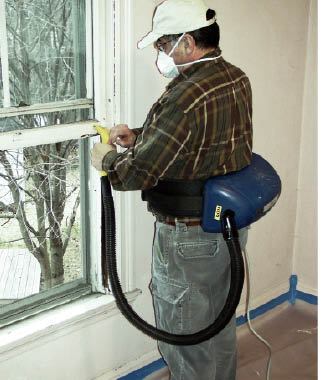
Necessary equipment. Every remodeler should have a good HEPA (high-efficiency particulate air) dust-collection system. Sanding, grinding, and power planing are specifically prohibited unless the tool has a dust-collection shroud and is connected to vacuum with a HEPA-rated filter.
Propane torches can no longer be used to remove lead-based paint. Heat guns that operate at temperatures lower than 1,100°F are okay because they don’t create fumes when the paint is heated.
If you have to remove paint, a chemical paint stripper like Peel-Away (Dumond Chemicals, 800/656-5053, peelaway.com) can be effective. Lye-based and highly alkaline, Peel-Away isn’t as hazardous as traditional methylene chloride–based strippers but still should be handled carefully. Soy-based and citrus-based strippers — considered by some to be greener options — are also available. Or you can remove paint with steam or infrared heat.
A simple dust mask isn’t sufficient protection when working with lead; at minimum, you’ll need a NIOSH-rated N100 or HEPA respirator, even if the tools you’re using are connected to a HEPA vac. Disposable coveralls, shoe covers, and gloves aren’t required but can make it less likely that lead dust will be tracked home from a job.
Minimizing dust. Misting areas before sanding or cutting is a good way to reduce airborne dust. Another is to score painted surfaces with a utility knife before removing trim. Some remodelers use negative air machines to depressurize a room during heavy demolition. These machines — unlike a fan set in the window — force the exhaust air through HEPA filtration to capture any dust before it leaves the room. But if you’re doing a good job of capturing and controlling dust where it’s created, a negative air machine is probably redundant.
Cleanup. Work areas should be thoroughly cleaned every day, with dust, chips, and debris collected and folded up in the protective plastic so that everything is contained before being discarded. Dust and debris also need to be contained when they’re transported off the job site, and must be handled according to local regulations.
Cleaning should be done from the top down, starting with a HEPA vacuum and finishing up with wet cleaning or mopping of all surface areas with a strong household detergent.
Post-Renovation Verification
Once the work is completed, the certified renovator must conduct a thorough visual inspection to make sure no lead-dust or contaminated debris is left behind. If there’s any visible residue, the area must be cleaned again. Every interior renovation requires a cleaning verification test, which the certified renovator performs using a damp disposable cleaning cloth matched against a standard “cleaning verification card.” These cards — which are still being developed — will be distributed and approved by the EPA.
Exterior renovations won’t require a cleaning verification card but must be visually inspected by the certified renovator. Only when no dust or debris remains in the work area, on window sills, or on the ground can warning signs be removed.
Recordkeeping
Records related to each job must be kept on file for three years (though statutes of limitations on negligence lawsuits in some states may require that records be kept for up to six years). These include signed and dated notification records, mailing receipts, homeowner waivers, and other related information. Documentation of compliance that a certified renovator supervised the job in accordance with EPA guidelines is also required. Information about test-kit results must be provided to the person who contracted the renovation within 30 days of completion of the job, and all lead test results — both negative and positive — should be kept on file.
Eileen Franko is the director of the Bureau of Occupational Health at the New York State Department of Health and a former OSHA inspector.


