
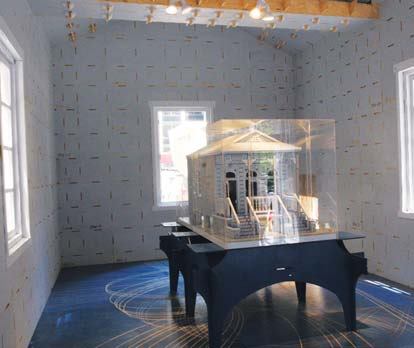



Made of 5,200 interlocking, friction-fitting plywood components,…
What do you get when you cross a jigsaw puzzle with a Lego set? Maybe the digitally designed and fabricated concept house conceived by MIT assistant professor Lawrence Sass and his students for a recent show at the Museum of Modern Art in New York. Made of 5,200 interlocking, friction-fitting plywood components, the 400-square-foot house was assembled mainly with clamps and rubber mallets. The result is an amazingly detailed and impressively rugged structure, calculated to withstand 140-mph winds.
The design process began at the computer, using CAD/CAM software. A precise, 1-to-6 scale model was then laser-cut to test-fit all components. Once the model assembly checked out, full-size parts were produced on a CNC router, cut from 3/4-inch B/C plywood. The pieces remained captive in the parent sheet for shipping. At the build site, assemblers freed them with a hand router and fit them together in numbered sequence.
The MoMA show — called “Home Delivery: Fabricating the Modern Dwelling” — ended in October, but there’s still more to learn at momahomedelivery.org.