
About 80 miles northwest of Des Moines, Iowa, lies the small town of Manson. Nothing much has ever happened there, unless you count the time 74 million years ago when a giant meteor crashed nearby. Actually, calling it “giant” doesn’t do it justice: The meteor was 1 1/2 miles across, weighed 10 billion tons, and was traveling at 45,000 mph.
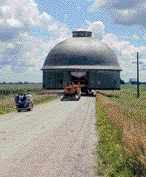
Compared with that, the second biggest thing to hit town was almost puny — it measured 60 feet in diameter and 53 feet in height, weighed 42 tons, and moved down the road at a mere 5 mph.
Still, the people of Manson can be forgiven for making a fuss over something that — comparatively speaking — was not so big. After all, no one was around when the meteor landed, but a lot of folks were there to see the round barn with a dome-shaped roof being hauled onto the grounds of the camp at Twin Lakes Christian Center.
Built in 1920 by a traveling carpenter named Charles Knapp, the barn was donated to the camp by a local farmer. The original owner used the lower level to house draft horses and dairy cattle, and the upper level to store hay. At the time, round barns were popular because they required much less lumber to build than rectangular barns of the same volume.
Considering how windy it can be in such a flat, treeless area, it’s amazing how little framing this barn contains.
Curved laminated rafters run up from the walls and end at a wooden compression ring; the unsheathed walls are stiffened by a series of let-in diagonal braces. According to an engineer who consulted on repairs, the purlins account for 80 percent of the roof’s strength.
Perhaps it’s all a matter of perspective. The barn may be small compared with that meteor — but it probably looked real big to the guys who used 54 squares of cedar shingles to reroof it several years back.
David Frane, with special thanks to Mark Parlee and Joel Rude for providing photos and information


