
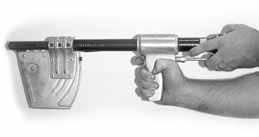
According to Marvin Hirsch, who was present that evening in the mid-1950s, it all began when a group of veterans meeting at the Winsted, Minn., Legion Hall came to the sage conclusion that they could buy a lot more beer if they had more money. “Reuben [Miller] said we gotta invent an automatic nailer that works like a machine gun,” Hirsch recalls.
Many of the guys sitting at the club that night — including Hirsch — had returned from service in World War II and were familiar with machine guns and how they worked. Seizing the inspiration, Hirsch, Miller, and their buddy John Ollig began designing just such a product in Ollig’s garage. After developing several workable demonstration models, they received three patents for the power nail-driving tool and the multiple nail clip, giving them exclusive rights to the device.
Next, backed by $10,000 in private-investment money they’d scrounged up, Hirsch and Ollig boarded a train to pay Independent Nail Co. a visit.
The duo showed their nail gun to the company president, who asked if it required electricity to work. Hirsch and Ollig said it did not and proceeded to demonstrate the tool, using compressed air. Several company engineers were summoned; they were sufficiently impressed to offer Ollig and Hirsch $25,000 to let them keep the gun for 30 days and send it to MIT for further study.
Ollig and Hirsch declined. Ultimately, they decided to make a go of it themselves and started Port-A-Matic Tools in Grantsburg, Wis. But the fledgling company ran into financial difficulties almost immediately and was forced to shut down. Eventually the bank foreclosed on the business and took everything — including the three patents, which it sold at auction. The highest bidder was a company called Bostitch.
“Every time I see a roofer using a pneumatic nailer gun, I always think of my dad and those young men who had a dream and got to live it for a while,” says Mark Ollig, John’s son. “It’s a good story,” Hirsch agrees, with a smile. “The only bad thing about it is how it turned out.”
Following the demise of Port-A-Matic, John Ollig and his family moved back to Winsted, where they owned and operated the Winsted Telephone Co. “In 1979, my dad showed me the nail gun and explained how it worked,” Mark Ollig says. “I will never forget the whimsical look he had as he slowly shook his head while looking at the gun, no doubt remembering how it was, and the regret he had that it did not turn out the way he had envisioned it might have.”
Adapted from an August 1, 2005, article in the Winsted, Minn., Herald Journal.


