Some predictions come true before they’ve even been made.
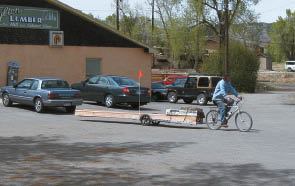
In October 2007, JLC illustrator Tim Healey envisioned a future in which pickup trucks would be replaced by freight-hauling bicycles. Who knew then that a few intrepid builders had already made the switch? Among them is Salida, Colo., straw-bale builder Greg Walter, who relies on a flatbed bicycle trailer manufactured by Bikes At Work in Ames, Iowa (bikesatwork.com).
Like motorized contractors, Walter has the lumberyard deliver the initial lumber package to the job site. But for picking up the inevitable small batch of dimension lumber or other needed-right-now material, the bicycle flatbed is his vehicle of choice. “When I load the trailer at the lumberyard,” he says, “I often head out of there with more material than the builder next to me has in his diesel truck.”
Although the manufacturer rates the trailer for a 300-pound payload, Walter has occasionally used it to transport nearly twice that amount. Once bike and trailer are in motion, he says, even heavy loads are surprisingly manageable on flat roads (he once pedaled a full-sized washing machine from the local Sears store to a customer’s new home 10 miles away). Still, he concedes that hills are a challenge. “Sometimes you’ll be grinding uphill in your lowest gear, and you’ll see that you’re being passed by people walking along the sidewalk,” he says.
Admittedly, two-wheeled transport isn’t for everyone. Walter builds one house a year, and his projects are all within a very few miles of town and the local lumberyard. And because he usually bikes to work anyway, it’s simple enough to stop at the yard in the morning for any materials that will be needed that day.
Bicycle delivery also requires some planning, Walter points out, since it’s a waste of time and energy to pedal back to town for those 2x8s you should have thought to get that morning. But then, with diesel fuel pushing $5 a gallon, those last-minute lumberyard runs are starting to look like a bad idea for everyone.