
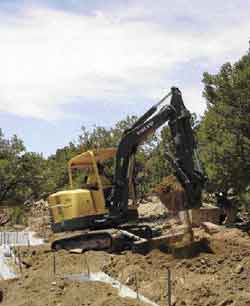
As a custom builder, I used to take on about three new homes or large additions a year. Most of our work was done by my employees, but like most builders I hired subcontractors for special tasks. Using subs has many advantages, but maintaining control over the building schedule is not one of them. If an excavation sub is late for any reason, your schedule is ruined, because all the subsequent trades are affected.
After calculating how much money excavating delays were costing me, I realized I could no longer afford that approach, and I began doing much of my own dirt work. At first, I rented equipment as needed, which worked fairly well except during the busy season, when I had to wait for a machine. I also discovered that some of the overworked rental equipment wasn’t very reliable.
So I started thinking about buying my own machine.
The Decision to Buy
Since heavy equipment is expensive, it has to pay for itself. To determine whether buying my own excavator made financial sense, I looked at budget vs. actual job costs on my projects. I wanted to see what the excavation delays were costing me in wasted crew time and how much money I was spending on my excavation sub’s services. On the other side of the equation, I added up what the machine would cost me, including the machine payment, fuel, insurance, and maintenance.
The payment, in my case, was $785 per month. Insurance would go up by about $40 per month. Maintenance is related to use, but I guessed at an average of $100 per month. Fuel would run about $20 per day, and would vary with use. I figured that a total of $1,200 per month ought to be pretty close. At first, I didn’t factor in an operator, because that would be me; as the site supervisor, I’m already there.
So, at the local going rate of $65 per hour for machine time, I needed to run this machine 19 hours a month to have it pay for itself. I was surprised to find that if I started three houses a year on time and did all of my own dirt work, the machine was essentially free.
That said, the monthly payment is nothing compared with the related expenses of owning a machine. For example, if the machine is abused or if a careless operator causes damage, the cost can quickly outweigh the benefits. Even with proper care, wear items like bucket teeth, tires, and tracks need replacing. You will also need to store the machine and trailer somewhere, which can be a problem, depending on where you live.
Choosing the Right Machine
I already knew I didn’t want a full-size backhoe or excavator. What I needed was something inexpensive, small enough to fit through tight spaces and up against the walls of existing buildings, and powerful enough to handle everything from footings and trenching to landscaping.
At a construction trade show, I happened to see several compact excavators in the 3- to 5-metric-ton class. Unlike little rental machines, these were functionally identical to a full-sized track excavator but small enough to make sense on a residential site.
As I looked more closely at the compact excavators, I realized that beyond the obvious advantage of being able to put dirt behind you as you dig (something a backhoe can’t do), they could get into all kinds of places. Plumbed for auxiliary hydraulics, they could run a variety of accessories, and with a hydraulic thumb, they could pick up or tear down almost anything on a residential site.
Best of all, these machines could be towed behind a pickup truck on a small tandem-axle trailer. I didn’t want a gooseneck trailer because I needed the use of my pickup bed. A little simple arithmetic told me the machine had to weigh less than 8,500 pounds and be no more than 6 feet wide. With that in mind, I went shopping for a compact excavator.
Picking a Model and Brand
After price, rated horsepower and maximum dig depth are the first things a new buyer should consider. Do not fall into the trap of thinking that a bigger machine with more power and more reach is always the best choice. I have run 54,000-pound excavators with 35 feet of reach that pull dirt out of the ground a pickup-truck load at a time. And believe me, in no time at all, you still want more power and more reach.
A better approach is to match the machine to the job. The smallest machine that will do the majority of your work efficiently is the best choice. The old 80/20 rule applies here: If you can find a machine that will do 80 percent of your work effectively, you can deal with the other 20 percent as the need arises.
Quality of construction is a judgment call. Better machines tend to cost more, but you may not need the most expensive, best engineered machine. One quality I would investigate no matter what machine you choose is the competency and training of the dealer’s service department. Your best bet is a referral from a satisfied and impartial customer. Similarly, if customers have had a bad experience with a service department, they are usually not shy about sharing that information.
I’ve had great luck with my Caterpillars — I’ve bought three Cat machines: a dozer, a skid steer, and a large excavator — in the past 15 months. These machines are reliable and rewarding to operate and I’ve paid for nothing more than oil changes. I’ve had only one occasion for warranty service, and that was handled in the field, within eight hours of my call, at no charge.
Conversely, my Volvo — the compact excavator I ultimately decided to buy — had some built-in maintenance problems that the dealership charged me for, and on several occasions the company couldn’t provide on-site support when I needed it. Although the Volvo is a highly productive and generally well designed machine, the maintenance record reads like a sad story. Repairs and maintenance have cost me roughly 10 percent of the purchase price in only 1,000 hours of use, which is excessive.
My experience with these two brands of machine has shown me that the dealer can serve as either an active business partner who helps you be successful in your business or a roadblock to that success. If the company can’t be there when you have a problem, it’s going to cost you money.
Options and Accessories
Whichever machine you buy, I recommend adding a quick coupler for the bucket and work tools. With a quick coupler, you can change buckets in a minute or two. Without one, you’ll need to drive bucket pins, which is such a slow process you’ll find yourself using the wrong bucket rather than changing it. The $800 option will easily pay for itself in time saved swapping buckets or backfilling a bigger hole or trench than was necessary. (As with anything, though, you have to be careful: There have been several recent OSHA reports of operators seriously injured or killed while using a quick coupler.)
I’d also make sure to get a hydraulic thumb. Demolition, loading debris, placing large rocks, and removing stumps are all easy with this tool. Unless all you ever do is trenching, a thumb is a wise investment.
If your machine does not come equipped with a block heater, ask the dealer to install one before delivery. These small diesels can be temperamental in cold weather. If there is an optional work-light package, I’d recommend that, too. I try hard never to run machines in the dark or when I’m tired, but sometimes it’s unavoidable. When this happens — think broken water line — you can never have too much light on the job.
Operator comfort is crucial. An uncomfortable operator is unproductive and unsafe. When in doubt, spend the extra money for creature comforts like heat, air conditioning, suspension seats, and extra lights.
If you’re planning to do your own routine maintenance, it’s also important to pop the hood and see if the filters and other common maintenance items are readily accessible. One frequent complaint about the newer compact excavators with little or no tail swing is that they’re tougher to work on because they have smaller engine compartments.
Learning the Machine
While it takes only about five minutes to figure out the controls of a machine, it takes a lot longer to actually become skilled at operating one. Even more important than operator skill is an understanding of good construction practice. If the dirt work isn’t done properly, the results can be expensive. Nobody wants to see a foundation failure.
Most important of all, of course, is an attitude of alertness and concern for the safety of everyone else on the job. The first three rules of heavy-equipment operation are safety, safety, and safety (see “Excavator Safety”). With this much power and weight, there is no such thing as “oops” or “sorry.”
Excavator Safety |
An accident involving a piece of heavy equipment and a person will usually result in serious injury. Don’t let it happen. On the job, your primary safety asset is an alert operator. A comprehensive safety training program for everyone on the site is important, too. It doesn’t need to be anything more than a short discussion at coffee break once a week, and a briefing for the crew prior to any unusual or dangerous tasks. An operator has the responsibility to inspect his or her machine before every shift. A machine that does not function properly should not be used. Operators also must be aware of the particular hazards on a job, such as overhead or underground utilities, unstable soil, structural collapse, heavy objects rolling away or falling, and unexpected behavior by onlookers or others at the site. As far as I know, every state requires contractors engaged in excavation to notify local utility companies so that utilities can be marked prior to excavation. This free service is known by a variety of names — Miss Utility, Blue Stake, One-Call, Dig Safe. Where I work, if you don’t make that free call and you subsequently hit a gas or electric line, the fines start at $25,000. Following a few simple rules will help keep everyone alive and working. •••Never step inside the swing of the boom while a machine is running. A shift in soil stability may result in fast and unexpected movement of the boom. An electrical or hydraulic failure can also cause uncontrolled movement. Or the operator may just not realize that you are there. I have seen every one of these scenarios happen. The result can be fatal. •••Never approach or walk behind an operating machine until you have made eye contact with the operator, and the operator has acknowledged your intent with a signal that you have agreed upon in a safety meeting. •••Laborers should always wear high-visibility clothing when working around equipment, including hard hats, safety vests, yellow or orange T-shirts — anything that helps the operator keep track of where the crew is. •••No overhead lifting: Never swing a load over a person and never step under a load. •••Recognize that equipment hydraulics run at a pressure of several thousand pounds per square inch. Stay clear of hoses. If high-pressure fluid penetrates a person’s skin as the result of a pinhole leak or a failed fitting, he will need immediate medical attention to save his life. |
New Opportunities
The first few jobs I did with my new machine were for my own company, so pricing was not a concern. As long as I was getting the job done on time and covering my expenses, I didn’t give it a lot of thought.
I soon realized, however, that I had discovered a market niche. Calls from other contractors started coming in when word got around that I had bought this unusual new machine that was faster than a backhoe and would fit almost anywhere. Footings for complex building footprints are no problem with this smaller machine, and I have received several calls to dig for infill houses that have 14 or more corners in a 2,500-square-foot floor plan.
Pricing Jobs
Some excavation contractors price their jobs on an hourly basis. This is similar to building on a time-and-materials agreement, and, like T&M, it’s okay when you’re getting started, but most businesspeople soon abandon that approach. T&M is a lot riskier than it sounds, so I try to avoid it. I still work hourly for some contractors who prefer this arrangement, but we have a history of working well together, and they understand how long a job should take.
I prefer to price all my work on the basis of unit cost. From experience, I know that I can move dirt for a certain cost per yard, and I can trench for so much per foot to a certain depth (all of which varies with the soil conditions).
With a little practice, you’ll learn to recognize the various soil types in your area. I watch for rock outcroppings or dramatic changes in elevation across a site, indicating erosion patterns that expose hard soil. I also watch for especially soft or sandy soil, which can be far worse to work in.
I find that customers are almost always more comfortable with a fixed price, just as I am. On an hourly job, the customers will always wonder if they’re paying for the time you spent on break, performing maintenance, talking on the phone, or pulling your machine out of the mud.
The Bottom Line
As a custom builder, owning my own equipment gave me a definite advantage. I had more control over the schedule, and paying myself for excavation increased profits. Now I’ve made the switch to working as a full-time excavation sub, and I’m still making the same money I did as a GC, but with fewer headaches.
David Crosbyis an excavation contractor and the owner of Crosby Construction in Santa Fe, N.M.


