
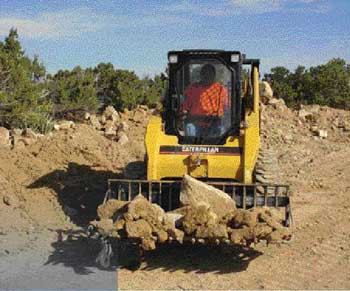
Demolition, excavation, waste removal, finish-grading, landscaping, and hauling heavy objects: For residential builders and remodelers, it’s all in a day’s work.
Subcontracting these tasks, of course, is always an option — but on a residential site, where projects tend to be small, the cost of doing so can take a disproportionate bite out of the budget.
Believe me, I know — I used to be a residential general contractor. However, after I bought my own machinery to perform routine heavy-equipment duties, I began generating enough work to move full-time into sitework and excavating.
So if you find yourself spending too much time waiting on your excavator — or if you’d like to keep a little of the money you’ve been paying him — think about buying a skid-steer loader for yourself. After all, this machine is the Swiss army knife of the heavy-equipment world: It can do all the work mentioned above and then some.
Choosing a Brand
Skid-steer loaders come in several different brands. Which one to choose is entirely a matter of what you like and what your business needs.
Operating conditions are severe for my excavation business, and minimizing downtime is a priority. So I bought a Caterpillar, the machine that I think is the strongest and most comfortable. In addition, it has the best parts availability and the highest resale value, and I’ve had positive experiences with other machines made by the same company. Not surprisingly, the Caterpillar is also one of the more expensive skid steers.
I have used other brands, so I was able to make comparisons before making my decision. One of the greatest benefits of the Cat is its piloted hydraulic controls, which make a huge difference in operation, especially as the machine ages. Less expensive machines have cable-operated controls, which tend to degrade over time: When they get dirty, frozen, worn, or stretched, it becomes much more difficult to control the machine, which increases the likelihood of causing serious damage on a close-quarters residential construction site.
Cheaper machines also have lower-quality bushings and wear parts — and regular repairs can quickly eat up any up-front cost savings.
Still, not every user requires a top-of-the-line machine. If your skid steer will see only occasional use, or steady use under light conditions, you should be able to spend less and get satisfactory results. For such buyers, the best advice I can give is to talk to other skid-steer owners about their experiences and their dealers.
Also, demo or rent machines from at least three different manufacturers before you buy. Most equipment dealers are willing to let you try the machine; often they’ll even bring it to your site.
Skid-Steer SafetyAlways: • Read and understand all of the manufacturer’s safety recommendations. • Understand the tipping limit and gradability limitations to the front, rear, and sides. • Be aware of the stability of the terrain and stay away from edges. • Watch for holes, weak floors, weak ramps, deep mud, and drop-offs. • Keep everyone out of the operating area. Visibility is often restricted and these machines are quick. • Maintain everything on the machine in proper working order. If anything does not work the way it is supposed to, fix it. Repair frayed hydraulic lines immediately. • Perform daily inspections, including a close inspection of the tires and tire pressure. A tire failure with a raised load could be a tragedy. • Give yourself enough time to work carefully. • Be aware of the alternate exit (often the rear window), especially if you work around water. • Be aware of all underground or overhead utilities. Locate utilities before you dig. • Use manufacturer-supplied struts, supports, and locks during maintenance. • Walk around the machine before you move it. • Carry loads as low as possible. • Wear the seatbelt. If you can stay at the controls, you are more likely to stay in control. • Climb on and off the machine carefully, with three points of contact. Slipping on a muddy surface can cause serious injuries. Never: • Work in the dark, when you are tired, or when you are under the influence of drugs, alcohol, or medications that can interfere with your judgement. • Modify any part of the protective structure for any reason. • Get out of the machine under a raised load. • Work around or on hydraulic systems unless you know what you are doing. An accidental injection of high-pressure fluid can be fatal and may require immediate surgery by a physician familiar with these types of injuries. • Use ether if the engine is equipped with a preheater of any type. • Lift or move a load over a person. • Disable or bypass any safety equipment on the machine. |
Dealer Support
In my opinion, the single most important factor in the buying decision is dealership support. If your dealer provides timely parts delivery and professional service after the sale, you will be much happier with your choice. If you cannot get good service or if you have to wait a long time for parts, you’ll end up regretting that you bought that brand.
I once had a fan belt break on a mini excavator. The dealer didn’t have one in stock and couldn’t even tell me the size so that I could pick one up at the auto-parts store. I ended up paying $70 in shipping and wasting two days of work — all for a part that took 15 minutes to install.
Compare that with what happens when I need a Caterpillar part: If the company can find the part within 500 miles of my home, it will deliver it to my site by 7 a.m. the next day at no charge. I can also go to the Cat Web site with my serial number and order parts online. The company provide a parts book and a CD-ROM to make ordering easier.
Features and Options
In general, skid steers boast between 47 to 84 hp and weigh 5,500 to 7,500 pounds. Wheelbases typically range from 39 to 48 inches; machine widths fall between 5 and 6 feet. Operating capacity runs from 1,500 to 3,000 pounds.
The range of sizes can make choosing what to buy tough. Just remember that bigger is not always better. A skid steer’s strong suit is speed, agility, and maneuverability. And nothing is more frustrating than having a machine that’s just a few inches too wide to fit on site. Smaller machines tend to be more nimble and are easier to tow behind pickup trucks.
If you need the lifting or digging capacity of a larger machine, then go ahead and buy one. But buying more than you need can be counterproductive.
Radial or vertical lift? There are two types of lift linkages: radial and vertical. Since radial systems are less complex, they’re generally stronger and less expensive. Machines with radial lifts usually offer better views out the side of the machine, too.
Vertical-lift machines, by contrast, have more complex linkages and can load almost to the center of a tandem-axle dump truck. If you spend most of your time loading trucks, the vertical lift is the way to go. If not, the simplicity and durability of radial-lift machines may make them a better choice.
Track or rubber tire? Unless you need the flotation of tracks for soft or muddy ground, rubber-tire machines should be adequate. Track machines are more expensive by 15 percent to 25 percent; it makes sense to spend the extra money only if you lose a lot of time to muddy conditions.
Track machines also provide better stability when traveling, grading, and lifting — but they cost more to maintain because they contain more moving parts that are exposed to dirt.
And while tires — at $1,000 for four — aren’t cheap, a set of tracks can easily cost two to three times that, and they may not last as long.
Open or closed cab? This is a matter of personal choice and depends on your climate, operating conditions, and budget. Operator comfort is crucial, however: A comfortable operator will be safer and more productive. For me, a cab with air conditioning and heat is worth every dime.
Attachments Galore
When it comes to loading or carrying dirt and gravel, a skid-steer loader is the star of the show. But it can do so much more. With a backhoe attachment, you can trench for utilities or dig shallow footings. And pallet forks make quick work of moving asphalt shingles, bagged concrete, and other heavy, palletized loads.
Material-handling booms are great for lifting heavy objects on sites where a crane won’t fit. A brush grapple is one of my favorite attachments. I once cleared a mile of road with a dozer and a skid steer equipped with one; the resulting brush pile measured more than 830 cubic yards. The skid-steer allowed me to carry brush and roots a pickup truckload at a time. The same grapple works equally well on demolition waste.
With a hydraulic hammer attachment, you can break up the thickest concrete. Broom attachments allow you to sweep streets quickly, which keeps the neighbors happy. There are compaction rollers for road building and backfilling and several attachments for landscape and seeding prep.
Dozens of attachments are available. Thanks to them, I find additional uses for my skid steer all the time.
Maintenance and Repairs
Neglecting maintenance can increase your liability and result in expensive repairs. Plan on spending a half-hour every day greasing, fueling, and inspecting your machine, plus making minor repairs. Schedule more extensive maintenance — a half-day in your shop or a full day in the dealer’s service department — every 250 hours for severe use or 500 hours for light use.
Skid-steer loaders are tough, but there are ways to help the machine last longer with fewer repairs. Probably the most important precaution is to warm it up adequately, especially the hydraulics, before use. To do this, let the engine run for five to 15 minutes at a fast idle (depending on ambient temperature) and operate several hydraulic functions gently, without a load, to circulate the oil.
The next most important practice is to cool down the turbocharger by running the machine at a slower speed for at least a few minutes after any hard use. Failure to do so can destroy the bearings in the turbo; repairs can run into the thousands of dollars.
Stalling the machine under load is also severely abusive to the turbocharger, because it leads to oil starvation. And shutting down a turbocharged engine right after heavy use can set up thermal stresses. Instead, let the engine idle down for a few minutes. Another no-no is ignoring hydraulic leaks: If oil is leaking out, dirt is getting in.
Finally, operator abuse — such as driving into hard objects — is really tough on pivot points and undercarriages.
Choosing the Best Tires
There are numerous options for tires. Pneumatic tires provide the best ride for the least cost. If you work around minor puncture hazards like nails, add a sealant to prevent flats. If you work around severe puncture hazards, you can have your tires filled with urethane foam. This makes the tires about twice as expensive, but I do it anyway; I don’t want to worry about flat tires and I find that the extra weight makes the machine more stable.
I’ve destroyed an entire set of tires in 200 hours. I’ve also had tires last twice that long with no appreciable wear. It all depends on the terrain and the operator.
You can also buy solid tires, but they are generally designed for specialized industrial applications, not for residential construction.
The Scoop on Trailers
Most skid steers can be moved on a trailer behind a 3/4-ton or larger pickup; unless you buy an oversized truck or trailer you won’t need a CDL. The trailer and hitch should be rated for the weight of the machine, and the trailer brakes should be checked before every trip.
Appropriate tiedowns are essential, too. Using anything smaller than 5/16-inch Grade 70 chain with ratchet binders is imprudent — and nylon load straps are a very bad idea, as the straps can chafe and fail catastrophically in as little as a half-hour.
What Does It Cost?
The monthly payment for my top-of-the-line machine with all the bells and whistles is $650. Insurance runs about $300 or $400 per year. I budget $4 to $6 per hour for maintenance and repairs and $5.50 per hour for fuel. My maintenance budget for the machine ends up being $4,000 to $6,000 per year.
Most contractors won’t need to spend that much, but I like to be conservative in my estimates. Given the costs, I find that just to break even, most contractors need to bill between 350 to 500 machine hours per year depending on the cost of the machine, which commonly ranges from $25,000 to $45,000.
For occasional use, renting is the way to go. (If you’re on the fence, try renting a machine for a while, and then, if you decide it suits your business, buy one.) But for regular use, the typical $180-a-day rental is too expensive to be profitable.
The key is to estimate your utilization rate. If you can get enough billable hours a month to cover the cost of the machine, I don’t see why you wouldn’t buy one. The resulting increase in productivity should allow you to take on more jobs — which, in turn, would mean even more billable hours for the machine.
The Upshot
By the pound or by the dollar, these rats are among the most productive and profitable machines on the job site.
If you employ one or more helpers to do little more than sitework and carrying material, consider letting them go the next time they show up late or hung over, and buy a skid-steer loader instead.
You’ll probably come out ahead and you’ll definitely have fewer headaches.
David Crosby is an excavation contractor. He owns Crosby Construction in Santa Fe, N.M.


