- Q. What is the best way to retrofit foundation insulation?
A.J. D. Ned Nisson responds: The three common options for foundation insulation are exterior foam, interior foam, and interior framed wall with fiberglass batts. Which approach is best depends on a few site-specific variables, including climate, soil conditions, and homeowner preference. Consider these questions when making your decision:
Is the basement heated? How cold are the winters? Heated basements obviously require higher R-value than unheated basements. Since exterior foam is practically limited to R-5 or R-10, interior insulation is more suitable, especially in very cold climates.
Is the site wet? If the basement walls have a history of moisture problems, or if the site appears poorly drained, interior fiberglass is risky, no matter how well protected. Interior or exterior foam is fine under these conditions. Recent research at the University of Minnesota, however, showed that interior foam is much more effective in keeping moisture out than exterior foam.
Is this a termite area? In termite areas, use only interior insulation. Exterior foam foundation insulation serves as a hidden pathway for termites on their way to the tasty wood wall and floor framing. Termite shields often don’t work, and even soil treatment may not always be effective. Terminex Corporation, a leading termite exterminating service, refuses to treat houses in the Southeast with exterior foam foundation insulation.
Is the basement to be finished?If the basement is to be finished, then the obvious choice is between an interior framed wall or interior foam. If there are any questions about moisture, I’d recommend foam.
ommonsense questions. Is the basement so full of junk that any work would require hazardous duty pay? How about the outside? How difficult would it be to excavate 2 feet? 4 feet? 7 feet? Is there extensive shrubbery around the house? These considerations have obvious implications regarding interior vs. exterior insulation.
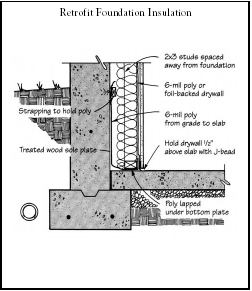
My favorite system. Except in wet basements, the most sensible retrofit in my opinion is an interior framed wall with fiberglass batts. One nagging question is whether to install an interior vapor retarder, a moisture barrier, or both. There are as many answers to that question as there are building consultants. I prefer to install a poly moisture barrier against the inside foundation wall, and a vapor retarder beneath the drywall, starting the moisture barrier at grade level, as shown in the illustration above. This leaves an escape route through the top of the foundation for any moisture that might accumulate in the wall.
— J. D. Ned Nisson is an energy consultant and editor of Energy Design Update, a monthly technical newsletter on energy-efficient building design and construction, as well as the energy columnist for JLC.
Q&A: How to Retrofit Foundation Insulation
2 MIN READ