
I recently replaced an older, water-guzzling toilet with a low-flow model. The old toilet had been installed over a ceramic tile floor on a concrete slab, so I anticipated an easy swap. But one look at the rusted-out steel mounting rim on the ABS-plastic closet flange told me I had a bigger fish to fry. The old flange had to be cut off below slab level in order to sleeve in a solid PVC flange. No way was I going to break up the floor. Somehow, I had to cut the 3-inch drainpipe from the inside. A picture of a 2-inch-diameter circular saw blade on a long shaft formed in my head, but I didn’t want to go chasing all over town hunting for parts. After building a plywood sled for my drill to control the cutting depth, I tightened a new 3-wing carbide-tipped slot-cutting router bit in my 1/2-inch drill and stuck it down the pipe. But within a few rotations, the bit rattled itself loose and went spinning down the drain. I fished it out again with a long snake and a magnet and moved on to Plan B.
After scouring three hardware stores without finding a suitable metal blade, I spotted a 2-inch abrasive cutting disc (The M.K. Morse Co., Canton, Ohio; 800/733-3377; www.mkmorse.com; $2.50) with a 3/8-inch arbor hole and recommended uses that included cutting plastic pipe. The proprietary arbor was too short (and too expensive for one-time use), so to make my own, I bought a 6-inch carriage bolt, two nuts, several washers, and two fender washers.
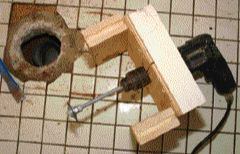
I added 2×4 legs to the sled, which set the disc at the right depth to cut just below the flange collar. It took about five minutes of clockwise rotation around the drain to chew through the pipe wall, and a couple of vertical slashes with a recip saw to remove the old flange in three chunks. I enlarged the slab hole slightly with a cold chisel, then used a shop vacuum and crevice nozzle to suck the sand away from around the stub to accommodate the new flange. To reach the shortened drain stub, I extended the flange collar with a cut-down straight coupling and glued the sections together with solvent adhesive. Four Tapcon screws anchored the flange, and the chipped slab was repaired with topping cement.
1. Preserving the floor slab meant cutting out the old flange from inside the pipe using a homemade abrasive cutoff tool.
2. The author filed the lugs round on a 3/8×6-inch carriage bolt to allow the head to seat snugly against the washers that captured the abrasive disk. The second nut locks the primary nut tight, while three bench-ground flat spots at the other end of the bolt provide a positive grip for the drill chuck.
3. The cut end of a straight pipe connector was glued to the roughened end of the common PVC closet flange to provide an extended collar to reach the drain stub.
4. In all the excitement, the author forgot to remove the knockout in the flange before installing the toilet and had to start over with a new wax ring.


