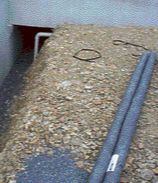
- Q. We need to pour a 24×24-foot concrete slab for an attached garage next to a precast foundation. The precast walls are 9 feet and 4 feet tall (see photo). Unfortunately, the trench overdig is 7 feet deep and as much as 4 feet wide in some places. We would prefer to avoid backfilling and tamping such a huge void. Is there another more cost-effective option?
A.Jay Meunier, a contracting specialist at S.T. Griswold and Co., a ready-mix supplier in Williston, Vt., responds: We have seen too many garage slabs fail due to improper backfill and compaction. This applies to the overdig area as well as the raised sub-base underneath the slab. Each time a vehicle pulls into a garage and stops, that action creates a plate compactor effect. If the backfill under the slab has not been properly compacted, the structural fill will eventually settle, leaving voids. Since a slab-on-grade is not meant to be structural — supporting its own weight plus any imposed loads — the slab will certainly crack if the voids are large enough.
You are right to be concerned about the void created by the foundation overdig, which appears to extend under an adjacent living space supported by a 4-foot precast wall. You’ll need to block off that extension of the overdig before backfilling; otherwise, the backfill material will migrate from under the slab into this sizable hole, leaving an unsupported void. Build a small containment wall with masonry block, concrete rip-rap, or a similar permanent material.
Once that area is blocked off, use a clean structural fill such as crushed stone or gravel. If you use stone, you can typically avoid compacting in place, as it is considered a self-compacting material. If you use gravel, you will need to compact in lifts of 8 to 12 inches.
An alternative is to use a cementitious product such as flowable fill. Flowable fill is more expensive per cubic yard than structural fill (stone or gravel) but provides several advantages. It can be placed directly from a ready-mix truck, it requires no compaction and little labor, and its strength can be adjusted downward so it can be excavated later on if changes are made to the house.
If you spend the time and money to properly prepare the backfill and sub-base, you’ll prevent slab failure later.
Q&A: Is It Necessary to Compact Slab Sub-Base?
2 MIN READ