- Q. What’s the best way to support a new garage slab next to an existing foundation wall?
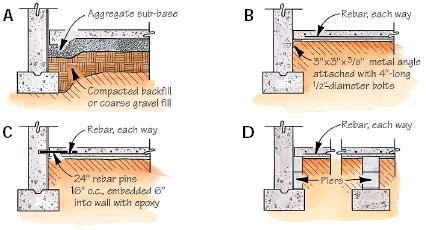
A.Brent Anderson responds: There are many ways to support a garage slab next to a basement wall. The best approach is to provide compacted backfill to 95% Proctor density from the footing to the sub-base (see “Soil Compaction Basics,” 3/94). The sub-base should consist of 4 to 6 inches of coarse aggregate (illustration A below).
If the job schedule or budget does not allow for careful soil compaction around the basement wall, then any area of overexcavation should be backfilled with minimum 1 1/2-inch-diameter clean gravel, which will self-compact evenly under the weight of the slab and any future loads.
Another option is to use a shelf angle to support the edge of the garage slab (B). We usually recommend a continuous 3x3x3/8-inch steel angle, bolted to the concrete foundation wall every 16 inches with 1/2-inch-diameter bolts. However, this will support only the slab edge, and will not prevent distress cracking that may occur as the soil under the slab consolidates, leaving voids where the slab is not supported. A preventive measure is to use #3 or #4 reinforcing steel placed 12 inches on-center both directions in the slab. This will enhance the slab’s ability to span the voids as soil consolidation occurs.
Slabs can also be connected to the basement wall with rebar pins (C). This is essentially the same concept as a shelf angle. However, because the steel reinforcement restricts slab edge movement, there may be more cracking on the garage floor.
Another technique is to support the slab on wall pilasters or concrete piers (D) bearing either on the footing below or wherever areas of soil subsidence are suspected.
Brent Anderson, P.E., is president of BA Associates, specialty contractors and consulting engineers in Fridley, Minn.
Q&A: Supporting a New Slab Next to Existing Foundation
Supporting a New Slab
2 MIN READ