I frequently get requests to fix pocket doors
that have come out of the track and are difficult to operate. I
used to be reluctant to take this kind of job; I could replace
the wheels on top of the door, but I couldn't guarantee that
would take care of the problem. So I developed a method that
resolved this both for me and for my clients. Without breaking
into the wall, I remove and replace the old track with a
high-quality track and hangers from Johnson Hardware (model
100PD, which costs me around $24; 800/837-5664,
www.johnsonhardware.com). Not only does the
Johnson hardware roll a lot more smoothly than the typical
cheap original hardware, but it's designed so the wheels can't
come off the track.
To remove the old track, I take out as many of the attachment
screws as I can get to by reaching inside the opening. I bend
down that section of the track and cut it off with metal snips.
I then use a short combination crowbar and nail puller to
remove the remaining track. I cut off the end of the bar so it
will fit into a 1-inch-diameter iron pipe, which gives me an
extension handle to get back into the recess (see Figure 1).
The track rips off easily, but it's hardly ever easy to get all
the screws out, so I leave them in place.
Figure 1.Cutting the end off a small crowbar/nail
puller and fitting it into the end of an iron pipe provides a
tool for reaching into tight spaces.
Before installing the new track, I have to make a few
modifications. Using a grinder to notch the metal, I create a
tab at one end for attaching to the stud at the rear of the
pocket (Figure 2). I drill a 3/16-inch screw hole in the tab,
then bend it over. Also, to accommodate the protruding
screwheads that were left in place when the old track came out,
I glue flat washers to the new track at each screw hole, and
one above the tab at the far end (Figure 3). These act as
spacers so the track clears the old screws. Adhesive caulk
works fine to keep them in position.
Figure 2.A grinder makes quick work of forming an
attachment tab on the end of the pocket-door
track.
Figure 3.Washers caulked to the top of the new
track provide clearance over screwheads from the previous
track.
Next, I position the track with one hand and drive a screw
through the hole closest to the pocket opening. This keeps the
track in place while I use extension bits — up to three
— to reach the screw on the tab. I also drive a couple
more screws at a slight angle up through the track in the
pocket, and the rest of the screws into the doorway overhead
(Figure 4).
Figure 4.Here, the new track is in place, with the
tab at the end secured to the stud at the back of the
recess.
Now all I need to do is install the hanger brackets on top of
the door and make final adjustments. A job like this takes only
a couple of hours, and can be billed at around $200, including
materials, when working with a hollow-core door.
Al Constanis a door hanger in Garden Grove,
Calif.
Smooth Tube Piers
by Dave Doddridge
Tube-formed concrete piers are standard for supporting decks.
Often, the paper form gets left in place, and when it's
stripped it leaves a characteristic spiral imprint on the
concrete. When the piers are tucked away under the structure,
no one cares too much about their appearance. But what if you
need to pour an "architectural" column — one that will be
prominent in the finished work?
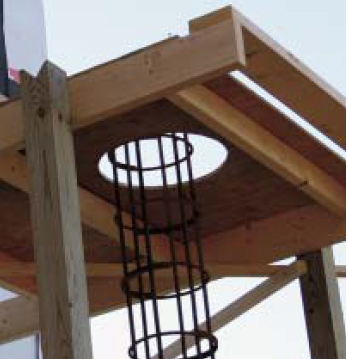
Temporary scaffolding (center) provided
a work platform from which to place the concrete, as well as a
convenient support for the tube form. Plastic spacers centered
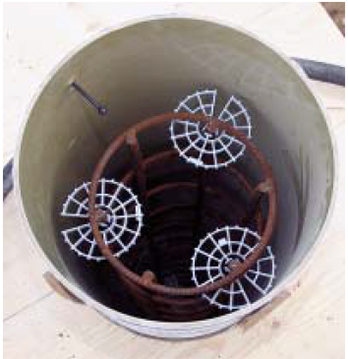
the rebar in the tube (right); note the smooth, reflective
surface of the form's inner surface.
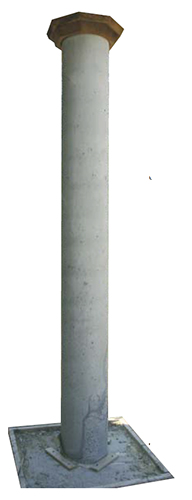
On a recent job, the architect called for the 10-foot-tall,
14-inch-diameter columns supporting the second-story decks to
have a completely smooth finished surface. The local branch of
concrete specialty supplier A.H. Harris & Sons
(860/665-9494, www.ahharris.com) told me about Sonotube
Finish-Free tubes, which I special-ordered. I was concerned
about a cardboard form of this height buckling sideways under
the weight of the wet concrete, but a technician at A.H. Harris
assured me that we'd have to brace it only at the top and
bottom. The cylindrical rebar cages I needed turned out to be
standard stock items.
So that we could brace the top of the form and also be able to
stand at the top while pumping the concrete, we cut a 14
1/2-inch-diameter hole in the middle of a sheet of 3/4-inch
plywood; we supported the plywood on a lumber-framed scaffold
just below the top of the form. This allowed us to drop the
form through the hole and over the rebar cage onto the footing,
then shift the plywood around on the frame to plumb the column
before nailing it off. Wood blocks shot into the footing
prevented the form's bottom from walking.
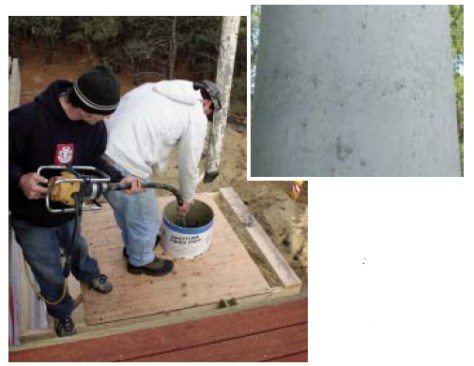
Periodic vibration during the pour
helped the mix consolidate around the rebar and against the
form's surface (left). Even with vibration, the column's
surface had small pits and voids (right); these can be easily
grouted flush if the customer wants.
We used a 4,000-psi concrete mix; 3/8-inch aggregate helped it
flow around the steel cage. We also vibrated the concrete to
ensure full, even distribution. After the mix cured and we
stripped the forms, we found only a few small pits and voids in
the concrete surface. Curiously, the bottoms of the piers had
some discoloration — probably from the mix water leaking
out and causing a change in the hydration process. Luckily,
these spots would be covered by backfill. Other than that, the
piers looked good. Including labor, concrete, staging, rebar,
pump truck, and forms, the final cost for the columns was about
$1,800 each.

Dave Doddridgeowns Doddridge Associates in Orleans,
Mass.