Drywall Back-Blocking in Action
I’m writing regarding the discussion on back-blocking for drywall seams (Letters, 3/08). I’ve been asked about this code issue many times. I know that there are efforts under way to have some back-blocking products accepted in the code, and that many inspectors will accept the technique.
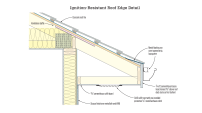
I recently finished a job where the ceiling of an addition had to blend into the existing ceiling. For backing, the carpenter had attached a 2×4 to the edge of the outer ceiling joist of the existing ceiling. If I had attached the new drywall to the 2×4, it would have created a seam that was difficult to hide — most likely a bump in the ceiling — and probably would have cracked in time. Instead, I cut the existing drywall back and floated the seam between the joists, using a metal back-blocker called the EZ-Backer (www.butthanger.com) to create a recessed butted seam that won’t show after painting, and won’t crack or ridge over time.
Myron Ferguson
Galway, N.Y.
A-Frame Appreciation
Thanks for the piece on A-frames (Backfill, 3/08). I grew up in one and have endless fond memories and head scars. My nonbuilder father drafted his own plans and the whole family took part in building it in the summer of 1967 — perhaps at the peak of A-frame fashion.
The house sported double insulated glass windows and a compact “hot” roof: spruce decking and 2-inch asphalt impregnated fiberboard “insulation” covered by shingles. After the first energy crisis in 1974, we added a solar hot-water system. Then, in 1980, we overlaid the roof with 5/4×12 locally milled white pine “rafters” filled with fiberglass insulation, air-sealed the leaks throughout the house, and installed a row of 3-by-7-foot glass panels set high along the entire length of the south-facing roof.
Twenty-five years later, this passive solar system keeps the house at about 60°F in midwinter without any supplemental heat, provided the sun is shining. And the extra glass solved one of the most troubling dilemmas of an A-frame: the lack of natural daylight. My mother still lives in the house and wouldn’t have it any other way.
Mike Guertin
East Greenwich, R.I.
Remembering a Mentor
I wanted to remember Sonny Lykos, who died recently. He was an important mentor for many of the participants in the JLC Online forums. Sonny was not your typical contractor; he always made it a point to teach us the business of being a great contractor. He was the little voice in the back of our heads whispering, “You damn well better charge for that change order; you have a business to run!” He was a legend, but you could call him at 11:30 p.m. to ask his advice.
Though I never met him, I — like many others in the forums — will miss him greatly.
Greg DiBernardo
Fine Home Improvements of Waldwick
Waldwick, N.J.
Found: Hard Workers
In response to the letter “Hiring Illegals: Immoral?” (2/08): I live and work in California and see only a very few nonimmigrant construction workers. I have never had problems with immigrant workers. They show up ready to work and work hard and honestly.
Contractors, like all business owners, sell what their customers will buy. Most customers — at least in the repair and remodeling fields, which I am familiar with — won’t pay more to hire a contractor who has all citizen workers, pays workers’ comp, and has full liability coverage. The real cause of the problem is that clients won’t pay the ticket for GCs who follow all the rules, and instead will go looking until they find a cheaper contractor who will do the job with immigrant workers.
Lance Hudson
Licensed General Building Contractor
Los Angeles