
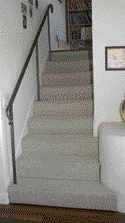
A couple of years ago, I designed and built a home for a friend of mine in the San Francisco Bay area. The original plan had been to build a small office a few steps up from the second-floor hall, but during construction we raised the floor even more to take advantage of the view. Suddenly there was all this dead space below the room.
Not wanting the area to go to waste, my friend suggested turning it into a cool little playroom for his kids. Since he wanted it to be a surprise, we decided to access the room through a secret door. We considered using a fake bookcase or a hidden wall panel, but ultimately settled on something much more unusual — a hinged set of stairs like the ones in the 1960s TV sitcom The Munsters.
Peter Dickson, a mechanical engineer from Bay City Iron Works in Oakland, helped me design and build the stairs. Safety was a prime concern, so we devised a simple system that uses counterweights rather than motors and hydraulics. This way, the stairs open manually, and if the power goes out no one will be trapped.
We framed the stairway the usual way but sheathed the bottom with 1/2-inch plywood. Dickson’s company fabricated a custom-made pivot — basically a giant piano hinge — that we fastened to the stringers and the floor framing above. The hinge “pin” was welded to the lower leaf and bolted to a steel lever projecting out to one side.
At the end of the lever are two shackles, each connected to a cable that runs through pulleys in the joist bay and down the opposite wall, where they connect to a pair of counterweights. When the stairs are open, the lever is up and the weights are down. When the stairs are closed, the lever is down and the weights are up.
The system is so well-balanced the owner’s 5-year-old can open the stairs by lifting up the bottom riser.
Robert Waal owns R and S Homes, a design/build company in Alamo, Calif., with his wife, Sharon.


