
Download PDF version (848.9k) Log In or Register to view the full article as a PDF document.

To allow plenty of room for step-by-step photographs, we are running this article in two parts; the second part will appear next month. In this installment, the author shows how he lays out balusters, installs the landing newel, and accurately positions the railing and volute. In Part Two, he will explain how to make a gooseneck from stock fittings when the manufactured gooseneck doesn't fit, and how to fit and install the volute newel and balusters. — The Editors

Image

Over-the-post railings run continuously, starting at the bottom tread and stopping at the wall at the end of the landing on the floor above. The rail passes over pin-top newels so that your hand can run the full length without hitting a newel post.

For this article, I built a full-dimension model staircase to explain a time-tested technique for building a traditional over-the-post balustrade using high-end manufactured parts. The rail system is assembled from straight rails and various fittings — such as volutes, easings, and goosenecks — that are generally obtainable through your local lumberyard. I recommend that you buy the best parts available, and then inspect them carefully before you start cutting. Reject parts with knots or checks, and don't accept sapwood, mismatched grain, or obvious finger joints.

Rail Centerline Layout

There's a classical, time-honored way to lay out balustrade parts, which I believe should always be the starting point for stair design: The front face of the first baluster on a tread should align with the face of the finished riser below, and the outside face of the baluster should line up flush with the face skirt below (see Figure 1).

Image

Image
Image

Figure 1.Handrail layout begins with a detailed drawing showing the locations of and relationships between posts, balusters, and treads (A). The surest way to mark the landing newel for notching is to hold it up inplace and refer to full-size drawings made at the planning stage (B). The author marks the finish and subfloor locations on the newel base as the first step in notching the post for installation (C).

The centerline of the handrail is one-half the baluster width in from the face skirt. This maximizes the usable width of the stair and looks right because the corner of the baluster base appears to be an extension of the corner formed by the miter joint between the riser and the skirtboard.

To lay out the balusters, I mark the centerline at half the baluster thickness in from the face of the skirtboard and riser. You need to keep the centerline in mind when taking the first step in installing the balustrade — installing the upper-level landing newel. Contrary to many depictions of installed newels, which show the post installed entirely on the tread surface, half the landing newel's thickness will stand proud of the face skirt and extend below its lower edge.

Landing Newel Post First

I install the landing newel before the skirtboards, finish treads, and risers go in. The landing newel must be notched over the rough stringer; installing it first leaves more meat on the post. The treads, risers, skirtboards, and molding then butt against the newel and help stiffen it.

Notching the newel. The square base of the landing newel has to accommodate the height of two stair risers plus the drop of the face skirt. I figure 36 inches for the post height above the tread nosing, and add 18 inches for the risers and skirt drop, so the minimum post length to order is 54 inches. The newel bottom can be trimmed later for best appearance, typically about 1 inch below the bottom edge of the face-skirt molding. The end cut is typically capped with a drop finial, or pendant.

I start by locating the elevation of the finish landing on the newel. By code, the landing rail has to be at least 36 inches above the finish floor in residential construction (42 inches in commercial). Including the thickness of my handrail at the top shoulder of the pin-top newel, I square a line across the post base at 36 inches, then make another mark below it that represents the thickness of the finish floor. I label this line "subfloor."

Then I measure the distance from the landing subfloor down one riser to the top of the subtread below and mark this on the newel. It's important to remember that unless the finish treads are the same thickness as the finish landing floor, this distance will not be the same as one net rise — the distance between the tops of two consecutive treads, which must be the same on every rise from floor to floor.

Take a good look at the post, decide which side has the best appearance, and rotate the newel so that this side is most visible when the post is installed. I mark this face "F" for reference. The newel's centerline must match that of the balusters, which on this stair measure 1 3/4 inches square at the base. Therefore, the centerline needs to be 7/8 inch in from the face of the 3/4-inch-thick skirtboard (in this case, that puts the centerline 1/8 inch behind the face of the drywall).

When the rail continues straight along the landing, there'll be a pocket cut to receive the corner of the landing. I'm careful to set the pocket depth so that the landing nosing dies fully onto the newel. (When I install the landing nosing, I rip it to width so that its back edge aligns with the back of the newel, which saves the flooring installer a notch cut and looks much better.) I shade the waste area to remind me which side of the line gets cut, and hold the newel up against the stair one last time to check my marks — this is an expensive piece of wood to ruin.

Cutting the notches. To make the vertical cuts, I use a circular saw. Clamp the newel to sawhorses so you can keep both hands on the saw. I make the crosscuts with my sliding miter saw, cutting as far as I can without running past the vertical lines, and finish the pocket cut with a sharp chisel (Figure 2).

Image

Image

Image
Image

Figure 2.A circular saw set to depth is fine for making the vertical cuts; a sliding compound saw handles crosscuts (A). The pocket cut that will cover the landing corner is completed with a sharp chisel (B). The author uses high-strength steel lag screws to fasten the newel post to the rough stair carriage (C). A shim corrects the newel for plumb and is later concealed by the skirtboard and trim. The function of the pocket cut can be clearly seen here (D).

I mount the newel to the stair with 31/2-inch-long high-strength GRK or TimberLok screws in countersunk holes. (Later, I bung the holes with plugs cut from the waste piece so the grain will match.) I shim the newel square to the stair and set it dead-plumb, which makes it much easier to install the skirtboards, risers, and finish treads.

That's the next step, but we'll skip over it here for space considerations. For now, let's assume that the treads, risers, and skirtboards are installed.

Handrail Stands

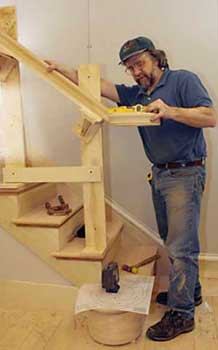
Most instruction books suggest cutting and assembling the rail pieces with the rail set directly on the tread nosings to find the correct angles. I find it much easier to start with the rail set in its actual position and height. I have a set of homemade 3/4-inch plywood handrail stands that help me do just that (Figure 3). Four stands are enough for most straight stairs.

Image

Image
Image

Image
Image

Figure 3.Shopmade handrail stands are the key to the author's assembly system (A). Screwed to the stairs near the top and bottom, the stands provide support for accurately locating and assembling the hand-railing system in its final position on the finished stair (B). At the base, the author locates the handrail centerline over the starting baluster center (C, D), drills through this point, and screws the base to the tread at the first baluster location (E).

I begin by marking the front baluster centers on the finish treads, which in this case are 2 1/16 inches (overhang plus half the baluster thickness) in from the nosing in both directions. I set my combination square and draw crossing lines, then drill through the center with a 3/32-inch bit. On the handrail stand, I drill a hole 2 1/16 inches back from the front edge of the base, and one-half the rail thickness out from its vertical face. I screw the rail stand to the stair through this hole into the baluster center hole.

