
Installing an Over-the-Post Handrail - Part One -
Continued
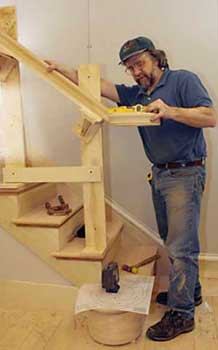
Then I set one stand on the second tread up from the bottom,
and one on the top tread, with one or two intermediate stands
on a long stair. I screw a 1x4 platform across the stand
brackets and adjust them so that the railing, when sitting on
the 1x4, will be 34 inches above the nosings, per code, and at
the same pitch as the stair. To set the pitch, I use either a
digital level or place a torpedo level on my pitch block
(Figure 4).
Figure 4.The author sets the handrail platform
angle by putting a torpedo level on his pitch block, made on
site for each stair. The triangular pitch block is cut from a
piece of 1-by lumber, with the tread rise on one leg and the
tread depth on the other; the hypotenuse thus produced
describes the pitch of the stair (A). A rough length of rake
railing is clamped to the platform (B) and checked for
regulation height (C). The author centers the railing on the
baluster line using a laser plumb bob for reference
(D).
I clamp a rough length of straight rail onto the 1x4 and check
its location with a laser plumb bob, making sure the centerline
of the rail bottom is plumb over the baluster centers. If an
adjustment is necessary, I shim the stands to correct the
alignment. The handrail must remain snug against the vertical
face of the stand. Finally, I connect the rail stands with
horizontal braces for stability.
Fitting the Volute
The up-easing on a manufactured flat volute has to be cut to
the pitch angle of the stair. To do so, I set the volute on a
flat surface and slide the pitch block under the easing, with
the run edge of the pitch block horizontal, then make a mark on
its bottom exactly where the pitch block touches it. This is
the tangent point, where the line of rise intersects the
easing's radial curve (Figure 5). Use a strong backlight to
make it easier to see the exact point of contact.


Figure 5.With the volute section laid flat and the
easing rising, the pitch block is slid into place and its exact
point of contact — the tangent point — marked on
the easing (A). Then the pitch block is turned to its
complementary angle and scribed across the easing at the
tangent point to show the cut line (B). The author screws an
auxiliary fence and table to his saw to create a more stable
base and a higher continuous fence. A kerf in the base makes it
easy to line up the tangent point with the blade. Hot-melt glue
secures the pitch block to the volute for support during
cutting (C).
Next, I flip the pitch block 90 degrees to mark the cut line
across the up-ease through the tangent point. To make the cut,
I temporarily hot-glue the pitch block to the bottom of the
volute for support and make the cut with the blade set plumb
and square on the chop saw.
After cutting, I connect the volute to the straight rail
section, clamp it to the stands, and check it for level (Figure
6). If the cut needs correcting, it's a lot easier and safer to
do it on the straight rail section. I just loosen the rail bolt
enough to raise or lower the volute to level, then mark the
correction on the straight rail. But I never glue the
connections until I've totally dry-fit the entire railing
assembly.
Figure 6.The volute is drilled for rail bolts and
fitted to the rake rail section (A). The assembly is then
clamped on the rail platform for positioning (B). To correct
for level, the author loosens the rail bolts enough to allow
the volute to drop. The reveal at the connection can then be
marked for recutting, which is easiest on the straight rake
railing (C). The author's preferred rail bolt can be tensioned
with a nail set. Bottom holes are later plugged with matching
stock (D).
Locating the Volute Newel
Typically, there's a paper pattern in the box the volute comes
in (Figure 7). I scissor a notch in the pattern so that it fits
on the bottom bullnose tread. The notch wraps the corner where
the second tread's riser and face skirt miter; the volute's
centerline aligns with the baluster layout line. I move the
pattern forward and back until I like the way the volute falls
on the bullnose tread, at which point I punch a reference hole
through the newel-post center mark into the tread.
Figure 7.The paper pattern shipped with the volute
is fitted to the bullnose tread. The newel center point is
targeted with a laser plumb bob (A) and the volute is slid up
or down the support platform until its dowel hole is directly
centered above the pattern (B). The railing assembly is clamped
and marked on the platform for future reference (C). The author
punches the newel center mark through the pattern into the
finish tread (D).
I remove the template and set my laser plumb bob over the mark,
then move the rail assembly up or down until the laser dot hits
the center of the volute's dowel hole. Then I clamp the railing
tight to the stand. Now I've got my volute and straight rail
exactly where they'll be permanently fixed — both in plan
and elevation — on the finished stair.
Before removing them to fit the gooseneck at the upper landing,
I measure between the bottom of the volute and the bullnose
tread to find the length of the volute newel. I pencil witness
marks between the rail-stand platform and the railing so that I
can later return the assembly to the exact same spot to fit the
gooseneck.
Jed Dixonis a master stair carpenter in Foster,
R.I., and a regular presenter at JLC Live.


