
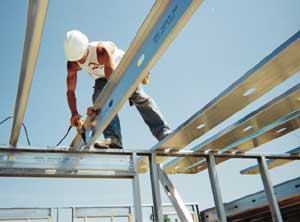
Thanks to new prescriptive tables, light-gauge steel floor framing is as simple to use as I-joists or solid lumber
Steel framing has so many advantages over wood — including dimensional stability, consistent pricing, and resistance to rot and termites — that I’m convinced it will claim more and more of wood’s market share in the years ahead. But for builders who have never used anything but wood, the prospect of diving into steel framing all at once can present a big mental barrier (see ” Making the Switch to Steel,” JLC 6/00). One alternative is to start at the bottom, and begin the transition to steel with the floor framing system. As the former project manager of a family-owned company that has been framing entirely with steel for years, I found that the material’s benefits were especially attractive for floor framing.
Allowable Spans for Cold-Formed Steel Floor Joists (1,2,3,4) Single Span 33 ksi Steel |
||||||
|
Nominal
Size
|
30 psf Live Load Spacing (inches)
|
40 psf Live Load Spacing (inches)
|
||||
|
12 |
16 |
24 |
12 |
16 |
24 |
2x6x33 |
11′-7″ |
10′-7″ |
9′-1″ |
10′-7″ |
9′-7″ |
8′-1″ |
2x6x43 |
12′-8″ |
11′-6″ |
10′-0″ |
11′-6″ |
10′-5″ |
9′-1″ |
2x6x54 |
13′-7″ |
12′-4″ |
10′-9″ |
12′-4″ |
11′-2″ |
9′-9″ |
2x6x68 |
14′-6″ |
13′-2″ |
11′-6″ |
13′-2″ |
12′-0″ |
10′-6″ |
2x6x97 |
16′-1″ |
14′-7″ |
12′-9″ |
14′-7″ |
13′-3″ |
11′-7″ |
2x8x33 |
15′-8″ |
13′-3″ |
8′-10″ |
14′-10″ |
10′-7″ |
7′-1″ |
2x8x43 |
17′-1″ |
15′-6″ |
13′-7″ |
15′-6″ |
14′-1″ |
12′-3″ |
2x8x54 |
18′-4″ |
16′-8″ |
14′-7″ |
16′-8″ |
15′-2″ |
13′-3″ |
2x8x68 |
19′-8″ |
17′-11″ |
15′-7″ |
17′-11″ |
16′-3″ |
14′-2″ |
2x8x97 |
21′-10″ |
19′-10″ |
17′-4″ |
19′-10″ |
18′-0″ |
15′-9″ |
2x10x43 |
20′-6″ |
18′-8″ |
15′-3″ |
18′-8″ |
16′-8″ |
13′-1″ |
2x10x54 |
22′-1″ |
20′-1″ |
17′-6″ |
20′-1″ |
18′-3″ |
15′-11″ |
2x10x68 |
23′-8″ |
21′-6″ |
18′-10″ |
21′-6″ |
19′-7″ |
17′-1″ |
2x10x97 |
26′-4″ |
23′-11″ |
20′-11″ |
23′-11″ |
21′-9″ |
19′-0″ |
2x12x43 |
23′-5″ |
20′-3″ |
14′-1″ |
20′-11″ |
16′-10″ |
11′-3″ |
2x12x54 |
25′-9″ |
23′-4″ |
19′-7″ |
23′-4″ |
21′-3″ |
17’6″ |
2x12x68 |
27′-8″ |
25′-1″ |
21′-11″ |
25′-1″ |
22′-10″ |
19′-11″ |
2x12x97 |
30′-9″ |
27′-11″ |
24′-5″ |
27′-11″ |
25′-4″ |
22′-2″ |
For SI: 1 inch = 25.4 mm, 1 psf = 0.0479 kN/m2, 1 foot = 0.3 m 1. Table provides the maximum clear span in feet and inches. 2. Bearing stiffeners shall be installed at all support points and concentrated loads. 3. Deflection criteria: L/480 for live loads; L/240 for total loads. 4. Floor dead load = 10 psf (0.479 kN/m2) Courtesy of the NAHB Research Center |
||||||
Figure 1. Steel joists permit unsupported spans of well over 20 feet. By varying the gauge of the material, it’s possible to increase the allowable span without increasing the depth of the joist.
Advantages of Steel Floor Framing
As you can see from the table at right, at 24 inches on-center, a 10-inch-deep 54-mil steel C-joist can span 15 feet 11 inches at 40 psf live load (see Figure 1). To get the same span from wood joists of the same depth, you’d have to go to a 12-inch spacing. If you go to a 12-inch spacing with the same steel joist, you can span up to 20 feet. That’s a nice option if you want to build a bonus room over a garage without having to add a beam. You can span even farther with heavier-gauge joists, but I’ve found that if you go beyond 16 gauge, it gets difficult to drive screws into the material. Although steel is usually referred to by gauge on the job site, current tables reference it by mils of thickness. Sixteen-gauge steel is 54 mils thick, 18 gauge is 43 mils, and 20 gauge is 33 mils. For easy reference, steel framing is also color coded, with 16 gauge being green, 18 yellow, and 20 white. Unlike wood I-joists, steel joists also allow you to vary the gauge of the material to suit the span, without increasing the depth of the joist. That’s useful when you have two spans of different lengths that lap over a beam. With I-joists you’d have to frame the shorter span with an unnecessarily deep joist, or go to a shallower joist and face the problem of getting the floor surfaces to line up at the beam. With steel, you can use a 16-gauge joist on the longer span and go to 18 gauge for the shorter one — maintaining a constant depth without throwing away material.
Figure 2. A conventional wormdrive saw with an abrasive blade (left) is the preferred tool for most cuts made on site. The 14-inch chop saw (right) can cut several stacked pieces of material at once, speeding repetitive cuts. |
|
Working With Steel
The steel framer’s tool kit is pretty simple. For cutting joists and tracks, we use a standard 7 1/4-inch wormdrive saw equipped with cheap abrasive blades that we buy from a local supplier for about $3 apiece, or a 14-inch chop saw with the same type of blade (Figure 2). We tried a new carbide-toothed blade from Tenryu that lasted longer and provided a nicer cut, but the results didn’t seem to justify the $40-per-blade price tag. Also, we found that any vibration in the blade had a tendency to cause the teeth to chip. All steel-to-steel connections are screwed together with self-tapping screws. Our crews like the Quik-Drive QD2000MT housing for strip screws, mounted on a DeWalt screwgun. Whatever gun you prefer, stick with a 2,500 rpm model; screws driven at 4,000 rpm tend to burn at the tip and are therefore more difficult to set. In addition to the power tools, each framer also needs self-locking clamps (usually one large and one small will do the trick) to temporarily hold joists and tracks in place until they can be screwed together. A pair of aviation snips can also come in handy at times.
Planning and Layout
When you’re framing with steel, you need to spend extra time previewing plans and doing takeoffs, because you can’t just make a run to the local lumberyard for material you forget. While many contractors and subs view this as an extra burden, our company found it to be a blessing in disguise. By spending a few extra hours in the office detailing and laying out the plans, we save twice that much time in the field. Our crews aren’t left standing around waiting for missing material to be delivered, and the detailed plans show them exactly where each piece of steel is to be used. Finally, most of the material is ordered precut, which eliminates the need for cutting and saves time and material. Dealing with foundation irregularities. It can be risky to order precut full-length joists, because you don’t really know the exact dimensions of the foundation until the forms are stripped. Unless the foundation is dead on, the joists won’t fit. Ordering them a little long and cutting them down is a waste of time and material, but if you wait for the actual foundation measurement to place your order, you may not get the material by the time you need it.
Figure 3.Lapping joists at a central beam eliminates the need to cut joists precisely to length, making it possible to order material before the exact dimensions of the foundation are known. Web stiffeners are not required at the laps. |
To avoid these kinds of problems, we plan the floor layout with a central I-beam where we can lap the joists (Figure 3). That lets us adjust the joist length as needed without any cutting. The joists are still ordered to length, with an additional 6 inches to allow for the lap. This also saves time, because screwing the joists together back-to-back at the lap eliminates the need for web stiffeners over the beam.
Span Tables and Approved Details
Until just a few years ago, all steel framing had to be approved by an engineer. But now, steel framers can draw on span tables and approved details from the Prescriptive Method for Residential Cold-Formed Steel Framing, developed by HUD, the American Iron and Steel Institute, and the NAHB Research Center (available from the NAHB Research Center, 400 Prince George’s Blvd., Upper Marlboro, MD 20774-8731). The prescriptive method is recognized by the 2000 International Building Code and 2000 Residential Building Code, and we’ve had no problems with the building inspectors here in Indiana. But as we all know, each municipality and local building official is different, so I would suggest opening a line of communication early on. The North American Steel Framing Alliance (NASFA, 1726 M St. NW, Suite 601, Washington DC 20036-4523; 202/785-2022; www.steelframingalliance.com) is an excellent source for both information and assistance in educating your local officials.


