
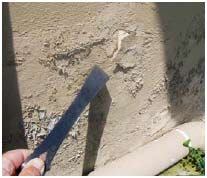
- Q. The painted finish on my client’s recently purchased stucco house is blistering and peeling, and it’s obvious that the traditional three-coat stucco underneath has been patched on several previous occasions (see photo, below). The stucco is applied over wood framing, but as is common in older houses, there is no weep screed; the stucco continues right past the bottom plate to the ground. What is causing the problem, and what’s the best way to fix it?
Installing a weep screed around the bottom of the house a minimum 4 inches above grade (2 inches above paved surfaces) would also help to keep efflorescence at bay. To do this, you will have to remove all the stucco up to about a foot above grade, install the weep screed, install 60-minute — or better — building paper and lath, and patch in the stucco. It’s a very slow process: Expect to complete only 3 or 4 feet an hour, depending on how hard the stucco is. The risk is that your lather won’t carefully chip back enough of the stucco and expose enough paper to be able to properly lap all of the layers. In some cases, you might find that the building paper has deteriorated or the metal lath has rusted away, in which case you’ll have to remove all the stucco, lath, and building paper and start over again.
To prep the wall for stucco repair, dig back the dirt to below the bottom of the stucco wall. You may need to trench perpendicular to the wall so that later, when you rinse the walls, excess water can flow away. Next, scrape and brush away all the soft, loose, deteriorated paint and stucco until you get to the good hard stucco. Thoroughly rinse the exposed stucco with clean water. To dissolve the salts, scrub the walls with undiluted vinegar or a solution of 95 percent water and 5 percent muriatic acid. Use a long-handled brush and proper skin and eye protection. Try to keep the wall wet while you scrub; if it’s a hot day, you’ll need some help. Then thoroughly rinse again. To neutralize the acid, brush on a solution of one cup baking soda per 5 gallons of water, then thoroughly rinse one more time and allow the wall to dry completely.
When you patch the stucco, use an acrylic admix to enhance adhesion, density (watertightness), and flexibility. If you put admix in the base coat, add it to the finish coat as well. After the stucco has dried, spray the bottom 4 feet of the wall with a penetrating sealer before recoating with a paint specifically formulated for stucco.


