- Q. I built a house with a second-floor balcony, and I installed waterproofing membrane and tile on the balcony deck. Around the perimeter of the door, I installed Moistop flexible flashing. The siding is stucco. The room under the balcony is now leaking. Can you provide details on the best way to flash the intersection of the deck waterproofing and door threshold, as well as the best way to flash a door in a stucco house?
A.Ron Webber, owner of Prime Plastering in Irvine, Calif., responds: There are many available deck waterproofing systems, and they aren’t all installed the same way, so check with the manufacturer for the correct installation technique. Generally speaking, most leaks occur at termination points, including the transitions between deck and wall metal, deck and door threshold, and deck and door jambs. Other trouble areas include the attachment point for handrails and the area around scuppers and drains.
All penetrations and terminations should be flashed in a weatherboard (overlapping) fashion, with a minimum horizontal overlap of 2 inches and a minimum vertical overlap of 6 inches. Deck-to-wall joints must be lapped and caulked or soldered.
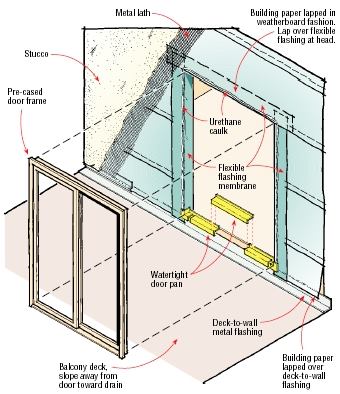
A door will require the following installation details:
- Install a watertight door pan, like the Jamsill Guard (Jamsill, P.O. Box 485, Talent, OR 97540; 800/526-7455; www.jamsill.com). The door pan and finished floor inside must be at least 3/4 inch above the finished deck.
- Tack the flexible flashing membrane (such as Moistop from Fortifiber) around the perimeter of the rough opening, being careful to lap the flashing over the deck-to-wall metal. The top piece of flexible flashing should overlap the side pieces.
- Run a liberal amount of good quality urethane caulk around the rough opening, on top of the flexible flashing. Then install the pre-cased door jamb, pushing the stucco mold trim into the wet caulk.
- When lathing, be sure to lap the felt or kraft-paper weather barrier in a weatherboard fashion. The felt should lap over the flexible flashing at the head of the door, and over the deck-to-wall metal.
- If there are any holes, rips, or tears in the flashing membrane or weather barrier, repair the holes.
The deck should be sloped away from the door, toward the drains. The deck should be watertight before the base coat of stucco goes on. To check for watertightness, take a hose and squirt the deck and then the walls, starting at the bottom and working your way up. If anything leaks, locate the holes and repair them.
For more information, see the article “Stucco Flashing Details,” 10/98.Flashing Details for a Balcony Door
Q&A: Making a Balcony Door Watertight
2 MIN READ