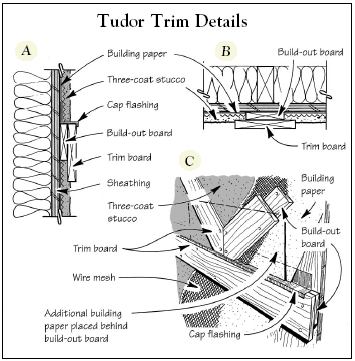
- Q. We will soon be building a stuccoed Tudor-style home. Standard practice in our area is to fasten the wood trim directly to the sheathing, then apply a three-coat stucco to the areas formed by the applied trim. How can the trim-stucco joint be detailed to prevent water infiltration?
A.Steve Thomas responds: The key to leak-free details is to install “build-out boards” behind the trim. In our area, 1×6 cedar is commonly used for Tudor trim. We center the vertical and angled trim boards over a 1×4 build-out board (see illustration, below). The smaller width build-out board allows the two stucco base coats to be troweled in behind the 1×6. The finish stucco coat is run tight to the edge of the overlapping 1×6 trim board, which discourages water from working its way behind the base coats.
Unlike vertical trim, horizontal trim is held flush with the upper edges of the build-out boards, and a galvanized cap flashing is installed to prevent water infiltration.
It’s important to follow the proper sequence when installing these Tudor trim assemblies. Horizontal assemblies and cap flashings are installed first, housewrap or Class D building paper is stapled to the sheathing, then vertical and angled trim assemblies are installed.
If cedar trim is used, insist that it be prestained on all sides before installation, and that all site-cut ends have stain applied to them. Cedar contains extractives that can “bleed out” if not properly sealed.
Formerly in the stucco trade, Steve Thomas is now a sales representative for The Columbus Coal & Lime Co., a brick manufacturer in Columbus, Ohio.
Q&A: Wood Trim with Stucco
Wood Trim with Stucco
1 MIN READ