
Replacing Windows in Stucco Walls, continued
Prepping the Opening
Around here, most new windows are vinyl and have integral
fins. Installing them in old buildings is similar to installing
them in new ones. In both cases, the fin is installed over
flash paper.
The usual procedure in new construction is to run a strip of
flashing across the wall just under the opening and lap it with
strips that run up either side. The window is installed over
those pieces, and a fourth piece of flashing is applied above
the window so that it laps the side flashings and upper fin.
The walls and every fin except the bottom one are covered with
two layers of building paper before the lath and stucco are
applied.
Flashing material. In the
stucco trade, we still refer to flashing as flashing paper,
even though it's now made from other materials. Most of the
builders in this area use Moistop (Fortifiber Building Systems,
Reno, Nev.; 800/773-4777, www.fortifiber.com), a paperlike
polyethylene membrane with a fiberglass core. One version goes
on with nails, but you can also get it with peel-and-stick
material along one edge. I have no problem using either of
these products on new construction. You can also use them on
replacement jobs, but for that kind of work, I prefer to use a
peel-and-stick adhesive membrane such as FortiFlash (also from
Fortifiber). It has a rubberized asphalt core and a
polyethylene skin and is similar to other sheet membranes such
as Ice & Water Shield. I use FortiFlash for a couple of
reasons. It's self-sealing, so it won't leak at fastener
penetrations. It's very flexible, and the entire back side is
sticky, so it seals tight to whatever I put it on. Adhesive
membrane flashings cost more but are worth it if they can help
me avoid even one leak per year.
| |
Once the old window is
out of the way, the author installs new peel-and-stick
flashing around the opening, sliding it under the lath
and adhering it on top of the existing paper (right).
Installing the new window then proceeds normally (far
right). |
Base flashings. Ideally,
the old window would come out without causing any damage to the
existing paper. However, old paper can be extremely delicate.
By the time you get the nails out, it's unlikely there will be
much left of the edge. Fortunately, a damaged edge can be
repaired by lapping an adhesive membrane over it.
Inspectors want you to fold back the old paper and put the new
flashings under them. After the window is in, you're supposed
to fold the paper back over the fin. The trouble is that older
stucco buildings are covered with a different kind of paper
than we use today. The old stuff is sometimes so fragile that
it will break when you fold it back. It's a disaster if the
paper breaks off where it comes out from under the stucco
because there's no easy way to make the repair. You're supposed
to lap over the break at least 6 inches with another piece of
building paper. The only way to do that is to tear out more
stucco. If the building is sheathed, you'd have to take out 6
more inches; but if it's open-stud, the next good stopping
point could be 14 1/2 inches away. You could shorten that
distance by installing another stud closer to the break, but
you'd need to do it from the inside.
Alternate flashing method.
If the old paper is in good shape, we'll fold it back and
install the flashing against the framing in the usual way. But
if the paper is fragile, we'll install the side flashings over
it. That way we don't have to risk breaking it to get the
window in. Depending on how much stucco was removed, the
flashing might lap 3 or 4 inches onto the paper. We always use
FortiFlash for this application because it will stick to the
existing paper and create a seam that water has a hard time
getting through. Once the flashings are in, it's time to
install the window.
Installing New Windows
Before you install the window, use a caulking gun to put a
thick bead of sealant along all four edges of the opening. It's
important to use a good-quality sealant that's compatible with
the flashing, window, and building paper. We use Moistop
Sealant, a polyurethane product from Fortifiber.
The window is placed against the sealant and flashings,
plumbed, and secured to the building with roofing nails driven
through the holes in the flange. The final step is to run a
strip of flashing over the upper fin all the way to the outer
edges of the side flashings. This top piece of flashing should
tuck under the existing building paper above.
Papering in. Once the window
is installed, it's time to paper it in. The conventional way to
paper in a house is to cover it with two layers of grade D
building paper. The paper should lap the top and side fins and
tuck under the bottom piece of flashing. This works fine when
the flashings are under the paper but is impossible when the
flashings are over it, which is often the case on replacement
jobs.
| |
| With the new
window in place, a second layer of peel-and-stick seals
the window flanges to the first layer (top left). The
top strip goes in last and is tucked under the existing
paper above (top right). Next, the author bends the
original lath back into place in preparation for
stucco. Above, he fills in with a new strip of diamond
lath, overlapping the original wire by several inches
to prevent cracking. |
Although the fins are bedded in sealant, they are still
supposed to be covered. Grade D paper will work, but only if
you remove enough stucco to get the required 6-inch vertical
lap. It's better to paper in the window with self-adhering
membrane because you don't need much lap to get a good
seal.
I start by running a horizontal strip of FortiFlash across the
bottom fin. Technically, this step is not necessary, because
the lower flange already laps over a piece of flashing. I do it
to ensure that water doesn't get through the nail punch-outs
and to cover the small voids that sometimes exist at the
mitered corners of the flange.
Next, I install strips of membrane over the side fins. They
should be long enough to lap the strip below the window and
tuck under the old paper at the top of the opening. The last
strip of membrane covers the upper fin, laps the side strips,
and, again, tucks under the existing paper at the top. We
inspect the paper for nail holes and fill those we find with
the same polyurethane sealant we used to set the windows. The
wall should now be waterproof.
Lath and Stucco
After the window is papered in, it's time to install lath. The
old lath can be folded back down onto the paper and reused. If
any of it's missing, you can patch it with new material. All
kinds of wire lath are made for doing stucco. It doesn't matter
what kind you use as long as there's a good tie-in. This means
there should be a few inches of overlap between the old and new
lath. If the lath doesn't lap, cracks are likely to develop at
that spot.
We normally use expanded metal diamond lath on replacement
jobs because we can get it in precut strips to fit the 3- to
4-inch space we have to work with. The diamond lath goes over
the existing wire and is fastened every 6 inches with staples
or 1 1/4-inch roofing nails. For larger repairs, we'd use
self-furring wire lath.
Materials. In this area,
builders use traditional three-coat stucco. It's about 7/8 inch
thick and consists of a scratch coat, brown coat, and finish
coat. The first two coats are made on site by combining plastic
cement, bulk sand, and water. We use a premixed bagged product
for the top coat, which contains white cement, sand, and lime.
It's mixed with water on site.
| |
Above left, the
author trowels on Maxit 690, a premixed one-coat
reinforced stucco that reduces the time it takes to
make a patch. Above right, a worker rolls on a bonding
agent, which helps the stucco finish coat adhere to the
painted surface of the existing stucco. |
Repairs made with traditional cement-based stucco require
multiple trips and take weeks to complete because cure time is
needed between coats of mud. The scratch coat should cure for
48 hours, and the brown coat should cure for 7 days. Shrinkage
cracks may appear in the finish if you skimp on curing.
We use traditional materials for new work and for large
repairs. Window replacements are different because there's only
a small area to patch. For small repairs, we'll use a one-coat
system for the scratch and brown: Maxit 690 (Maxit, Antioch,
Ill.; 847/395-7110, www.maxit-usa.com), a premixed bagged
product that contains Portland cement, sand, glass fiber, lime,
and additives that reduce shrinking.
Maxit 690 can be applied in a single coat up to 1 inch thick
or in two coats that can go on the same day. It's more
expensive than traditional material, but the labor savings make
up for it by allowing you to make one less trip to the site.
The manufacturer recommends 7 to 21 days of cure time, but we
have had no problems with finishes applied after only a day or
two of cure.
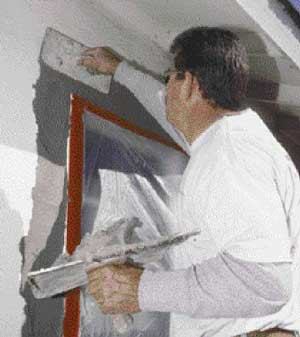
We always cover windows with plastic to keep stucco off the
frame and to prevent the glass from being scratched. The
plastic is held on with plastic tape, which is removed as soon
as the repairs are complete. The tape can leave an adhesive
residue if you leave it on too long. Never use duct tape,
because the adhesive ruins vinyl frames.
Base and finish coat. The
one-coat material is mixed on site and applied to the lath with
a trowel. We don't want it to sag, so we add just enough water
to create a very stiff mix. I'll build the base coat flush to
the surrounding stucco and then use a sponge float to smooth it
out. In some cases, I'll cut it back slightly to accommodate
the thickness of the finish coat. This might be 1/8 inch for
smooth finishes and more for textures. A day or so later, we'll
come back to apply the top coat.
| |
For the sand
finish being applied here, the top coat is applied with
a trowel (left) and feathered out with a sponge float
(right), which brings the sand to the
surface. |
There are many different ways to apply the top coat of
stucco. It can go on smooth or textured, be painted after it
cures or be applied with the color already in it. It's beyond
the scope of this article to describe all the ways there are to
apply texture, but I can explain how we do the sand finish
that's on the houses pictured here.
The top coat has to cover the areas we patched and feather
onto the existing stucco. If distance isn't too great, we'll
extend the top coat to the nearest corner. That way the
transition between new and old will be harder to see. Stucco
does not adhere well to paint, so if the building was painted,
you'll need to use a liquid bonding agent. It gets applied to
painted surfaces where the top coat will be feathered in. We
generally use bonding agent on all patches, because it prevents
the base coat from sucking the moisture out of the top coat.
This makes the top coat easier to work and prevents cracks by
promoting an even cure.
The top coat is applied with a trowel and goes on about 1/8
inch thick. We use a sponge float to smooth it out, feather it
in, and create texture by exposing the sand in the mix. Once
the building is painted, you won't be able to tell where
repairs were made. If the underlying paper and lath were
properly tied in, there will be no cracks or leaks.
Don Thorvundhas been in the stucco trade for 20-plus
years and is the owner of TNT Plastering in Fremont,
Calif.


