Correct Wiring
There’s not a lot to say here — obviously, this is the reading you want — but I’d like to stress a point that I’ve made in other JLC articles. When wiring a receptacle, never use the push-in type connections that come on the backs of some receptacles. These are not reliable; they may work loose over time. Always use the screws; otherwise, a “Correct Wiring” indication one month may result in a dangerous situation the next month.
Loop the stripped end of the wire around the screw and tighten it snugly. Make sure you loop the wire so that it gets tighter, not looser, as you tighten the screw.
Reversed Polarity
I’ve been asked why this matters. “What difference does it make if you plug in a lamp and the current goes in the neutral leg and comes out the hot leg? The light bulb still comes on, doesn’t it?” Not long ago, a little girl in my home state put her tongue into the round metal bulb holder of a decorative electric candle — the kind you see in windows at Christmas. Even though the switch was off, the girl was electrocuted because the fixture had been wired backwards and the round cylinder that holds the bulb was hot. On a recent service call, I was working on a pump in an underground concrete enclosure. The owner had switched off the power; I measured 0 volts from hot to neutral. But when I touched the neutral, I got a nasty shock that caused my elbow to smash into the concrete wall. Remeasuring, I read 120 volts from neutral to earth. On troubleshooting, I found that the receptacle the pump was plugged into was wired in reverse, so the neutral was hot. I went home with a sore, bruised elbow, but the situation could have been lethal.
If a branch circuit is wired backward, the same situation exists every time an appliance or light fixture is plugged in. Unfortunately, this is more common than you might think. In some cases, I have seen entire houses wired in reverse. The only remedy is to rewire.
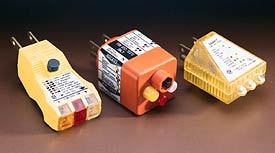
Advanced Plug-In TesterIndustrial Commercial Electronics has taken the plug-in tester concept to a new level of sophistication with its SureTest line of “branch circuit analyzers.” Besides the usual checks that common plug-in testers do, the SureTest ST-1D (the model we tested) will check for a bootleg ground, read line voltage, check for voltage drop, measure the load on the circuit between the receptacle and the panel, and measure the impedance of the building’s grounding path. Considering the cost — less than $300 — the tool is great for anyone who needs to quickly and safely check a circuit. Say, for instance, that you’re adding on a home office for your client, and that the office will be stuffed with expensive, state-of-the-art electronic equipment — computer, fax machine, copier, etc. Despite assurances from the electrician, and despite the presence of plug-in surge protector strips at every receptacle, your client still wants evidence that the equipment is protected against power surges (either from the utility or lightning), and that neither noise in the lines nor power fluctuations will garble data. Unfortunately, there is no way for you to guarantee protection against lightning — the voltage from a near or direct hit is massive (see Foolproof Surge Protection, 2/94); and it’s up to the power company to deliver continuous, good-quality electricity. But with the SureTest, you can be reasonably certain of the power quality within the house itself. So you pull out the SureTest and plug it in a receptacle. The green lights tell you the receptacle is wired correctly; the digital display confirms that you’ve got 120 volts present from the utility. (Wild fluctuations in the reading would indicate that the utility is delivering poor-quality power.) You push the “display advance” button, and you get the voltage drop on that receptacle under 15-amp load (given as a percentage of 120 volts). Push the button again and you get voltage drop under 20-amp load. For either size circuit, any drop under 5% is okay; above that, you may have a problem. Besides causing equipment problems, excessive voltage drop causes heat buildup in the wire and at connections, and can be a fire hazard. Let’s say you get a reading above 5%. Maybe this is because you’ve pulled the wiring for the addition off a lightly loaded preexisting bedroom circuit, but the extra length of wire is creating too much resistance. So you rewire the circuit as a “homerun” back to the panel. Or maybe there’s a bad connection at the receptacle that’s causing the resistance. Either way, you locate the problem, fix it, and test again. The next test is for excessive voltage between ground and neutral — an indication of how much noise is in the lines from the operation of other appliances on the circuit. For computer operation, a few volts is okay; for dedicated lines for faxes or copiers, no more than a few millivolts should be present. With this test, it’s best to leave the SureTest plugged in overnight, or even for a few days. It will hold the peak reading that develops. That way, you can figure out how the intermittent operation of other appliances on the line — a hairdryer, a television, or a vacuum cleaner — might affect the circuit. Push the advance button again and you get a reading of the load on that circuit, in amps, back to the panel (it’s best to take this reading from the last receptacle on the circuit). This is a good way to check a dedicated circuit; if you get any reading at all, it may mean that the circuit shares a neutral. Again, the SureTest allows you to test for load over an extended period; just leave the device plugged in and it will record the peak reading. A final test measures the resistance of the ground path in ohms — a very important test when it comes to sensitive electronic equipment. A low reading, preferably below .25 ohms, helps assure that excessive voltages that may develop in the line (from lightning or a power spike, for example) will be safely returned to ground at the panel without destroying equipment. For more information on the SureTest ST-1D or other less expensive models, contact ICE (2421 Harlem Rd., Buffalo, NY 14225; 800/442-3462). |
Open Ground
In this case, there is no ground connection at the receptacle, perhaps because it’s a two-wire circuit, or because the ground wire has come loose, or because the installer cut the ground wire too short to make the connection. (Sometimes this is done on purpose because an untrained installer doesn’t know what to do with the wire.) An open ground gives the illusion of safety when actually there is grave danger. People see the three-prong receptacle and assume there’s a proper ground. If a tool or appliance plugged into that receptacle develops a hot-to-ground fault, the user can get shocked and possibly electrocuted.