
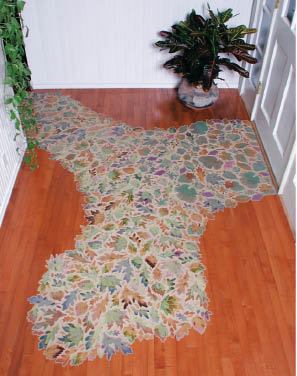
The main challenge of the project shown here was to join
irregularly shaped but relatively stable porcelain tiles to a
wood-strip floor subject to the normal cycles of expansion and
contraction. Our solution was to use an attractive, almost
invisible movement joint.
The work was done as part of a whole-house remodel and involved
considerable effort on the part of the lead carpenter, both in
reframing the floor structure and in preparing the flooring to
match the contours of the tile. In all, reworking the structure
took about 30 hours, and shaping and finishing the wood floor
another 54. By contrast, once the carpentry was done, the tile
work took only about 26 hours, including 10 to prep the edge
tiles so they would butt tightly to the wood; 12 to install the
membrane and tile, including grouting; and three to complete
the movement joint. This suggests that if you want to use a
similar technique on a future project, a simpler design would
make a very affordable enhancement.
Beefing Up the Floor
I noticed the deflection in this floor the first time I walked
on it. The problem wasn’t with the 1/8-inch-thick plywood
subfloor, but with the framing — 6-inch-by-8-inch joists
4 feet on-center. The floor wasn’t going to cave in, but
tile requires joists on 16-inch centers, which meant the
carpenter had to add 2x12s to create the proper spacing. We
extended the new joists at least 2 feet beyond the area to be
tiled and added full-depth blocking under all the plywood
joints (1). I then checked deflection with weights and a dial
indicator and found it to be well within industry tolerances.
Nevertheless, to protect the installation, I decided to include
a crack-isolation membrane in the tile substrate, NobleSeal TS
(800/878-5788,
noblecompany.com).
For setting the tiles, I would use a premium thinset mortar
from Custom Building Products (800/272-8786,
custombuildingproducts.com)
mixed with an acrylic additive in place of water, and a
polymer-modified grout and color-matched sealant from the same
manufacturer.
Laying Out the Pattern
After removing the existing tile from the foyer, the homeowner
used building paper and rope to lay out the approximate shape
of the pattern he wanted (2). He lived with it for several days
and made some modifications, then cut out the pattern and sent
it to the tile manufacturer (Michelle Griffoul Studios,
805/688-9631,
michellegriffoul.com),
who assembled the required tiles and back-mounted them onto 1-
and 2-square-foot sheets. Each mosaic sheet was given an
identifying marker for accurate positioning according to a
layout map provided with the tiles.
While waiting for the tiles to arrive, the carpenter proceeded
with prepping the floor, using a router to cut out the rough
outline of the mosaic and remove the stub ends of the strip
flooring so new flooring could be woven in (3). Once the tile
arrived, we filled the void in the flooring with 3/4-inch-thick
foam panels; this would allow us to position the mosaic sheets
on a smooth plane for accurate scribing (4). Our primary
purpose was to precisely locate all the edge tiles, so that a
line could be traced for routing the wood floor. But a critical
secondary purpose for dry-fitting the sheets was to eliminate
the appearance of seaming, which occurs whenever too much space
is allowed between sheets of mosaic tile. Also, because the
surface of hand-molded tiles is variable, I wanted to make sure
that the perimeter tiles were the flattest possible. In some
cases, I swapped slightly irregular edge tiles for flatter
field tiles of the same pattern to minimize lippage where the
tile would abut the perfectly flat wood floor.


Once we were satisfied with the dry-fit, I spent several hours
squaring up the flared edges of all the perimeter tiles, first
marking a line (5), then using a grinder to remove the material
that would abut the wood (6). This ensured that I could
maintain a tight 1/8-inch movement joint around the tile
— the smallest recommended width for an interior movement
joint. There was also a practical consideration: The owners
have a very active dog whose claws would be too wide to slip
into and ruin the soft filler in a 1/8-inch joint.
After grinding the perimeter edges, we repositioned the mosaic
sheets and carefully traced a line to guide the router
(7).
Routing the Floor Mosaic
Outline
According to Mike, the carpenter on the job, the secret to this
painstaking task was to use a powerful router and brand-new
bits and work up to the finish cut in steps, never trying to
rout to the line on the first pass or hog off too much
material. He started with a 1/2-inch bit, then moved to
1/4-inch and 1/8-inch bits for the tighter spots (8). After
routing, Mike sanded a slight bevel on the plank edges,
vacuumed away the dust, and applied two coats of sealer to the
newly exposed wood edges. When he was finished, there was a
smooth, uniform gap around the edge of the tiles (9).
Installing the Sheet Membrane
Normally, this is a simple task, requiring a few straight cuts
— but not on this floor. The membrane, NobleSeal TS,
comes in 5-foot rolls, and two pieces were required to cover
the width of the tiled area (10). After stapling the membrane
to the floor to prevent it from moving, I cut it with a utility
knife to within 1/16 inch of the flooring (11). Then I removed
the staples and prepared to adhere the membrane to the subfloor
using NobleBond 21, which is a contact adhesive, so it grabs
quickly and makes it difficult to reposition the sheet. To
avoid misalignment, I positioned the larger sheet of membrane
carefully, then folded half of it back on itself before
spreading the adhesive with a 1/8-inch V-notch trowel
(12).
10
1113
After waiting about 20 minutes for the adhesive to become
tacky, I lowered the membrane and used a hand roller and a
small trowel to laminate it to the subfloor. I repeated the
process with the other half of that sheet, then installed the
second sheet in the same way. Finally I glued the 2-inch
overlap between the sheets with NobleSealant 150, which makes a
watertight seam when NobleSeal TS is used as a waterproofing
membrane.
Setting the Tile
Again using the manufacturer’s layout map, I repositioned
the tiles. They were now locked into place by the routed wooden
edge, but it was still important to dry-fit all the sheets and
make sure there were no loose seams. Next, working a few sheets
at a time, I spread the thinset with a 1/4-by-3/8-by-1/4-inch
square-notch trowel (13) and also used a 1/2-inch-wide tuck
pointer to work the mortar into the recesses around the
perimeter (14).
After carefully placing each section of tile (15), I adjusted
the position of individual tiles as needed before the thinset
hardened, then wiped the mortar residue from the surface of the
tile and the wood floor with a clean sponge. As the thinset
firmed up, I also cleaned up excess mortar that might get in
the way of the grout (16), being careful not to puncture the
membrane. I took special care cleaning the perimeter, where the
movement joint would be installed (17). When cutting away
excess thinset, it’s best to leave the damp crumbs to
harden completely — which takes a day or so — then
vacuum them up. If you try to clean them up while the thinset
is still wet, you risk nudging some of the tiles out of
position. However, it’s important to clean up the tiles
and the joints while the mortar is still green; you risk
damaging the tiles if you wait until the excess thinset is
hard.
13
1415
1617Grouting
Because the tiles were installed over an impermeable membrane,
I had to allow extra time — about 72 hours at
70°F — for the thinset mortar to dry
completely and the tiles to harden off before I could get back
on the floor for grouting.
Grouting hand-molded tiles requires patience and a soft touch;
as with grouting any kind of tile, timing is everything. For
this job, the temperature was in the mid 70s with no
discernible breeze — ideal conditions. I spread grout
over the entire floor (18), working the rubber grout trowel
back and forth and side to side to completely fill the joints
and eliminate voids. I then waited 20 minutes or so before I
began wet cleaning (19). I use this term loosely, because I try
hard not to drip any water on the freshly grouted tiles and use
only a tightly wrung-out sponge when it is time to remove the
grout residue. With practice and experience, a lot of the
residue can be removed with the edge of the grout trowel after
packing — but there will always be excess on the tiles,
and the grout in the joints will need to be smoothed and
finished.
18
19
When its pores are open, a sponge can be a gentle finishing
tool; when its pores are clogged with sand and cement
particles, it quickly morphs into an aggressive gouging tool.
At first, I work the sponge in a circular motion and
don’t wait for it to fill with cement before I flush,
rinse, and wring it out in a bucket of water. For any tile,
grout removal is a gradual process, with varying amounts of
excess material removed at each step: As the tiles become
cleaner and cleaner, less material needs to be removed.
After several circular passes with no sand or cement particles
or residue visible, I rinse the sponge and make parallel
passes, using very light pressure and a fresh sponge face each
time. On this job, I used the technique on both the tiles and
the wood flooring.
I tried to avoid getting grout in the perimeter joint, and
removed any that did get in with a 1/4-inch tuck pointer once
the grout had begun to set up after wet cleaning — about
two hours after I first mixed the grout. On a hotter day, this
would have happened sooner.
Filling the Movement Joint
With straight floor edges, it’s relatively simple to hide
perimeter joints under baseboard or other trim — which
means that most joints are never seen. On this floor, though,
the movement joint would be highly visible, and if done poorly
would attract attention. And it not only had to look great
— it also had to perform well as a walking surface.
Therefore, I used backer rod to help form the sealant into its
most effective cross-sectional shape: concave on the bottom and
on the surface. The bow-tie-like cross section allows the cured
sealant to stretch and compress without shearing off the sides
where it adheres — in this case, to the tiles on one side
and the wood on the other.
I pushed 1/4-inch-diameter backer rod into the gap with the
head of a large finishing nail (20), leaving the joint ready to
be filled with sealant within a few minutes (21).
The one-component acrylic sealant was colored and textured to
match the grout. I don’t try to be Michelangelo when
using the caulking gun, but prefer to pile up the sealant over
the joint (22). Then, rather than tooling the sealant with a
margin trowel or even my finger, I use a damp sponge to gently
remove the excess (23).
One-component sealants tend to shrink as they cure, so I try to
keep the material as high in the joint as possible, and begin
wet-cleaning as soon as I can. On this floor, I shot about 10
feet of joint at a time and cleaned all that length before
filling more of the empty joint. The trick is to keep the
surface moist, not wet. I begin as I do when grouting, with
soft, circular strokes focused primarily on the surfaces to
either side of the joint itself. This helps prevent gouging.
After several passes with a freshly rinsed and barely damp
sponge, I gently apply the sponge to the joint area and begin
smoothing it.
20
2122
2324
Finishing the sealant is an exacting task, but with patience
you can mimic the profile of the grout and make the movement
joint seem to disappear (24).
JLC contributing editor Michael Byrne is a tile-setter and
consultant in Los Olivos, Calif., a longtime member of the JLC
Live demonstration crew, and the moderator of the JLC Online
tile forum.


