
Uppers First
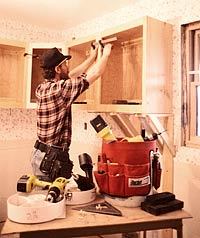
Many cabinet installers put the base cabinets in first, then use them to support the uppers. This sounds good, but I find it’s inefficient. Not only must you reach over the base cabinets to hang the uppers — a position my back loudly complains about — but there’s a real danger that you’ll damage the base cabinets as you work over them. Installing the uppers first also leaves plenty of room to get under them to make adjustments, and lets you stand next to the cabinet when working — a position that my back seldom complains about. The only problem is that you might forget about the uppers when installing the lowers. You would be surprised how easy it is to unthinkingly stand up and whack your head. To temporarily support the upper cabinets, I use a set of easy-to-build wall-support brackets. No high-tech gimmickry here, just some plain old 1×4 pine that can be screwed or nailed together in a few minutes (see Figure 1).
Figure 1. The author supports uppers with a pair of site-made brackets. He positions the top of the brackets a few inches below finish cabinet height, and uses shims and a T-Jak screw jack (shown leaning against the wall) to raise the cabinets to their final position. |
I make my brackets 52 inches long (a few inches shorter than the common 54-inch upper height) and fasten them to the wall with two screws each. I then place the cabinet on the brackets, shim it to the proper height, and clamp it to the adjacent cabinet. That leaves both hands free to screw the face frames together and to fasten the cabinet boxes to the wall.
