
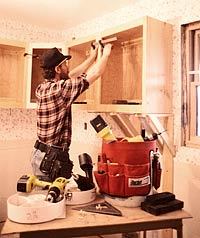
Keeping Tools Nearby
A major time-killer when working solo is hunting for tools
and fasteners. Making a profit means keeping wasted time to a
minimum. Here are some devices that will help.
Rolling cart.
My
movable cart is one of my most time-saving devices, since it
keeps my tools close at hand during installation (Figure
3).
| Figure
3. A rolling metal cart keeps supplies nearby
during a kitchen installation. A Bucket Boss holds
tools in a drywall bucket, while a set of round
Drop-in-the-Bucket trays keeps fasteners neatly
organized. |
Having tools and fasteners always within reach really helps
keep the job rolling. The cart serves as a central location to
which all tools are returned, and can be rolled out of the way
as additional cabinets are brought in. It’s especially
handy when you must steady a cabinet with one hand while
reaching for a tool with the other. I made my cart from a used
overhead projector cart.
Of course, having tools nearby is one thing; keeping them
organized is another. For this task, few job-site containers
are as valuable as five-gallon joint compound buckets. Here are
a few of the ways I use these gems of the drywall trade:
Tool organizer.
I used
to drag two good-sized toolboxes to each job, then use about
10% of the tools in them. Now I can fit most of the tools I
need in my Bucket Boss (Portable Products, 58 E. Plato Blvd.,
St. Paul, MN 55107; 612/221-0308), and set it on top of my
rolling cart where I can reach it whenever I need to. The
bucket also serves as a great cradle for storing charged
battery drills. I dedicate one of these buckets for cabinet
installation, load it up with the tools I need, and pass it off
to anyone on the crew heading out for an installation job.
Bucket screw organizer.
This is a must for cabinet installers. I use a product called
Drop-in-the-Bucket (Journeyman Products, 303 Najoles Rd.,
Millersville, MD 21108; 800/248-8707), which consists of four
round trays that stack inside a bucket, with each tray divided
into four compartments. I use it to store screws, finish nails,
and drill bits. I keep the trays I need on the lower shelf of
my cart so the proper fasteners are always within reach. Be
sure to fill it up before you head out to the job.
Finish gun belt hook.
Few things are as frustrating as struggling with a piece of
trim on a ladder, getting it in the proper position, then
realizing that your finish nailer is out of reach. To keep my
finish gun close by, I made a belt hook using the handle from a
five-gallon bucket (Figure 4).
| Figure
4. The handle from a drywall bucket makes a good
belt hook for a finish nailer. Dipping the hook in a
liquid plastic coating keeps it from scratching cabinet
faces and other surfaces. |
To protect nearby surfaces, I dipped it in Plasti-Dip (PDI,
3760 Flowerfield Rd., Circle Pines, MN 55014; 612/785-2156), a
liquid coating applied to tool handles that dries to a soft,
no-scratch coating.
Work Surfaces
I’ve
seen lots of advertisements for fancy miter saw stands. But
I’ve yet to see one that could top my quick-and-dirty
homemade miter-saw table. All it requires is a pair of
sawhorses, a sheet of 1/2-inch plywood, and about two
hours’ labor (Figure 5).
Figure
5. A homemade miter saw table is handy for solo trim
cuts. The tabletop overhang provides a convenient surface for
clamping jigs and stop blocks.
It provides support for the occasional long piece of trim
(important when working solo), and when turned upside down
during transport can hold a lot of tools. Letting the top of
the table overhang an inch or so on all sides makes it easy to
clamp work pieces, jigs, and stop blocks to it. I wish I could
take credit for the design, but I discovered it in the shop of
a cabinetmaker I know.
Another useful device is a hand truck. Every once in a
while, the cabinets end up being unloaded at the wrong end of
the house. A hand truck eases the potentially nightmarish task
of moving them to the kitchen.
Drilling and Driving
Nearly everyone has a cordless drill. If you’re serious
about solo cabinet installation, get two of them. Even with a
keyless chuck, switching from drill bits to driver bits wastes
time. I’ve seen interchangeable devices that let you slip
a driver bit over a drill bit, but these won’t help you
when you’re working one-handed. If you have one of those
early cordless drills that lack gumption, take it with you
anyway; it’s still useful for removing and installing
hinges and pulls.
Drilling pilot holes.
I
drill pilot holes with Fuller countersink bits. They’re
inexpensive, use standard twist drill bits, can be quickly
sharpened with a flat file after you hit that hidden staple,
and are easy to adjust for length. Rather than making constant
adjustments, I keep three or four countersinks on the job and
set them up for individual tasks, like drilling face frames,
hanging rails, and so on (Figure 6).
Figure
6. The author keeps several Fuller countersinks on the
job, each set at the depth needed for a specific task.
Switching between bits is much faster than repeatedly resetting
the pilot depth.
When bouncing between tasks, I just unchuck one bit and
rechuck another.
Square-drive screws.
I
remember when Phillips-head drywall screws became popular on
the residential construction scene. But while Phillips-head
screws have many advantages over slotted-head screws,
square-drive screws are even better. For one thing, the shank
on a square-drive screw is thicker than the shank on a Phillips
drywall screw, so you don’t have to worry about snapping
it off when drawing face frames tightly together. And the
square recess holds the screw firmly on the end of the driver
bit. This makes a big difference when you’re steadying a
cabinet with one hand and positioning the drill to drive the
first screw with the other.
The square drive also reduces cam-out, which is what happens
when a driver bit slips out of the recess and grinds away at
the screw head. With Phillips-head screws, the only way to
overcome cam-out is to hold your breath and apply as much
in-line force on the drill as possible. If everything goes
right, you’ll drive the screw home; if things go wrong,
the drill can slip off the screw and punch a nasty hole in the
cabinet. Brass square drives can be lifesavers when working
with soft brass screws, which are usually required on brass
hinges and are notorious for cam-out. Combination screws are
also available; these have the thicker shank of a square-drive
screw, but allow you to use either a square-drive or
Phillips-head bit.