Until recently, new plunge routers came out every year, but fixed-base models seemed frozen in time. Most tool companies made fixed-base routers, but there wasn’t much innovation because Porter-Cable completely dominated the market. As a result, tradespeople who wanted fixed-base tools had to settle for old designs and technology, while those who wanted cool new machines bought plunge routers.
This started to change a few years ago. Bosch and Makita introduced new fixed-base routers in 2000. DeWalt and Milwaukee brought some out in 2002. And Porter-Cable recently updated some of the features on its fixed-base models. Plunge routers may have more features, but fixed-base tools are lighter, cheaper, and less subject to damage because they have fewer exposed mechanisms.
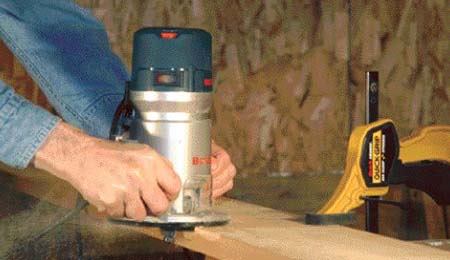
For this article, I tried pro-grade fixed-base routers from Bosch, DeWalt, Makita, Milwaukee, and Porter-Cable. The motors for these tools can be removed and used in multiple bases, so I also checked out D-handle and plunge versions.
Power
Unlike most power tools, routers are still rated by horsepower (hp). But they’re also rated by amps. Until recently, the average fixed-base router had a 1 1/2- or 1 3/4-hp motor. Most of the newer models have 21/4-hp motors. To me, routers between 1 1/2 and 2 1/4 hp are midsize tools. Anything over 3 hp is big.
The difference between 1 3/4 and 2 1/4 hp sounds more significant than it is. If you compare the tools by amp rating, you’re looking at the difference between 11 amps and 12 amps. When I used the routers, the 2 1/4-hp models did not feel significantly more powerful than the 1 3/4-hp tools. And it wouldn’t have mattered to me if they did, because 1 3/4 hp is plenty of power for the vast majority of hand-held operations. This includes flush trimming, milling dados, and shaping and rabetting edges. I wouldn’t use a 1 3/4-hp machine to drive large cope and stick bits, but that’s an amateur woodworking operation, not something most tradespeople ever do.
I also tried a couple of big 15-amp routers from Porter-Cable and Milwaukee. Both tools are significantly more powerful than 11- and 12-amp models. Milwaukee’s router is brand new, but Porter-Cable’s Speedmatic has been around forever. Anyone who has worked in a cabinet shop has probably seen a 15-amp Speedmatic mounted in a table and used like a shaper. This machine has the power and durability to do production milling, but it’s heavy and hard to use by hand. That said, big routers are the tools of choice for tough jobs like fabricating solid-surface material. The Speedmatic used to be the only game in town, but Milwaukee’s 15-amp router is a legitimate contender. It has an array of features that includes interchangeable grips and a knob-controlled height adjuster.
Size and Weight
In general, I prefer smaller, lighter tools because they’re more maneuverable and easier to lift than big, heavy ones. But size and weight are not as critical for routers as they are for tools like recip saws and drill-drivers. Most routing is done on flat, stable surfaces. A router is not the kind of tool that you operate from the top of a stepladder or while hanging off the side of a building.
Most of the tools I tested weigh between 8 and 9 pounds with the standard fixed base. They’re a pound or two heavier with a D-handle or plunge base.
Speed Control
One of the most significant developments in router design has been the introduction of variable-speed controls. Plunge routers have been available with this feature for years, but it’s kind of new for fixed-base models.
The main reason to vary the speed is to slow the motor down to safely run oversized bits. Typically, oversized is anything over 1 1/8 inches in diameter. That may not sound very big, but I own 100-plus bits, and only a few are larger than that. Most oversized bits are designed for woodworking and furniture making. The only ones I’ve ever used on site are a 3/4-inch roundover and a 1 1/8-inch bearing-over flush-trimming bit. I own two variable-speed routers, and I almost never use them at less than top speed.
Most of the tools I tested are available with either fixed or variable-speed controls. In most cases, variable-speed versions have slightly higher power ratings. Milwaukee’s 1 3/4-hp BodyGrip router is available only as a single-speed tool, but the manufacturer will soon introduce a 2 1/4-hp variable-speed version.
Soft-start. The best thing about variable-speed routers is that they come with soft-start. This feature causes them to accelerate smoothly to their final speed. Without this feature, starting torque causes routers to jerk when you turn them on. Think of it as the difference between accelerating a truck slowly and gunning the engine and popping it into gear. Soft-start reduces the starting torque so that you hardly notice it. This makes it easier to control the router and reduces wear and tear on the motor.
The strength of the jolt is related to the weight of the motor and the size of the bit. In my experience, starting torque is a minor issue for 11- and 12-amp routers. It shouldn’t pose a safety problem as long as you have a good grip on the machine. But it’s a serious issue for larger tools. I’ve used a lot of 15-amp routers that don’t have soft-start, and hanging on to them can be like wrestling an alligator. It wasn’t a problem with the 15-amp routers I tested because they both have this feature.
Most of the tools I tested are available as single-speed or variable-speed models. I wouldn’t go out of my way to get variable-speed, but I would insist on soft-start.
Depth Control
Plunge routers aren’t necessarily popular because they plunge but because they have superior depth-control mechanisms. The best thing about the current crop of fixed-base routers is how much easier it is to make fine adjustments to depth.
With the Makita and Porter-Cable routers, bits are raised and lowered by releasing a lever-activated clamp and twisting the motor within the base. It’s a straightforward way to adjust depth of cut, but there are a couple of problems. The motor won’t stay in place on its own when the clamp is loose, so you have to hold it in position while you refasten the clamp. Another problem is that turning the motor changes the position of the cord and the switch. The cord is more likely to get in the way and you may have to hunt for the switch.
Porter-Cable updated its venerable 690 router by increasing horsepower and giving it variable-speed controls and a lever-activated base clamp. |
DeWalt’s router looks like it should work the same way as the Makita and Porter-Cable, but the motor actually moves straight up and down. You change settings by releasing a lever and turning a large depth-adjuster ring. An adjustable scale indicates how far the bit will move when you turn the ring. The scale is graduated to 1/64 inch, but the marks are widely spaced and easy to read. Porter-Cable’s scale is similar to DeWalt’s and is just as easy to read and use. Makita has a scale, but it’s hard to read because it’s entirely black.
DeWalt’s motor looks like it should twist within the base, but it actually moves straight up and down. You move it by releasing the clamp and turning the depth-adjuster ring that’s just above the yellow scale. |
The mechanisms on the Bosch and the Milwaukee are similar to those on some plunge routers. Both tools rely on lever-activated clamps and knob-operated lifting screws. Turning the knobs raises and lowers the motor with a high degree of precision and control. You can jiggle these tools when the clamp is loose, and it will not affect the depth setting.
The knob-activated screw on Milwaukee’s routers makes it easy to make fine adjustments to the depth of cut. A spring-loaded release on the base allows you to quickly remove and install the motor. |
Milwaukee’s motor is raised by turning a stout, coarsely threaded screw. You can use a knob to turn the screw from above, or you can use a 3/8-inch socket to access it through a hole in the base. This makes it easy to use the tool in a router table because you can adjust the depth of cut from above the table.
Bosch relies on a dual-action mechanism. Big adjustments are made using a spring-loaded dog to engage slots in the motor housing. Fine adjustments are made by turning a knob on a tightly threaded screw.
Bosch routers use a spring-loaded dog to make big changes and a knob-activated screw to make fine adjustments to the depth of cut. |
The Bosch and Milwaukee tools have scales to show how far the bit moves when you turn the knobs. The scales are clearly marked and allow you to make adjustments that are finer than you can measure with a machinist’s ruler. For example, a dollar bill is about 1/100 inch thick, and the Bosch scale is graduated to 1/256 inch.
Ergonomics
Most routers have the same knob-shaped grips they had 100 years ago, when a router was a hand-held plane. Makita and Bosch still use turned wooden knobs, and Porter-Cable uses hard shiny plastic. DeWalt and Milwaukee use molded plastic with a textured surface. I prefer the molded grips because they’re more comfortable to grasp and the texture makes them easier to hold on to.
Ideally, the on/off switch would be right on the grip, but it’s on the motor of fixed-base routers because the motor comes out of the base. Some fixed-base routers have rocker switches, and others have toggles. It doesn’t matter what kind it is as long as it’s easy to reach. In most cases, reaching the switch from the grip is a stretch. But it’s especially difficult with the Porter-Cable and Makita tools. Porter-Cable’s motor rotates in the base, so the switch is always in a different place. Makita’s switch is on top of the motor, where it’s easy to find but impossible to reach from the grip.
Milwaukee’s 13/4-hp router has a unique molded surface and a Velcro strap on the side of the base. If you grab the side of the housing and cinch down on the strap, it’s like you’re wearing the tool on your hand. The strap makes it easier to rout one-handed because you’re less likely to drop the tool.
The unique molded housing and Velcro strap on Milwaukee’s BodyGrip router allow you to fasten the tool to your hand for one-handed use. |
Changing Bits
Spindle locks allow you to operate the collet with a single wrench. This is a good feature to have on a plunge router, because it’s hard to get a pair of wrenches between the plunge legs. DeWalt put a spindle lock on its variable-speed model, which is nice when you use the plunge base. But it doesn’t add utility to the standard model because it’s easier to use two wrenches when the motor is out of the base.
Most motors are easy to remove. The Makita and Porter-Cable motors spin right out of the base. DeWalt’s motor is held in place by a pair of spring-loaded latches and Milwaukee’s by a spring-loaded release that engages the lifting screw. The Bosch motor is somewhat difficult to remove because it fits snugly within the base and must be twisted during the last inch of travel.
All the routers I tested come with 1/4-inch and 1/2-inch collets except Porter-Cable’s 15-amp model, which comes with only a 1/2-inch collet.
Auxiliary Bases
A removable motor makes it easier to change bits and allows you to use multiple bases. You can use more than one kind of base, or you can leave one in a table and save one for freehand use. Most fixed-base routers are sold individually or in kits with a standard base, plunge base, motor, and case. It’s cheaper than buying two machines, and the kits usually cost less than dedicated plunge routers.
Plunge bases. A plunge base is a handy accessory for tasks like mortising door and cabinet hardware. But if you do a lot of plunge work, it’s better to buy a dedicated model because it will be available with a sophisticated depth-control mechanism and a grip-mounted switch. Every company except Milwaukee makes an auxiliary plunge base.
Makita’s base looks like a modified version of Porter-Cable’s. Both have a self-activating plunge lock and a nut that limits the upward travel of the motor. Both bases plunge smoothly, but the return spring on Porter-Cable’s rasps in the housing.
The Bosch and DeWalt plunge bases are much more refined. Bosch’s base has comfortable T-shaped grips, a smooth plunge action, and a self-activating plunge lock. There’s a fine-adjuster screw on the bottom of the depth-stop rod, but it’s stiff and hard to turn.
DeWalt’s plunge base is the best of the bunch. It has a manually activated plunge lock and smooth plunge action. The simple depth-stop rod fits firmly in the base and is equipped with a fine-adjustment screw that’s easy to turn. This base also has integral dust collection. Chips can be extracted through the base and up through an oversized plunge leg.
The fine-adjustment screw on the depth-stop rod makes DeWalt’s auxiliary plunge base easier to use than others. |
D-handle base. A D-handle router has a circular-sawstyle handle in back and a knob-shaped grip on the front. A trigger-style switch allows you to activate the motor without shifting your grip. This type of router is a specialty tool, great for routing edges but awkward for other applications.
D-grip models have a short cord between the motor and the grip and a power cord that comes out the bottom of the grip. This means you can’t typically use a standard motor in a D-handle base because the motor cord will be too long. But that’s not the case with DeWalt’s router, which comes with detachable cords. This allows you to use the same motor in any base and makes it easier to replace a damaged cord.
There’s nothing unusual about any of the D-handle bases. They all have locking triggers and forward grips that can be removed and repositioned for left- or right-hand use.
Sub-Bases
Fixed-base routers can usually be fitted with a variety of sub-bases. Most routers take Porter-Cablestyle bushings, and for that, they need a sub-base with a small center hole. If you want to use large-diameter bits, you’ll need one with a large center hole. Bosch’s router comes with a single sub-base with a 2-inch hole. Bushings are held in place by a separate guide adaptor. The DeWalt and Makita routers come with two sub-bases, one for bushings and one with a larger hole. The Porter-Cable and Milwaukee tools each come with a single base.
For large-diameter bits, you need a sub-base with a big center hole. DeWalt uses clear plastic sub-bases to make it easier to see the work. |
Alignment systems. A few years back, Bosch introduced a system for adjusting the sub-base to make it perfectly concentric with the collet. The idea is to boost precision when you use a bushing or run the base against a fence. DeWalt recently introduced a similar system. Both systems rely on cone-shaped centering devices that you attach to the collet of the machine. DeWalt’s device comes with the router; the Bosch device costs extra.
To use Porter-Cablestyle bushings, you need a sub-base with a small center hole. |
Personally, I wouldn’t go out of my way to get this feature. I’ve never used a router where the base was off enough to cause problems. And if the sub-base is designed to be adjusted, then you can’t put it on properly without using the alignment device.
Favorites
Every one of the routers I tested is a smooth-running, solid machine. But if I had to buy a midsize router today, I’d probably get the Bosch or the Milwaukee. I like Bosch’s tool because the depth-control mechanism is extremely precise as well as quick and easy to use. The standard sub-base has a large center hole, and there’s no need to swap to a smaller size, because bushings attach with a snap-in holder. I like Milwaukee’s router because the depth- control mechanism is on par with Bosch’s and the motor can be removed with the push of a button. Plus, the molded gripping surface and the strap make the Milwaukee tool easy to use one-handed.
I also like DeWalt’s router. The depth-control mechanism is simple and precise, and the motor is nearly as easy to remove as Milwaukee’s. It’s not my favorite stand-alone machine, but I like the kit version because DeWalt’s plunge base is better than the competition’s.
If I were in the market for a big, 15-amp router, I’d pick the Milwaukee for hand-held use and the Porter-Cable for table use. The Milwaukee is relatively light and is equipped with user-friendly features like a lever-activated base clamp, a screw-driven height adjuster, and a quick-release motor. The Porter-Cable is a big, heavy machine with somewhat dated features. But it has a track record of being able to stand up under continuous heavy-duty use.