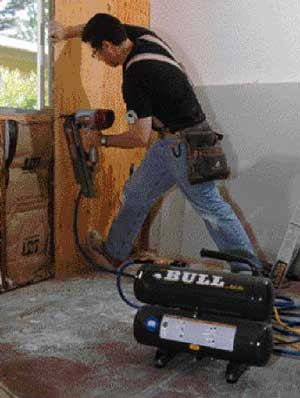
An air compressor isn’t the first tool people notice when they come on site. If you’re like me, you try to put it out of the way so you don’t have to listen to it. I might not see my compressor all day long, yet it’s one of the most important pieces of equipment I own. I work for a remodeling company and do everything from demolition to painting. Most of the work takes place in existing buildings so I only frame the occasional partition wall or shear panel. However, my compressor still gets a lot of use. It powers a finish gun, palm nailer, and framing gun. It drives the air hammer I use to chip out tile, an HVLP sprayer, and a gun and hopper for texturing drywall.
Some of these tasks will strain a small compressor, but it would be overkill to haul around the kind of unit a framing crew would use. A two to three horsepower four-gallon model is a reasonably good compromise; it’s small enough to fit in a crowded truck bed and light enough to lift alone.
Compressors come in all shapes and sizes. Some have a single “hotdog” or “pancake” shaped tank. Others have one big tank or a pair of cylindrical tanks. It’s impractical to review more than a small fraction of the available models, so for this article we tested ten twin stacked-tank compressors. We chose this type because every company makes them and they’re traditionally the type of unit a small crew would use. I also wanted to see if there was any difference between oil and oil-less models, so I tried some of each.
Testing Method
Compressor technology has changed little over the years. An electric motor drives a pump that pushes air into a storage tank. An automatic sensor turns the motor on when the pressure is low and off when it’s high. The air leaves the tank, passes through a pressure regulator, and is fed to the tools through fittings.
The tools were tested over a period of several months. I took them on site and used them for whatever I was working on. I also loaned them to the carpenters I work with and got their opinions. Near the end, we gathered the compressors in one place to measure sound output and recovery time.
All ten compressors ran my pneumatics effectively but some were more pleasant to use than others. The biggest difference between models had to do with portability, noise output, and how the components were positioned.
Motor and Pump
All of these compressors use an electric motor to drive the pump. The pump contains a cylinder and crank-driven piston. The piston produces heat and friction, so pumps have traditionally been lubricated with an oil bath. Most compressors still use oil, but some models do not. An oil-less compressor contains “self lubricating” piston rings. The rings are impregnated with Teflon or a similar material, which reduces friction to the point where oil is not needed.
Oil vs. Oil-less. There is a lot of debate about which type of compressor is better. I prefer to think of this in terms of what type of compressor is better for the kind of work you do. Oil lubricated pumps are very durable and can withstand eight to ten years of nearly continuous use. However, they won’t last nearly as long if they aren’t properly used and maintained.
Unless the manufacturer says otherwise, oil-lube compressors should be operated on no more than a 10-degree slope. If the angle is steeper the oil runs to the side of the crank housing and will not splash onto the piston.
Under normal circumstances oil-less compressor pumps will not last as long as the pumps on oil lubricated models. That said, I own an oil-less compressor and it’s going strong after five years of regular use. It requires less maintenance because there’s no oil to check or change. I feel better using it around finished surfaces because there’s no oil to drip or spill. It’s not a concern where I work, but oil-less compressors are easier to start in freezing weather because there’s no oil to thicken in the cold.
However, an oil-less unit is more vulnerable to contaminants because the bottom end of the cylinder is open to the air. This type of compressor is not the best choice if you expect to use it out in the dirt or on a really dusty job site. At minimum, place it on a clean solid surface, not on a pile of sand.
According to the manufacturer, the Renegade T-200ST is less vulnerable to contaminants because it has a dirt deflector. We removed the housings from the oil-less units and examined what was inside. The deflector looks like an improvement, but it’s impossible to believe it’s as protective as the fully enclosed housing on an oil-lube machine.
Noise output. I often work in the same room with the compressor, so it’s aggravating to use one that makes a lot of noise. To my ears Makita’s MAC2400 and Campbell Hausfeld’s Maxus EX8001 were noticeably quieter than the others.
We used a digital decibel meter to verify my observations. All ten compressors were tested in the same location and metered from 6 feet away. As you might expect, they were the loudest as they strained to put in the last few pounds of pressure. The results are in the spec table and are in line with how the tools sounded to me. It’s hard to detect a difference of two or three decibels, but you can definitely hear a difference of five to ten decibels.
Some carpenters claim oil-less compressors are noisier than oil-lube models. I don’t think this is true, at least not when the tools are new. We tested three oil-less models and the specs were all over the place. The Ridgid was the loudest tool of all but the Maxus was quieter than every oil-lube compressor except Makita’s. The Renegade was in the middle of the pack.
The type of pump may have something to do with sound output, but what really counts is how fast you run it. The motors on most of these tools run at or above 3400 rpm. Three of the four quietest models have motors that run at or below 1725 rpm.
Capacity
Air delivery is the volume of air that can be delivered at a specific pressure. You can use this spec to calculate how many tools a compressor can handle, but a good rule of thumb for these models is that they’ll run two finish guns or one framing gun, provided you’re not nailing vast areas of sheathing.
According to the manufacturers, a compressor is too small for the job if it has to run more than 50% of the time. The motor and pump will be damaged if you overheat them, which will happen if you run them more than 30 minutes out of each hour.
Air reserve. The tank contains a reserve of compressed air that allows you to use air tools when the pump is not running and, for a short time, to consume more air than the pump produces. If you do it for long, the tank pressure will fall to the point where air tools no longer work. All you can do is stop and wait for the pump to replenish the tank.
The bigger the tank and the higher the pressure, the greater the reserve. The old standard for stacked tank units was 4 gallons at 125 psi. Many of these compressors hold a greater volume at higher pressure. As a result, they don’t have to cycle quite as often.
You can boost the reserve by putting a portable air tank in series between the compressor and tool. I do this when I use an HVLP sprayer or a drywall texturing gun. It’s not a perfect solution, but it allows me to do more work before I have to stop to let the compressor catch up.
Recovery time. The compressor motor automatically comes on when the pressure falls below a preset “cut in,” typically between 90 and 100 psi. The motor turns off when it reaches the “cut out,” the maximum pressure rating of the machine. The amount of time it takes to go from cut in to cut out is referred to as “recovery time.”
We used a stopwatch to measure the recovery time of each compressor (See the spec table below). On average, the tools took 14 seconds to recover. I expected there to be a correlation between air delivery and recovery time, but it didn’t show up in the specs because there were too many other things in play. The tools have different size tanks, different maximum pressure settings, and different cut-in points.
Hand-Carry Compressor Specs | ||||||
| Pump type | Weight (lb.) | Size in inches (w x l x h) | Amps | RPM | Loud-ness (db) | |
| Bostitch CAP2045ST-OL | oil | 71 | 19x21x21.5 | 13.5 | 3450 | 86 |
| DeWalt DW55152 | oil | 69 | 17.5x18x16.5 | 14.0 | 3400 | 83 |
| Hitachi EC119 | oil | 67 | 18x20x15 | 15.0 | 3450 | 85 |
| Makita MAC2400 | oil | 76 | 18.5x19x17.5 | 12.3 | 1720 | 75 |
| Porter-Cable CPLD2540S | oil | 69 | 18.5x19x16 | 12.0 | 3450 | 85 |
| Rol-Air FC2002 | oil | 60 | 14.5x20x16.5 | 14.0 | 3450 | 86 |
| Senco PC2001 | oil | 59 | 14.5×20.5×14.5 | 14.0 | 3450 | 84 |
| Campbell Hausfeld Maxus EX8001 | oil-less | 65 | 17x19x16 | 13.0 | 1725 | 78 |
| Ridgid OF45150 | oil-less | 67 | 19x21x18.5 | 14.0 | 3450 | 88 |
| Thomas T-200ST Renegade Pro Series | oil-less | 66 | 14.5x19x16.5 | 13.0 | 1700 | 83 |
Hand-Carry Compressor Specs (continued) | ||||||
| Tank size (gal.) | Max. Press. (psi) | CFM | Recovery Time (sec.) | Number of air fittings | Street price | |
| Bostitch CAP2045ST-OL | 4.5 | 125 | 4.1 @ 90 psi | 15 | 2 | $349 |
| DeWalt DW55152 | 4.0 | 130 | 4.0 @ 90 psi | 12 | 2 | $299 |
| Hitachi EC119 | 4.0 | 125 | 4.4 @ 90 psi | 13 | 2* | $299 |
| Makita MAC2400 | 4.2 | 130 | 4.2 @ 90 psi | 20 | 2 | $299 |
| Porter-Cable CPLD2540S | 4.3 | 150 | 4.0 @ 90 psi | 14 | 2 | $289 |
| Rol-Air FC2002 | 4.3 | 125 | 4.1 @ 100 psi | 17 | 1 | $225 |
| Senco PC2001 | 4.3 | 125 | 4.3 @ 100 psi | 14 | 1 | $329 |
| Campbell Hausfeld Maxus EX8001 | 4.0 | 125 | 4.3 @ 90 psi | 12 | 1 | $295 |
| Ridgid OF45150 | 4.5 | 150 | 6.2 @ 90 psi | 11 | 2 | $259 |
| Thomas T-200ST Renegade Pro Series | 4.0 | 135 | 4.6 @ 100 psi | 12 | 1 | $349 |
*Has space for two fittings. Air fittings supplied by owner. | ||||||
Ease of Use
Until recently, the major components were bolted to a frame and the gauges, regulators, and hose fittings were installed like so much extra plumbing. These days the components are likely to be more integrated. Just over half of these tools had roll-cage-style frames and integrated instrument panels. The frame increases size and weight but it protects the components from damage. The panel also serves a protective function and makes it easier to access gauges, regulators, and fittings.
Hitachi’s EC 119 and DeWalt’s D55152 keep an especially low profile. The integrated panels are tucked between the tanks and angled upward so you don’t have to bend as far to read the gauges. About half of the compressors come with two air fittings — it’s much more convenient than using a splitter.
Mobility. A compressor is easier to move if it’s light and has a well-designed handle. It’s simpler to store and transport if it’s small and compact. If the compressor has a low center of gravity, it’s less likely to fall over when you hit the brakes in your vehicle.
There’s a 17-pound weight difference between the lightest and heaviest compressor; the average is about 66 pounds. Senco and Rol-Air produce the lightest units, Bostitch and Makita the heaviest. Thomas makes the most compact compressor. I had no trouble hauling it on the passenger-side floor of my compact truck. The Senco and Rol-Air are also quite small, while the Bostitch and Ridgid are on the large side.
Handles have a lot to do with whether or not the tool is easy to lift. I like straight handles better than canted ones. All of the handles were easy to grasp except for Makita’s, which in spite of its fancy rubber grip felt uncomfortable. Lifting any of these tools into my truck bed was a two-handed job.
Drain valves. Air tanks should be drained at the end of the day; otherwise condensation will build up and rust them out. More than once I’ve had to use pliers to open the conventional petcocks on old compressors. The ball valve drains on the DeWalt, Hitachi, and Makita units are a real step up. They operate smoothly and can be open or closed with a quarter turn. The other models have conventional valves, except for the Bostitch, which uses a strange spring-loaded fitting.
Air filter. The filter is designed to keep contaminants from entering the compressor and causing undue wear on the pump. Every one of these machines is equipped with a filter, but in several cases it’s hanging out where it can get bashed.
It’s much better if the filter is safely tucked away. In most cases, the filter is placed where it would be hard to hit. The filter on the Bostitch compressor, however, projects beyond the roll cage — an accident waiting to happen. The filter on Makita’s compressor is outside, too, but is somewhat more secure because it’s held on with a wing nut. Thomas and Hitachi removed the issue altogether by mounting their filters under rigid screw-down covers. They’re so well integrated you hardly notice they’re there.
Favorites
When space is at a premium and easy mobility is a must, I’d go for the Thomas Renegade Pro-Series T-200ST. This oil-less unit is of average weight but is the most compact and delivers more air than all but one of the compressors I tested.
In terms of features, I really liked the Hitachi EC 119. It has a low, stable profile, space for two air fittings, ball valve petcocks, a cord wrap, and a large comfortable handle. I also liked DeWalt’s DW55152. It has a ball valve petcock and a cord wrap, and it is relatively compact with all the components covered by a housing or tucked inside the protective roll cage.
This is the largest, heaviest compressor I tested. The filter hangs past the frame where it could get bashed. It’s equipped with a pair of strange spring-loaded drain fittings. The fittings are self closing so to drain the tanks you have to stand there and hold them open. The cables that hang from the fittings could easily get hung up on things.Stanley Fastening Systems L.P. 800/556-6696 | |
The Maxus is the second quietest compressor tested. It’s of average weight but the well-placed handle makes it easy to haul around. The motor and oil-less pump ran very smoothly and are protected by a rear roll bar. The gauges are easy to see because they face straight up. Campbell Hausfeld 888/247-6937 | |
The ball valve petcock on this compressor is tucked away where it can’t be damaged and is the best of the bunch. This tool has dual air fittings and a cord wrap for on-board cord storage. A low profile design means it’s stable in the back of the truck, while the frame offers many convenient grab points. DeWalt Industrial Tool 800/433-9258 www.dewalt.com | |
This all new compressor was one of my favorites. It has a smooth running motor, a low center of gravity, an onboard cord wrap, and the best handle of any model. The ball valve petcocks are easy to turn and very accessible on the ends of the tanks. The exposed location of the valves may subject them to damage but the integrated air filter is well tucked away. The EC 119 accepts two air fittings, but you have to supply them yourself. Hitachi Power Tools 800/829-4752 www.hitachi.com/powertools | |
The MAC2400 hit the mark in terms of noise and power consumption. It’s without question the quietest compressor I tested and draws only 12.3 amps. A transparent drain plug allows you to check the oil level without using the dipstick. You can store a hose in the roomy open interior. On the downside, this tool is somewhat bulky, and the skid plate sometimes rattled when the pump was on. Makita USA 800/462-5482 www.makitatools.com | |
One of two 150 psi models I tested, the CPLDC2540S is a large but manageable compressor with a well placed handle. It has dual air fittings and all the parts are tucked within a metal roll cage and a recessed instrument panel. This compressor draws only 12 amps. Porter-Cable 800/487-8665 www.portercable.com | |
This 150 psi oil-less compressor has bigger tanks and higher air delivery specs than any model tested. The OF45150 has good grab points for carrying but is bulky and heavy. It’s also one of the louder units. The high center of balance meant it was not very stable in the bed of my truck. Ridge Tool Company 866/539-1710 www.ridgid.com | |
The Bull is light and small, so it’s easy to carry one-handed. The only unusual features on this tool are the stainless steel petcocks. This is a basic inexpensive compressor, though the manufacturer also produces a similar model (D2000HSSV5) with a higher quality pump. Associate Engineering Corporation 920/349-3281 www.rolair.net | |
The PC2001 is very compact, has a comfortably positioned handle, and is the lightest compressor I tested. The gauges face upwards so they’re easy to read. It’s about average in terms of performance and features. It closely resembles the Rol-Air model but is equipped with a higher quality pump. Senco Products Inc. 800/543-4596 www.senco.com | |
This small oil-less compressor is my personal favorite. Everything about it looks and feels well made. The motor and pump put out more air than all but one of the other tools, and it has a quick 12-second recovery time. The filter is built into the head, so it’s totally protected. Thomas Industries Inc. 502/893-4600 www.thomasind.com | |
Victor Rasilla is a lead carpenter for Sattler’s Construction in Walnut Creek, Calif.