CONTENTS:
Carpentry is Going to the Dawgs
Router Innovations
Within the last year, manufacturers have come up with several new and different routers. I checked out three very different designs, and each has at least one innovation that makes it a potential problem solver.
Bosch 1619EVS Plunge Router
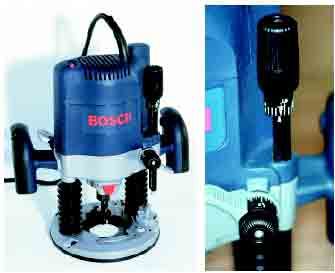
Most carpenters who buy 15-amp plunge routers plan to use them in and out of a router table. The problem is most plunge routers are better suited for one task than they are for the other. The Bosch 1619EVS, however, works equally well in and out of a table. Its most unique feature is a mechanism that allows you to override the lift springs and plunge lock. This makes it easier to use in a table because it means you don’t have to lift against the springs.
As with any table-mounted router, the bit is raised and lowered by turning a depth-control knob. The knob is attached to a threaded rod that connects to the base of the router. With most tools, big changes are time consuming because you have to turn the knob a lot of times. Bosch got around this problem by running the rod through a quick-release mechanism that allows you to make coarse adjustments fast and easy.
A depth-control knob usually makes it harder to work in plunge mode because you have to back it off to slide the motor up and down. But it’s not a problem with the Bosch router because the threaded rod can be disengaged from the base. Once it’s free, the router can move up and down, and the rod functions as a depth stop. A rack-and-pinion mechanism is used for big adjustments, and a fine adjustment knob is used for small ones. The indicator ring on the knob is graduated in 64ths of an inch, but if you split the marks, you can make changes half that size.
The 1619EVS draws 15 amps and is rated at 3 1/4 horsepower. It’s as powerful as any plunge router I’ve ever used. On one occasion I used it to drive a 1 1/4-inch pattern-cutting bit through 3/4-inch melamine, and the motor didn’t bog down.
This router has soft-start and a variable speed range between 8,000 and 21,000 rpm. Control circuitry maintains a constant speed by raising and lowering power input in response to the cutting load. You can’t see it, but you can hear and feel it happen.
The tool has padded grips with an integral trigger switch. The plunge lock is spring loaded, so you can’t forget to set it. At 13 1/2 pounds, it’s one of the heavier — though by no means the heaviest — plunge routers around. The base opening is 3 3/4 inches across, and maximum depth of plunge is just over 2 1/2 inches. The router retails for around $325 and comes with a bushing adapter, 1/4- and 1/2-inch collets, a wrench, a dust extraction hood, and an extension handle. If I were in the market for a big plunge router, the 1619EVS would be at or near the top of my list.
If you disengage the plunge lever, the Bosch 1619EVS allows you to make quick, coarse depth adjustments. Fine adjustments can be dialed to 64ths of an inch.
Milwaukee BodyGrip Router
For as long as I can remember, standard-base routers were frozen in time. New models always seemed to have plunge action. But in the last year or so, manufacturers have introduced a number of greatly improved standard-base models. Milwaukee’s BodyGrip router is certainly the most interesting one.
In addition to standard side-mount knobs, it has a molded grip and velcro-type strap that fastens the tool to your hand, like a camcorder does. The grip allows you to operate the tool one handed, which is the way a lot of us use routers. You can do this with other models, but it’s easier when the tool is strapped to your hand. And it’s safer because there’s no way you’re going to drop the machine.
Like that of most standard-base routers, the BodyGrip’s switch is high on the motor housing. But with the strap on, I could reach it with my thumb without losing my grip. The strap can be adjusted for left-hand use, but you won’t be able to reach the switch.
Another cool feature is the linear height-adjustment mechanism. It’s calibrated in 32nds of an inch, but you can easily adjust it in 64ths. You operate it by releasing a lock lever and turning a knob that’s attached to a threaded rod. This leaves one hand free so you can measure the height of the bit.
The BodyGrip works well in a table. A release button lets you pop the motor out of the base for bit changes. The router comes with a wrench that fits through the base to adjust bit height from above the table.
This router is a solid, powerful tool that’s rated at 1 3/4 horsepower and 11 amps. The single-speed motor spins at 24,000 rpm. It comes with 1/4- and 1/2-inch collets and a pair of wrenches for changing bits.
The standard sub-base accommodates bits up to 2 1/2 inches across, but you need to get an accessory base to use bushings. I tested the kit version of this tool, which comes in a plastic case and retails for around $175. Milwaukee also makes a D-handle version.
Milwaukee’s BodyGrip fixed-base router makes one-handed operation safer and easier (left). The depth adjustment on the BodyGrip is graduated by 32nds of an inch (right). Once the lock is released, depth is adjusted by turning the knob. You can use your other hand for measuring the bit.
Porter-Cable 9290 Cordless Router
Porter-Cable advertises its model 9290 as the world’s first cordless router. In reality, that distinction belongs to the 7.2-volt laminate trimmer that Makita sold in the 1980s. But it is fair to say that the 9290 is the first practical cordless router. If this tool looks familiar, it’s because it’s a cordless version of Porter-Cable’s venerable model 690. The motor-battery unit for this router is compatible with existing accessories such as Porter-Cable’s D-handle and plunging bases.
Using the 9290 is more or less the same as using a corded model. The single-speed motor runs at 23,000 rpm, which puts it in the same ballpark as corded models from Porter-Cable and Milwaukee. The motor is smooth and so quiet I could use it without ear protection, something I never do with other routers.
According to the manufacturer, you can put a 1/2-inch roundover on 100 feet of hardwood or 200 feet of softwood on a single charge. I wasn’t able to test this because a 1/2-inch roundover would not fit through the 1 3/16-inch hole in the base. The manufacturer does make a sub-base with a larger hole. But after using this tool with a number of smaller bits, Porter-Cable’s claim seems about right. The 9290 is powerful enough to perform common job-site tasks such as forming edges and cutting rabbets and dados. With a not-so-sharp bit in the collet, it managed to cut 1/4 x 3/4-inch dados in pine. But that seemed to be the limit of the tool’s power.
At 7 3/4 pounds, the 9290 weighs about the same as similar corded models. The on/off switch is designed to be somewhat hard to activate so you don’t accidentally turn it on while changing bits.
Although it’s very convenient to rout without a cord, I wouldn’t buy this tool unless I was already invested in Porter-Cable’s 19.2-volt system. Even then, the $289 price tag would be a major stumbling block unless I was totally committed to working cordless.
The 9290 comes in a plastic case with a charger, 19.2-volt battery, wrench, and 1/4-inch collet. It will accept an optional 1/2-inch collet and sub-base with a 2 1/2-inch hole.
Porter-Cable’s 9290 cordless router is based on the venerable 690 and has enough power to roundover 200 feet of pine on a charge.
David Franeis a finish carpenter and a contributing editor to The Journal of Light Construction
Manufacturers | |
Milwaukee Electric Tool Corporation Brookfield, Wisc. 800/729-3878 Porter-Cable Corporation Jackson, Tenn. 800/321-9443 S-B Power Tool Company Chicago, Ill. 877/267-2499 | |
Carpentry Is Going to the Dawgs
by Patrick McCombe Builders can get pretty creative when they have to work alone. Bruce Cameron needed a better way to take long vertical measurements by himself, so he invented the Dawg Stick (Camco Tool Inc., Manchester, Maine; 800/764-9499, http://camcotoolinc.com), a telescopic measuring stick with two sets of leveling vials. The vials give the tool its unusual versatility. The tool’s length can be adjusted to take inside measurements, or it makes a long and sturdy level. Bruce says his tool helps builders take accurate vertical measurements up to 10 feet, single handedly. The best part is that the measurements can be read at eye level, and because the device does double duty as a plumb stick, measurements are more accurate.
The Dawg Stick makes it easy to get accurate measurements without using a stepladder or a helper. Two sets of vertical and horizontal levels help maintain accuracy.
Construction
The Dawg Stick is constructed of two sections of rectangular aluminum tubing. One tube slides easily inside the other, without binding, and the tolerances are very tight; the appropriate length is held with a nylon thumbscrew. Two sets of break-resistant acrylic vials ensure that users get an accurate measurement and permit the Dawg Stick to be used for leveling, as well. The Dawg extends to 10 feet, creating a level that can really go the distance for gable walls and ganged windows. Because the measurements on the sides of the extrusion are on an applied tape, I was a little skeptical of their long-term durability. Bruce says that because of aluminum ridges on the measuring tape’s sides and a 1-mil clear overlay protecting them, the graduations should be readable for a long time.
Applications
The flexible length (5 feet 8 inches to 10 feet) allows the user to plumb doors and tall walls with the same tool. Leveling tasks like sills on wide or ganged windows and deck ledgers are easier with such a long level. I used it for installing wall angle for a drop ceiling and to get stud lengths for partitions in a remodeling project with more than a little rustic charm. The tool’s length allowed me to make reference marks easily for placing my wall angle, without constantly moving it. The floor’s undulations and the high ceilings normally would have meant the frustrating task of tape holding and reading. I simply extended the tool between my top and bottom plates and got a measurement I could read right at eye level, without a stepladder or helper.
This is the kind of tool that you find more uses for the more you use it. Measuring stud lengths for gable walls would be an ideal application, as would taking measurements for wood posts or steel lally columns. The tool makes an excellent grade-measuring rod, and because of the leveling vials, your helper probably won’t hold it at a 15-degree angle while you shoot an elevation. When completely collapsed, it makes a great straightedge for cutting panels or doing layout work. The Dawg Stick’s substantial length would help in keeping long cabinet runs straight and true.
The Dawg Stick comes in a nice nylon case and fit easily in the 6-foot bed of my truck. It weighs about 7 1/2 pounds; the T-5 aluminum alloy tube measures 1×2 inches. A Dawg Stick with a nylon case runs about $150.