
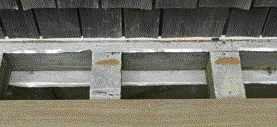
by Andrew Hutton We always protect pressure-treated deck (1) and stair framing (2) by flashing edges where water might collect and cause rot. This is vital here in the West, because the preservatives don’t penetrate very well into the hem-fir lumber used in this part of the country.
1
2 Several companies have recently released products designed for this purpose; probably the best known is Grace’s Vycor Deck Protector. For 10 years, though, we’ve been using Polyken 626-35 Foilastic, an aluminum-foil-faced adhesive tape from Tyco Adhesives (800/248-7659, www.tycoadhesives.com). Like other peel-and-stick membranes, it grabs well and self-seals around fasteners. It is also more resistant to UV rays than similar membranes (for up to a year in direct sun, according to the maker) and can be painted.
We put it on the top edges of deck joists, where fasteners are concentrated and water tends to sit. We also put it on the vertical cuts of stair stringers (3), where the notches go right to the untreated center of the material; merely painting the cuts with preservative can’t provide the same level of protection. Foilastic comes in 50-foot rolls in widths as narrow as 2 inches and as wide as 36 inches.
Andrew Hutton is a site supervisor for Moroso Construction in Pacifica, Calif.
Quick Brick Shelf
If you think this looks like an upside-down footing form, you’re right. A Colorado contractor used 28-inch Bigfoot forms (Bigfoot Systems, 800/934-0393, www.bigfootsystems.com) as quick and efficient support shelves for several large masonry-veneer porch columns. Rather than waste concrete forming wide piers all the way down to the footings, he relied on the Bigfoot’s flared shape to support the masonry; the 12-inch-diameter pier below will supply plenty of vertical strength. After the Sonotube and Bigfoot are filled, another column will be formed on top, leaving room for the masonry around the circumference. Note the footing in the bottom of the excavation. It was formed using a Fastbag form (Fab-Form Industries, 888/303-3278, www.fab-form.com), a single-use fabric bag that gets reinforced as needed and then filled with concrete. — David Frane


