Q. When we install vinyl flooring, we like to fasten the underlayment with staples because they install quickly and don’t need setting or filling afterwards. But occasionally we’ve noticed minor squeaking in some of our floors. Assuming that we’re using the correct number of fasteners, would we get better results with ring-shank nails?
A. Peggi Clouston, assistant professor of building materials and wood technology at the University of Massachusetts Amherst and a specialist in engineered wood products, material mechanics, and timber design, responds: Floor squeaks occur when the shank of a nail or staple rubs against the wood fiber surrounding it. Relative movement between the fastener and the underlayment — which can happen when someone walks across the floor — causes friction; the squeak you hear is the release of stored energy. If you can prevent the relative movement, you can prevent the squeak.
Ring-shank and spiral-shank nails are the best fasteners for this application because they are grooved to increase friction and resist withdrawal. In fact, studies at Clemson University in South Carolina have shown that these nails have as much as twice the holding capacity of smooth-shank nails and staples.
For maximum holding power, the length of the fasteners should be approximately equal to the total thickness of the subflooring and underlayment. This prevents the fasteners from punching holes through the subfloor that can cause the nails to loosen over time. To prevent shrinkage problems, which can also contribute to squeaks, the subfloor should be dry at the time of installation. Interestingly, the nailing pattern — though important for strength — should have no effect on the floor’s squeakiness, provided you follow guidelines for proper edge distances, end distances, and nail spacing.
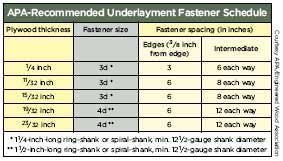
For best results under resilient flooring, sanded-face underlayment-rated plywood panels (or their equivalent) should be staggered at the joints, spaced 1/32 inch apart, and fastened according to the schedule above. Before installing floor covering, fill all seams and holes with quick-setting filler and sand smooth when fully cured.
For more information on the installation of plywood underlayment for resilient floor coverings, see APA Form No. L335L, available free online from the APA/Engineered Wood Association at www.apawood.org.