
- Q. The manufacturer of the glass tile my client chose for her shower recommends that it be installed with modified thinset mortar. But Schluter, maker of the Kerdi waterproofing membrane I typically use, specifies unmodified thinset mortar for both installing its membrane and setting tile. Does this mean that glass tile can’t be used with Kerdi waterproofing membrane?
A.Sean Gerolimatos, technical services manager for Schluter Systems, responds: Glass tile has some special characteristics that make installing it over Kerdi and other types of waterproofing membranes problematic. One concern is ghosting, where a mottled — rather than uniform — bond coat appears through the translucent or transparent glass (see photo). To avoid ghosting, some glass-tile manufacturers recommend skipping bonded waterproof membranes altogether and installing tiles over a substrate that can wick water away from the bond coat, such as cement backerboard or a traditional mortar bed.
Another issue is bond strength. For a variety of reasons, glass tiles are generally more difficult to bond to the substrate than ceramic or stone tiles. As a consequence, most glass-tile and setting-materials suppliers recommend that glass tile be installed with polymer-modified thinset mortar, which generally is stronger than unmodified thinset mortar. However, a polymer-modified thinset mortar must dry out to gain strength; sandwiching it between an impervious glass tile and a waterproof Kerdi membrane will slow down that process and may more than triple the mortar’s curing time, leading to polymer leaching and unpredictable results. An unmodified thinset mortar, by contrast, cures through portland-cement hydration and actually depends on the presence of moisture to gain its strength, making it better suited for use with the Kerdi membrane.
What this means is that Schluter can only warrant the Kerdi membrane itself, which must be installed with unmodified thinset mortar. If you choose to use modified thinset mortar to set glass tile over the membrane, you do so at your own risk and should confirm with the setting-materials manufacturer that its thinset mortar will gain strength and remain stable for each type of application (for example, a shower, steam shower, or tub surround). Also, since the mortar cures more slowly with large tiles than with small ones, be sure to give the technical representative details about the size of the tile.
Finally, before installing any glass tile in a shower, confirm with the manufacturer that its product is suitable for use in wet areas and can be installed directly over a bonded waterproofing membrane.
Glass Tile and Kerdi Membranes
2 MIN READ
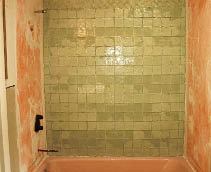
A mottled bond coat pattern may become visible through translucent or transparent glass tiles when they are installed over a waterproofing membrane.


