
If human scale is as essential to good design as architects say it is, the classic 1960s A-frame got it just right. You can confirm this by putting a ladder against an interior gable-end wall and climbing until your head is nestled snugly in the peak, as if you were wearing the structure like a dunce cap. Notice that your shoulders just fit the wider space below. It’s the perfect union of architectural theory, Pythagorean geometry, and musculoskeletal anatomy.
That was the good news about A-frames. The bad news was pretty much everything else. When it came to qualities like use of floor space, ease of heating and cooling, and availability of natural light, the best that could be said was that they were no worse than some geodesic domes. The images on this page — from architectural historian Chad Randl’s book A-frame (2004, Princeton Architectural Press) — trace the former leisure-time icon’s origins, maturity, and decline.
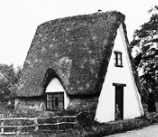
Until burned to the ground by high-spirited American airmen celebrating the end of World War II, this A-shaped cottage in Lincolnshire, England, was known to local residents as Teapot Hall. A former resident recalled her mother’s standard reply to sightseers who found its distinctive shape charming: “You wouldn’t think so if you had to live in it.”
By the early 1970s, growing desperation for verticality ushered in the modified A-frame, with its attractive “saddlebag dormers.” In an often-cited example of convergent evolution, A-frames would gradually develop sidewalls and flatter roof pitches, ultimately becoming undistinguishable from other gable-roofed structures.
The homeowner standing in the doorway of this proto-A-frame from rural Hungary appears to be gazing enviously in the direction of a neighboring house with walls.
“Come on down, honey, it’s almost time for The Man from U.N.C.L.E!” Protective A-frame helmets like the one worn by the woman on the balcony were briefly popular among vacationers weary of banging their heads on knotty-pine paneling.


