
I can remember sitting in trigonometry class in high school, thinking, “When am I ever going to use this?” But in fact, many construction problems can be solved by using basic math.
One of my recent projects, for example, featured a curved wall that needed crown molding. While made-to-order flexible crown is an option, in this case the match wasn’t perfect, and I needed only about 2 feet to finish the wall.
Not wanting to waste 10 feet of expensive custom crown (the minimum order was 12 feet), I decided to cut straight sections of crown into wedge-shaped segments and glue them together to form an arc that would fit the curved corner.
Calculating the Layout
First, I needed to determine the radius of the arc (or corner). With a long straightedge placed along each wall, I drew extension lines on the ceiling and measured the length from the starting point of the arc to the intersection point of the extension lines (see “Determining the Corner Radius,” ). Then I measured the distance from the intersection point of the extension lines to the corner.
With the help of Pythagoras’ very useful theorem (c2=a2+b2) and a little bit of geometry, I used these measurements to determine the arc’s chord length (x) and rise (y), which I needed for calculating the arc’s 9.47-inch radius.
Once I knew the radius of the arc formed by my curved corner, I could determine the exact size and shape of the wedge-shaped segments of crown molding. Each crown segment would need to be angled on each side to form the arc; the shorter the segments were, the more “rounded” the faceted crown would appear to be. I decided a workable length for each segment would be 3/4 inch each (as measured from short point to short point on the back of the crown).
To determine the cut angle for the sides of the crown segments, I drew another right triangle, with 9.47 (the length of the arc’s radius) representing the side adjacent to the central angle and half the length of the 3/4-inch-long crown segment representing the side opposite that angle (see “Cutting the Crown Segments,”).
Then I used the tangent function to find the angle, which I looked up in the trigonometry table in my handy Pocket Ref (by Thomas J. Glover; Sequoia Publishing), a great reference guide I found at my local hardware store. This angle measured a little over 2 degrees.
Determining the Corner RadiusTo make a section of curved crown for a rounded outside corner at the intersection of two perpendicular walls, the author first had to figure out the exact radius of the wall plane. He projected the 90-degree outside corner onto the ceiling, then used math to calculate the radius. |
Cutting the Crown SegmentAfter calculating the curved wall’s 9 1/2-inch radius, the author turned his attention to the crown segments, which he decided to make 3/4 inch long at the base. He used trigonometry to find the proper miter angles, then cut the segments to length and fastened them together with glue and brads. |
Putting Together the Pieces
Now it was time to make some sawdust. When cutting standard crown on a miter saw, the crown is always cut upside-down and backward, so I measured the 3/4-inch length of each segment along the base of the crown. I made the first (left-hand) cut and marked the crown’s length, then reset my saw for the right-hand cut.
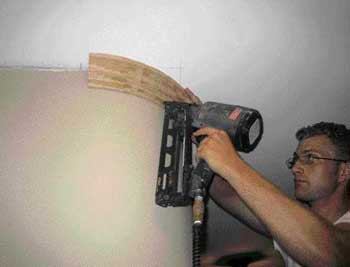
Once all the segments were cut out, I applied glue and fastened them together piece by piece, using 1-inch brads in my nailer. After the glue set up, I fastened the curved section of crown to the wall and finished installing the adjacent pieces of crown.
By using a paintable filler, MH Ready Patch (Zinsser Co., 732/469-8100, www.zinsser.com), and giving everything a good sanding, I was able to make the crown curving around the corner look as if it were carved from one piece (see photos, left).
The project took about 2 hours from start to finish.
Michael Sloggatt Jr. is a carpenter who works in Farmingdale, N.Y.


