- Q. On a recent house we built, cracking has occurred where nonbearing interior partitions join the ceiling. We used a wood truss roof system, and I’ve read that truss movement often causes this type of cracking. How do I correct this problem?
A.Jim Vogt, P.E., responds: According to the best available data, roof truss movement occurs in a very small number (approximately 20%) of reported cases of partition separation. This movement is typically caused by differences in the moisture content between the top and bottom chords of the truss. Other potential causes of partition separation include:
- Building settlement caused by undersized footings, shallow footings subjected to freeze/thaw cycles, and soil movement due to seasonally fluctuating moisture levels.
- Inconsistent framing, such as uneven stud lengths and irregular floor decks.
- Moisture-related effects. Framing members will shrink and swell with changes in humidity. This is particularly true for solid wood joists and studs manufactured from juvenile wood.
- Beam and joist deflection. When beams or floor joists aren’t stiff enough to support the applied loads, the resulting excessive deflection can contribute to partition separation.
Preventive action during construction is the best way to avoid costly repair work. Properly balanced attic ventilation helps prevent partition separation by exhausting moisture from the air in the attic space. Continuous eaves and ridge ventilation is most effective.
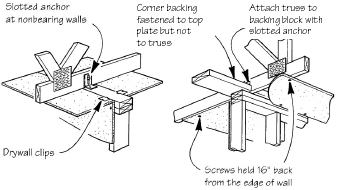
When appropriate, “floating corners” should also be used to minimize the possibility of cracking at wall and ceiling intersections (see illustration, above).Before jumping to conclusions, it’s important to investigate and determine the cause of partition separation problems. Use a transit or laser level to determine whether the floors, walls, or ceilings have moved.
Specific solutions should be handled on a case-by-case basis. In the majority of the cases, retrofitting floating corners with appropriate back-blocking solves the problem. Care should be taken to remove the fasteners attaching the wallboard ceiling to the trusses within 16 inches of the wall-ceiling corner.
A second possible solution is to install cove molding at the corner. Make sure to attach the molding through the ceiling to the trusses but not to the partition. This allows the partition to move independently of the molding; any gaps that occur between the partition and ceiling will be covered by the molding.
Jim Vogt, P.E., is a technical services representative at the Wood Truss Council of America.
Q&A: Ceiling Cracks With Trusses
Slab-on-Slab
2 MIN READ