- Q. What would cause the sole plate of a nonbearing partition wall to pull away from the subfloor? The wall is nailed into roof trusses where they cross it above. There is no sag in the floor system below.
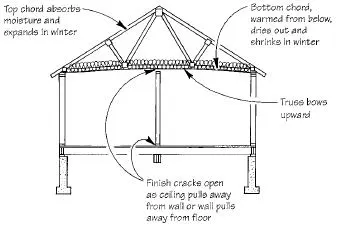
A.David Utterback responds: If your floor is framed with green lumber, shrinkage of the floor joists could contribute to the problem you describe. But the primary cause is probably truss uplift. Lower truss chords that touch the warm ceiling dry out and shrink during the heating season, while the cold upper chords gain moisture and expand. The whole truss then curves like a bow, rising at the center. If the truss is nailed to the wall, it pulls the wall with it. The moving truss can also create drywall finish cracks in the corners where walls and ceilings meet (see illustration, below).
Whether floor joist shrinkage or truss uplift is causing the problem, the way to prevent it is the same: Instead of nailing trusses to wall plates, use truss clips as shown in the photo below (available from Simpson Strong Tie, 4637 Chabot Dr., Suite 200, Pleasanton, CA 94588; 800/999-5099). The clips allow each truss to flex up and down freely, while preventing it from moving side to side Also, don’t screw the ceiling drywall to the truss where it passes over the partition. Instead, hold your screws 12 to 16 inches back from the partition and screw the edge of the ceiling drywall to 2-by nailer blocks that have been fastened to the wall top plate between the trusses. This gives the drywall enough room to flex at the joint and prevents a crack from forming.
We usually see these movement problems in the first couple of heating seasons. After that, the houses seem to settle down and the problems lessen. In any case, the wall should drop back down in the spring, so wait until then to fix the problem. Whatever you do, don’t shim under the wall during winter when the crack appears — if you do, when the roof settles back down in spring, you’ll have created a bearing situation in the center of the truss where there isn’t supposed to be one.
Dave Utterback is a district manager and code expert for Western Wood Products Association. Before joining WWPA, he was a contractor specializing in residential and commercial wood-frame construction.
Q&A: Truss Uplift Solutions
Truss Uplift Solutions
2 MIN READ