
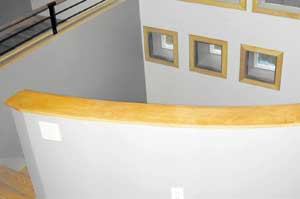
A recent whole-house remodeling project gave me and my crew the opportunity to use two different techniques for framing curved walls — one for an exterior wall and one for an interior wall.
Exterior Bulge
The plans called for a somewhat unconventional exterior curved bay. Instead of being a curved section of the exterior framing, the bay was really an applied decorative element, attached to the outside of the existing flat wall. The bulge was curved on the outside only; the interior side of the wall stayed straight. From the inside of the building, the only clues that the wall was unusual were the deep jambs on the three glass-block windows.
The curve was an arc with a 12-foot 8-inch radius that extended out from the plane of the wall about 10 inches at its deepest point. The architect thoughtfully designed the curved bay to be 96 inches long, measured along the arc, allowing it to be sheathed with full sheets of plywood running horizontally.
Although we could have framed the curved bulge by attaching vertical studs of varying depths to the existing sheathed 2×4 wall, I decided to install the new framing horizontally. We cut curved nailers out of 2x10s and mounted them horizontally on 16-inch centers. This provided great nailing for the sheathing.
Curved 2×10 nailers, cut on a band saw, define the exterior radius.
We drew the curves with a string and a pencil, working right on the subfloor. A jigsaw blade we tried was too light-duty for the cuts, so we ended up making the curved rips on a band saw.
We first attached 2×4 cleats to the 2×10 nailers, then nailed the cleats through the sheathing to the studs. We had no problem bending the 1/2-inch CDX plywood.
Because the curve is gentle, bending 1/2-inch plywood sheathing was easy.
To set off the curved bay from the main plane of the wall, we installed red cedar shingle siding with a shorter exposure than the cedar shingles on the rest of the house.
Sheet lead flashing over the window heads conformed easily to the curved jamb. (Although lead is easy to work with and makes a durable flashing, it is toxic. After handling lead, be sure to wash your hands before you reach for a donut.)
The architect proposed roofing the bay with a conical shingled roof or low-slope copper roofing, but the budget wouldn’t allow it. The rrofing we ended up with — a low-slope painted board — was not ideal.


