
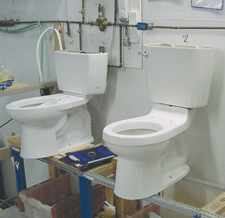
Although there’s nothing like the real thing, some imitations are better than others — especially when it comes to low-flow flush tests.
While previous toilet trials used sponges, plastic balls, and construction paper as test media, a recent study by Veritec Consulting and Koeller & Co. used extruded soybean paste and wads of toilet paper — arguably a more accurate replication of the real demands on a toilet. The researchers assessed more than 90 models that meet minimum certification requirements in the United States and Canada. The data is presented by flush type (gravity vs. pressure-assisted) and volume (1.6 gallons vs. 1.1 gallons), which makes the study particularly useful as a specifying tool for builders and remodelers. (The entire study, which is updated every four months, can be viewed at www.cuwcc.org/products_tech.lasso under “Maximum Performance Report.”)
| Toilet Trial Results | ||
Make | Model | Grams Flushed |
American Standard | Yorkville | 1,000 |
Mansfield | EcoQuantum-148 | 925 |
Mansfield | Quantum-148 | 925 |
Eljer | Titan | 900 |
Gerber | Ultra Flush | 900 |
Toto | Drake | 900 |
Foremost | Premier | 850 |
Mansfield | EcoQuantum-146 | 850 |
Mansfield | Quantum-146 | 850 |
Vitra | Corina | 850 |
| Maximum Performance Testing of Toilet Models: 4th edition May 2005 Appendix C | ||
Listed above are the top 10 performers of the 90-plus toilets tested, with gravity-fed models highlighted in orange. Each of these flushed more than 850 grams of the soy-based test media (above), exceeding the 250-gram threshold set by the researchers. The researchers focused specifically on flush capacity, and their performance threshold reflected a real average maximum fecal size. Those toilets that met that 250-gram threshold — meaning that they completely removed more than 250 grams of “waste” — passed the test. Results varied from 125 grams to 1,000 grams of waste successfully flushed in two out of three attempts.
More than 20 models didn’t achieve the threshold, suggesting that a certified toilet won’t necessarily meet consumer expectations. Still, many passed with flying colors. As is typical in this sort of toilet trial, the top performer was a pressure-assisted model. But, notably, the 10 highest scorers included four gravity-flush models, an indication that low-flow engineering has improved a lot since federal law mandated its use in 1994.
This is good news for builders shopping for less-expensive, reliable fixtures: You don’t have to choose the noisier pressure-assisted technology to guarantee a good flush.


