
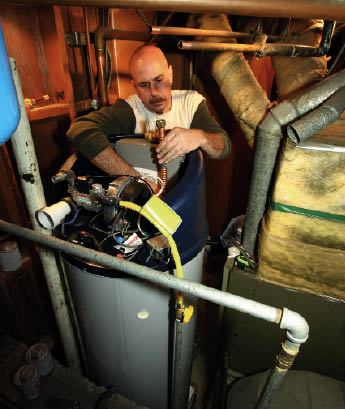
In my 30-plus years as a plumbing contractor, I’ve replaced countless water heaters. Our company, which works in the San Francisco Bay area, installs three basic kinds: conventional gas models, tankless models, and — increasingly — condensing storage heaters. Customers who want to save energy nearly always ask for a tankless water heater. That’s no surprise — tankless heaters have been getting a lot of media coverage and are the only efficient heaters most people have heard of.
In most cases, however, we recommend condensing storage heaters to our replacement customers, because they are arguably more efficient than tankless models and — when used to replace an existing heater — frequently less expensive to install. For homeowners, switching from a conventional heater to a condensing model is not a big change. If they consume the same amount of hot water as before, they’ll have lower gas bills and run out of hot water less often. Switching to a tankless heater, by contrast, requires some lifestyle adjustments: The homeowners will have to wait for the heater to produce hot water and they won’t be able to get it at very low flow rates (see “Is a Tankless Heater Right for the Job?”).
In this article, I’ll discuss condensing storage heaters and how they’re installed. Since natural gas is the primary fuel in our region, I’ll be describing gas-fired models, many of which can be field-converted for propane.
Is a Tankless Heater Right for the Job?When a customer asks us to replace a conventional water heater with an on-demand — or tankless — model, we often have to explain why a tankless unit may not be the right choice. In many cases we’ll steer the homeowner toward a condensing storage heater instead. Prominent among the selling points of tankless heaters are that they’re more efficient than conventional storage models and, within limits, able to produce an endless stream of hot water. However, the same can be said of condensing storage heaters. The unique advantage of tankless heaters is that they’re small enough to fit where storage models will not (see “Installing On-Demand Water Heaters,” 2/06). Efficiency ClaimsMuch of a tankless heater’s efficiency stems from the fact that it has no standby losses — no gas-consuming pilot light and no stored water losing heat through the walls of the tank. But its actual thermal efficiency (TE) is not all that high — typically around 82 percent. A number of companies have introduced condensing tankless heaters with TE ratings of up to 98 percent, but I won’t recommend these to clients until they’ve been around for a while and have proven to be reliable. The endless stream. The output of a tankless heater is rated in gallons per minute (gpm) of water at an assumed temperature rise of 77°F. However, advertised flow rates are frequently based on a 45°F temperature rise and may not be achievable — something we point out to customers. Installation DetailsAlthough tankless units may cost less than condensing storage heaters, installation costs can be a lot higher. This is particularly true in replacement jobs. Gas line. Tankless heaters have very large burners, so existing 1/2-inch gas lines will have to be replaced with 3/4- or 1-inch line. This could entail the last few feet of line or everything all the way back to the meter. Flues. Most tankless heaters require expensive Type III stainless steel vent pipe, which means existing flues cannot be reused in replacement jobs. In areas where the temperature doesn’t drop below freezing, it’s sometimes possible to eliminate the cost of the flue by installing the heater outside. OperationWhen a tankless heater’s flow sensor detects a demand for hot water, it activates a vent fan and a burner that heats water as it passes through a heat exchanger. The burner will not be activated at flows less than about 0.5 gpm, and once activated, it takes 5 to 10 seconds for the flow to go from cold to hot. If the drain is open, that several seconds of flow results in wasted water. A recirculation pump can reduce the amount of waste, but most recirculation systems are not directly compatible with tankless heaters. Cold-water sandwich. Cold water is introduced into the line every time the burner turns off — the so-called “cold-water sandwich.” To eliminate this slug of cold water, some plumbers may install a tempering tank — a small electric storage heater — downstream from the tankless unit. In my opinion, this is a poor solution because it wastes energy and adds to the cost of the system. MaintenanceThere is a filter screen on the supply side that prevents rust and sediment from clogging the passages in the heat exchanger. The screen should be cleaned and the heat exchanger flushed and delimed annually. |
How They Work
In several respects, a condensing storage heater is like a conventional model. Both burn gas, have exhaust flues, and store hot water in an insulated tank. But a condensing heater is much more efficient because of how heat is transferred to the water.
In a conventional heater, the fuel is burned in an open chamber, and hot combustion gas rises through a flue in the center of the tank. A lot of this heat is transferred to the water in the storage tank, but a good portion exits through the vent pipe and is wasted.
In a condensing heater, a draft-inducing fan pushes air and fuel into a sealed combustion chamber inside the tank. As the fuel burns, combustion gas is exhausted through a secondary heat exchanger — a coiled steel tube submerged inside the tank. The combustion chamber and heat exchanger have large surface areas to maximize heat transfer to the water. So much heat is transferred that the combustion gases cool to the point where the water vapor in the exhaust stream condenses, releasing its latent heat, which is also transferred to the stored water. By the time the exhaust gas leaves the heater, it’s cool enough to be safely vented through inexpensive plastic plumbing pipe. (Each manufacturer accepts different kinds of pipe; options include specified types of PVC, CPVC and ABS. All are far less expensive than stainless steel.)
The thermal efficiency (TE) of a condensing storage heater is quite high, typically between 90 and 96 percent. (For an explanation of thermal efficiency standards, see “Making Sense of Gas Water-Heater Ratings.”) Standby losses are low because the storage tanks are covered with thick foam insulation — plus these units all have electronic ignition, so there is no standing pilot.
Making Sense of Gas Water-Heater RatingsIn a perfect world, water heaters would be 100 percent efficient: Every Btu they consumed would be turned into hot water that was available for use. Of course, this never happens. Instead, heat is lost up the flue, and storage models contend with standby losses — which refers to the gas consumed by a pilot light (if there is one) and the heat lost through the jacket of the tank. Apples and oranges. Under federal law, different efficiency standards apply to different kinds of heaters. Storage heaters with inputs at or under 75,000 Btu and tankless models at or under 199,000 Btu are considered to be residential models and fall within the scope of the National Appliance Energy Conservation Act (NAECA), which requires heaters to be rated on the basis of energy factor (EF). Units with inputs greater than these are considered to be commercial units and fall under the Energy Policy Act (EPACT), which requires heaters to be rated on the basis of thermal efficiency (TE). It’s illegal for manufacturers to put TE ratings on a residential models or EF ratings on commercial ones. This presents a problem: EF and TE are so different that there is no way to use them to make an apples-to-apples comparison between residential and commercial models. Energy factor. The EF test is intended to rate the efficiency of the heater over the course of a typical day. The test assumes that the homeowner uses 64.3 gallons of hot water at a temperature rise of 77°F and that the water is consumed in six equal draws. The EF is derived by calculating the amount of thermal energy added to the water and dividing it by the energy used to heat it. Also, if a fuel-burning water heater uses electricity (to power a controller or fan), the electrical consumption is measured, converted to a Btu equivalent, and added to the input amount. The test is performed over a 24-hour period, so standby loss is automatically accounted for. EF is used to compute the projected annual operating cost listed on the yellow Energy Guide label found on new residential water heaters. A typical conventional storage heater has an EF of about .59. For a typical noncondensing tankless model the EF would be around .82. Thermal efficiency. TE refers to the ratio between the energy contained in delivered water and the energy consumed to heat it. It’s derived by measuring the flow of water the heater can heat to a 70°F temperature rise with the burner at full fire, calculating the amount of energy that was added to the water, and dividing it by the energy used to heat it. The result is expressed as a percentage and does not account for standby loss. Condensing storage models are between 90 and 96 percent thermally efficient. Standby loss. One of the descriptors for a commercial storage heater is standby loss, which for a gas model is expressed as the number of Btu lost per hour when the burner is not firing. Rarely listed on spec sheets, this number can be found in the Air-Conditioning, Heating, and Refrigeration Institute’s Directory of Certified Product Performance (ahridirectory.org). When comparing two heaters with the same TE, the one with the lower standby loss will be more “efficient” overall. — David Frane |


