
No Daddy With Deep Pockets
Regarding the ongoing debate over Hispanic labor in the market, here in my area of coastal South Carolina, I have tried for many years, through family, friends, and business contacts, to hire part-time unskilled labor. No experience necessary, just a body to tote material up the stairs, hold the other end of the board, and maybe learn something in the process.
The fact is the Anglo kids just aren’t dependable. They’d rather party than work. Hispanic workers, however, are dependable and honest, and the only problem is they’ll work in the heat way too long if you don’t tell them to take a break. They don’t have a mommy and daddy with deep pockets to feed them. They’re just happy to find a job.
These workers are filling an employment niche nobody else wants. Are they going to dominate the trades of the future? Probably, but who cares? When was the last time you heard of anybody — other than the children of builders — actively pursuing construction as a career choice after high school?
George Gritmon
Lonestar Home Improvement
Little River, S.C.
Help Wanted
How can we, as building craftsmen who are aging, encourage our society to bring back trade schools and a guildlike system to train the next generation? I haven’t found a young person who wants to work with his or her hands for the last 10 years; we need replacements.
D.W. Murphy
Yucca Valley, Calif.
Strong Hips
I appreciated the article “Building a Strong Cathedral Hip Roof” (11/04), by David West, which drove home the importance of resisting the outward thrust generated by sloping roof members without horizontal ties. After 25 years of structural engineering, I would say that in residential construction, roof behavior is by far the most misunderstood concept among contractors and framers. Without a vertical support at both ends of a sloping member, there are outward thrusting forces that must be considered. And collar ties near the top of rafters will not resist — and are not intended to resist — this thrust.
My own designs for roofs like the one shown in the article are very similar to the design presented by Mr. West. It seemed to be a good solution and design. The question I would pose, however, is why should the contractor take on the time — and, more important, the responsibility — of designing the structure and opening himself up to potential liability? I would have sent the drawings back to the architects and had their engineer complete the design.
Arthur LeBrasseur, P.E.
LeBrasseur Engineering
Newton Centre, Mass.
Attic Mold
After reading the Q&A regarding attic mold (11/04), I thought about two other causes I have run into more than once. One is bath fans vented directly into the attic, and the other is a plumbing vent pipe not extended through the roof. Both will cause the growth of mold in an attic.
Bill Tomko
WMT Carpentry
Nazareth, Pa.
More on Tandem Compressors
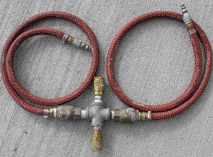
Years ago, I tried to double up my compressors the way Carl Hagstrom showed (Letters, 11/04), but I had a problem with “feedback” from one compressor into the other one and usually ended up with one compressor running continuously. So I fitted a cross-T with check valves on the compressor sides to prevent backflow and ran a hose from each compressor to the T. I also power my compressors on separate electrical circuits. I am able to run my four roofing guns with no problem.
Jeff Currier
Currier Builders
Stevens Point, Wis.
Water-Heater Efficiency
The article on twin water heaters (Kitchen & Bath, 10/04) suggests that standard efficiency for domestic hot-water heaters is around 80 percent. But according to the GAMA directory (an independent testing agency), standard water heaters start at about EF (energy factor) 0.49, or 49 percent efficiency. Power-vented and oil-fired units average around EF 0.60, or 60 percent. Indirect tanks do use the connected boiler efficiency, which can be from 80 percent up to 98 percent. And electric versions are around EF 0.90, or 90 percent, but the fuel cost is high, so the efficiency is moot.
I would not give your readers the impression that average efficiency of domestic water heaters is 80 percent.
Christopher T. Trolle, P.E.
Trumbull, Conn.
Mike Gordon, vice president of engineering at Bradford White, a water-heater manufacturer headquartered in Amber, Pa., responds: The efficiency ratings of water heaters and the efficiency ratings of boilers are determined by entirely different methods. While both test procedures are useful and valid for comparing like types of equipment, the ratings don’t work when comparing a boiler with a water heater. Boilers are tested according to the DOE-prescribed annual fuel-utilization efficiency (AFUE) procedure. AFUE measures the thermal efficiency of the boiler operated at 140°F supply-water temperature and 120°F return-water temperature and subtracts the amount of heat lost through the venting during off-cycle. Heat losses through the jacket are not counted, since the boiler is assumed to be inside the structure providing useful heat. Water heaters are rated using the DOE simulated use test (SUT). The water heater is operated for a 24-hour period with 135°F average tank temperature and 58°F cold water inlet temperature. The SUT calls for six water draws of 10.6 gallons each at a water flow rate of 3 gpm over a six-hour period, one draw per hour. The water heater then maintains the 135°F setpoint for 18 hours. The amount of energy provided as hot water is divided by the amount of energy used during the 24 hours to determine the energy factor (EF). Heat lost through the jacket and through the venting is counted as losses. Effective January 2004, the DOE increased the minimum efficiency level for water heaters. A 40-gallon gas model now has a minimum EF of 0.59. However, the thermal efficiency of the water heater typically ranges between 76 percent and 82 percent. Jacket and flue losses, as measured by the SUT, typically range between 17 percent and 23 percent. By contrast, a gas-fired boiler has a minimum AFUE of 80 percent. Many boilers measure around 81.5 percent to 84.0 percent thermal efficiency, with 1.5 percent to 3 percent flue loss. As noted above, jacket losses are not counted. The different test procedures weight the various losses differently. To provide an accurate comparison, the boiler/indirect water heater combination would have to be tested more like a water heater, with the same draws and maintained setpoint temperature. Off-cycle losses and losses from the connecting piping combined with the higher boiler water temperatures would reduce efficiency. A simpler method is just to compare the thermal efficiency, as noted in Dave Yates’ article — around 76 percent to 82 percent for water heaters and a bit higher for boilers. It would be interesting, however, to see what a boiler and indirect water heater combination would provide using the water-heater procedure. A big variable would be the amount of piping between the indirect and the boiler, and whether the piping was insulated.
WallShield Price Correction
The price given for VaproShield’s WallShield housewrap, featured in January 2005 Products, was incorrect. The product costs 45 cents per square foot. For more information, call 866/731-7663 or go to www.vaproshield.com. We regret the error.


