
A few months ago I received a call from a prospective client who wanted to replace the casement windows in her home in Berkeley, Calif. I went over there thinking it would be a straightforward replacement. As soon as I saw the house, I could tell that replacing the windows would be a very difficult job. The yard was beautifully landscaped, and the 1920s Spanish Mediterranean home was in pristine condition.
Options
Replacing the windows would require us to remove the interior trim and break out a lot of heavily textured stucco. Demolition would create a terrible mess, and it would be nearly impossible to patch this particular type of stucco without it showing. Even if we could patch the stucco, there was the question of what kind of windows to install. Wood or painted fiberglass windows would look right, but they would have to be custom made to fit nonstandard openings.
The usual approach would be to use vinyl windows because it’s easy and doesn’t cost much to get them in custom sizes. It’s even possible to get them as retrofit units that fit inside the existing jamb, but, retrofit units or anything made out of vinyl would destroy the architectural character of this house.
Because the conventional choices didn’t seem to fit, I asked the client what she disliked about the old windows. She liked the way they looked, but the house was on a busy corner, and the early morning commuters woke her up every day at 5 a.m. In addition, the house was drafty and the heat was uneven. We discussed the options and decided to rehabilitate the existing units.
We could have replaced the single-pane glazing with insulated glass, but the owner decided against it because she liked the wavy look of the original glass. Heat loss was not a big concern because the house was in an area where frost is rare and almost no one needs air conditioning.
The windows were old-fashioned casements with butt hinges. Most of the sash were in excellent condition, but several had enough rot that they needed to be replaced. My window supplier agreed to fabricate the replacement sash and showed me a sample unit. The existing windows had compressible brass weatherstripping, the kind that’s fastened to the inside of the jamb with dozens of nails. It fit poorly and made some of the windows difficult to open and close.
Material of choice. The sample unit had modern foam-polyethylene weatherstripping set into a kerf around the perimeter of the sash. I told the supplier that we’d like to put the same kind of weatherstripping on the remaining windows, and he agreed to sell me everything my carpenters needed to do the job. He provided us with a three-wing router bit and a roll of Q-Lon QEZD-250 weatherstripping.
This material is similar to the kerf-applied weatherstripping that comes on many prehung exterior doors. But instead of compressing between the stop and face of the door, it fits between the jamb and the edge of the sash. Q-Lon (Schlegel Systems, Rochester, N.Y.; 585/427-7200, www.schlegel.com) consists of a stiff plastic fin and urethane foam with a polyethylene cladding. The profile we used had flexible barbs to keep the fin in the kerf.
Reworking the Sash
The client was living in the house, and some family members were extremely sensitive to dust. Since one of the reasons for rehabbing the windows was to avoid making a big mess, we covered the patio with drop cloths and set up a work table there.
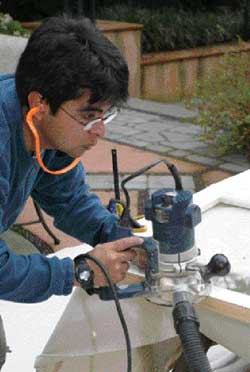
The gap around the existing windows was too small for the new weatherstripping. We needed about 1/8 inch to get it in, and our first thought was to pull the sash and use a portable table saw to rip material off each edge. There was paint buildup, however, and the house had settled so that in some places the sash rubbed and in others the gap was fine. We dealt with that by scribing the sash about 1/8 inch in from the jamb. Once the sash were marked, we removed them and took off all the hardware. We used a power planer to trim the sash to size. The edges were covered with lead-based paint, so we connected the planer to a dust-collecting vacuum. Very little debris made its way onto the drop cloth.
The fin is designed to fit into a kerf, so the next thing we did was use a router and three-wing cutter to cut a slot on each edge of the sash about 3/8 inch in from the outside face. It’s important to use the right-size bit. If the kerf is too narrow, the fin won’t go in; if it’s too wide, the weatherstrip won’t stay in place. Our supplier made sure we had the correct 2-mm (.078-inch) bit to make the cut.
Next, we used scissors to cut the weatherstripping to length and miter the ends so it would wrap the sash like a casing wraps a picture-framed window.
The last step was to press the fin into the slot. There were some gaps in the seal because the kerf-applied material could not run through the hinges. It’s not a big issue in our climate, but if we were in a colder area, I would have made the seal continuous by running a strip of self-adhesive foam across the hinge leaf on the sash.
The openings needed work, too. We removed the original weatherstripping, filled all the nail holes, and gave the surface a coat of primer and paint. The new weatherstripping could be pulled back out of the slot, which was good because we had to test-fit the first couple of sash. Once we understood the tolerances, we were able to process several windows at a time.
Some of the sash had dings and small areas of rot, so the carpenters patched them with wood filler. We also patched the insides of the jambs and then primed and repainted the jambs and edges of the sash. Reinstalling the windows was simply a matter of putting the hardware back on and screwing the hinges to the sash.
We used a similar weatherstripping product on the existing doors. It came attached to a removable stop, which we fastened over the existing stops. The door material can also be installed in a kerf between the stop and the jamb, but the kerf would have to be made before the jamb was assembled, so it wouldn’t work on a retrofit.
Cost and Results
You can find kerf-applied weatherstripping at a good lumberyard or building supply house, but you will probably have to special order the particular profile that we used. The material we bought was white, but it’s also available in cocoa, black, stone, bronze, and beige. Depending on where you buy and how much you get, you could pay between 25¢ and 75¢ per foot — we paid around 50¢ per foot. The cost of the material hardly mattered because rehabbing the windows was way less expensive than replacing them.
The first couple of windows were slow going, but once we got up and rolling, it took maybe two hours, including painting, to do each opening. The client was very happy with the results. It didn’t cost a fortune, and we didn’t have to tear up the house. The owner can still hear the traffic, but now it’s background noise. The house is less drafty and feels warmer. We could have made more money replacing the windows, but this project paid off by giving us a satisfied customer who has since since been referring us to her friends. David Grubb is a remodeling contractor in Berkeley, Calif.

