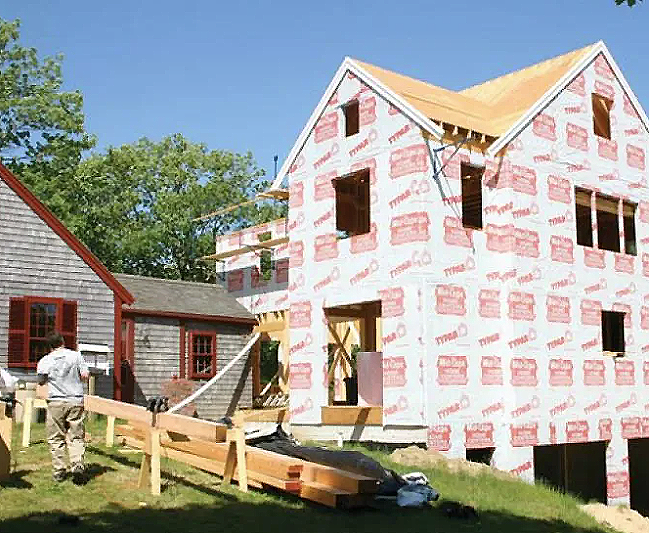
My crew and I just finished building a Cape-style addition to
a faithfully restored 1776 house. The antique home
couldn’t be properly heated, so the addition will serve
as wintertime living space. Since the owners wanted the new
stick-built structure to reflect the old building’s
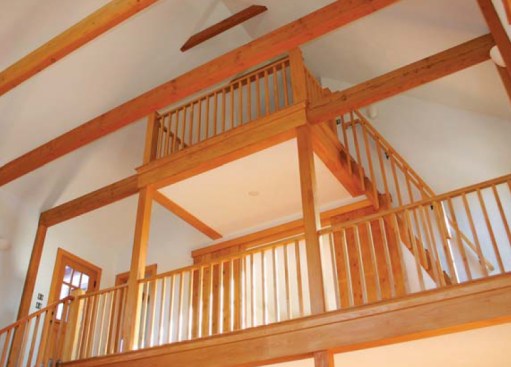
post-and-beam construction, the architect added exposed 6x10
posts and collar ties to the plans for the great room. I
ordered #1 Douglas fir beams from the local lumberyard, then
cleaned up the planer marks with a hand planer and belt sander
(1). We applied Watco Danish oil and let it
soak in; the oil penetrates and hardens in the wood, rather
than on the surface, and provides a good sealer.
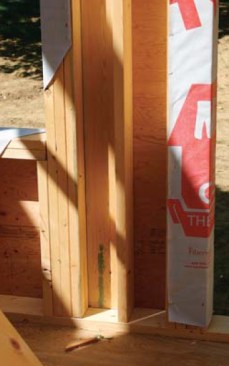
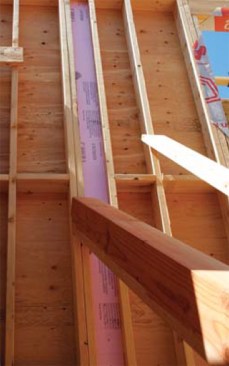
We balloon-framed the two-story walls with 18-foot-long 2x6s
on 16-inch centers. Every 4 feet, we created snug-fitting post
pockets (2), which we lined with 2-inch-thick
EPS foam board to reduce thermal conductivity
(3). We notched the posts top and bottom to
fit around the plates, then stood them in the pockets
(4). Pressed against the foam, the posts
projected 5 3/4 inches proud of the studs — 5 inches
after the 5/8-inch drywall and skim-coat plaster were
installed. To pull the posts snugly against the foam, we first
screwed them from outside, through the sheathing, with 4
1/2-inch TimberLok (800/518-3569,
fastenmaster.com)
screws, then nailed them through the studs on either
side.
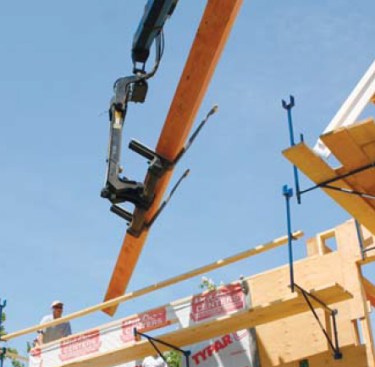


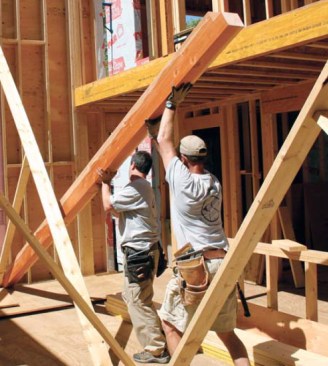
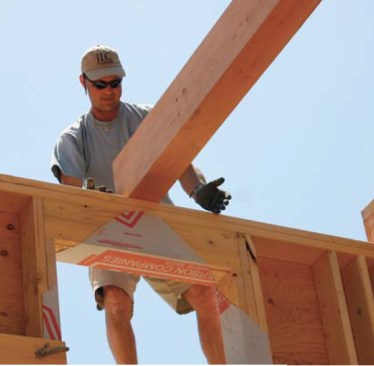
We brought in a boom truck from the lumberyard to hoist the
collar ties onto the plates (5,6). We fastened
the ties to the plates with three 8-inch TimberLok screws, one
angled in from each side and one angled through the end. I had
made sure that the posts were a scant 1/16 inch taller than the
plates so that the 24-foot collar ties would sit seamlessly on
their tops.
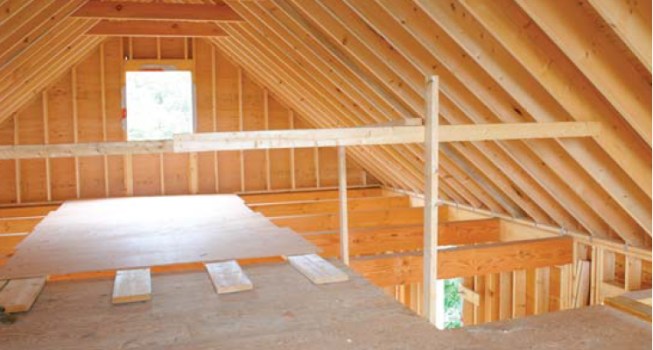
I cut the ties 3 inches shorter than the 24-foot span to allow
for a 2x10 rim board across their ends. We filled in between
the ties with 2-inch foam board, 1/2-inch plywood, and solid
2x10 blocking, then ran a double top plate across the top,
ready for rafters (7).
After framing the roof we added 3x8 Doug-fir collar ties on
4-foot centers, about 3 feet down from the ridge. We screwed
them through the rafters with 4-inch TimberLoks. The plaster
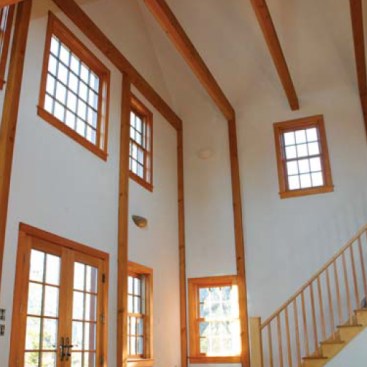
crew wrapped the posts and beams with protective paper as part
of their work. The posts stand out strikingly against the
rough-coat plaster and effectively evoke the look of the old
house (8, 9).
John Hemming is a contractor in Orleans, Mass.
Adding a Border to a Hardwood Floor
by Trevor Kurz
Our design-build company is always looking for ways to make
average jobs more interesting. For the project shown here, a
new client called us in to update kitchen cabinets. One idea
led to another and we found ourselves gutting the kitchen and
laying cherry floors in it and three adjacent areas. To help
define each space within the open floor plan, I proposed
installing opposing diagonal layouts and framing each area with
contrasting borders.
The border design (1) consists of three
courses of 3 1/2-inch cherry, followed by a contrasting strip
in bird’s-eye maple that’s either 1 1/2 or 3 inches
wide. In the past when I worked with borders, I’d install
the border first, then the field. Although that method got the
job done, it was time-consuming — and it would have been
a nightmare with this complicated layout.
Our lead carpenter came up with a better approach. We
installed the field flooring first, running the ends rough to
within a few inches of the walls and taking care not to nail
within the border zone. Once all four fields were completed, we
snapped reference lines for the borders. Then we simply laid
our newly acquired Festool plunge-cut saw and guide rail
(888/337-8600,
festoolusa.com) on the
lines and cut the edges clean (2).
Integral nonslip strips on the bottom of the guide rail saved
us the hassle of fastening it to the floor. At adjoining
angles, we completed the cuts with a flush-cut saw
(3).
Next, we ran a router equipped with a stacked pair of wing
cutters (4) along the sawn edges, creating a
groove for the tongued maple inlay strip. We had to replace the
locking nut on the router with a thinner version — and
even then we cleared the subfloor by only about 1/16 inch
(5).
We prepared the maple strips back at the shop, using a table
saw with a stacked and spaced dado blade to create tongues on
both edges (6). The two-way tongues allowed us
to orient the cherry strips tongue-to-the-wall for easiest
installation. Rather than mitering the borders at corner
junctions, we stepped the pieces, to add visual interest
(7).
In the entry hall, an inlaid compass-rose medallion
prefabricated by Oshkosh Designs (877/582-9977,
oshkoshdesigns.com)
put the icing on the cake. The inlay came with a prepared
routing template and router bit, simplifying its installation
(8). As with the borders, we were careful to
keep nails out of the 4-foot-diameter inlay area.
The border process added about a day and a half to the field
installation but went without a hitch. And the finished floor
looks fantastic (9).
Trevor Kurz is president of Kurzhaus Designs in Dennis,
Mass.