- Q. What is the life expectancy of electroplated nails, bolts, and lag screws as compared with hot-dip galvanized? Double-dipped fasteners are often recommended, but their cost is almost twice that of electroplated hardware. I have used electroplated on several projects in the past five years and have had no problems — yet.
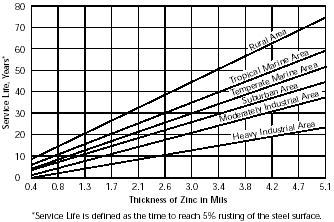
A.Shalea Hardison responds: There are several methods for coating steel with zinc. The most commonly used for nails, bolts, and screws are hot-dip galvanizing, mechanical galvanizing, and electroplating. The coatings resulting from the different methods have different characteristics and provide varying levels of corrosion protection (see chart below).
Hot-dip galvanizing is the process of dipping steel into a bath of molten zinc, creating a series of metallurgically bonded zinc-iron alloy layers. The fasteners are typically dipped in baskets, then placed in a spinner, or centrifuge, to remove the excess zinc from the threads. The minimum coating thickness for hot-dip galvanized fasteners ranges from 2.0 to 6.0 mils.
The term “double-dipped” is somewhat misleading. It does not mean that the zinc coating on the fastener is twice as thick (and will therefore last twice as long). However, dipping a fastener a second time does improve the overall quality of the outer zinc layer, while adding a small amount of thickness.
Electroplating is the process of applying zinc to the steel surface by electrodeposition. With electroplating, the zinc does not metallurgically bond to the steel surface. Also, the coating thickness is significantly less than with hot-dip galvanizing, typically between .14 and .28 mils.
With mechanical galvanizing, the fasteners are placed in a tumbler with zinc powder and other chemical catalysts. Again, there is no metallurgical bond created, and the minimum coating thickness ranges from .2 to .24 mils.
As a general rule, the thicker the zinc coating, the longer the corrosion protection afforded. As the graph shows, hot-dip galvanized fasteners will last longer than either mechanically galvanized or electroplated products.
In addition to providing longer corrosion protection, hot-dip galvanized coatings have a more uniform and slightly thicker zinc layer on edges and corners. Hot-dip galvanized coatings are also tougher and more durable than other zinc coatings.
In essence, not all zinc coatings are the same. Make sure the coating you specify is suitable for the environment in which the steel will be placed. Replacing an electroplated fastener just a few years after installation may mean spending more money than using a better quality product in the first place.
Shalea Hardison is the marketing services coordinator for the American Galvanizers Association, in Aurora, Colo.
Q&A: Life Expectancy of Galvanized Fasteners
Life Expectancy of Galvanized Fasteners
2 MIN READ