- Q. Do radiant barriers save energy?
A.Steve Andrews responds: Yes, radiant barriers in vented attics can cut cooling bills by about 10%. They achieve this by reducing heat flow down through the ceiling by 40% or more. But the better question is: Are radiant barriers cost-effective? The answer is also yes, but only in the right climates, only when properly installed, and only at the right price (see map).
Here’s a summary of the latest information:
Climate. The NAHB Research Center’s study (funded by Eagle Shield) promised to yield good information on radiant barrier performance in cold climates, but it has hit contractual snags. So climate-related advice hasn’t changed: Radiant barriers in attics make the most sense in locations where there are 2,000 cooling degree days or more (see map at right). They may also make sense in more moderate climates where annual cooling bills still exceed annual heating bills (excluding mild sections of the West Coast). In cold climates, radiant barriers can make sense in a crawlspace, but this remains unproven for attics.
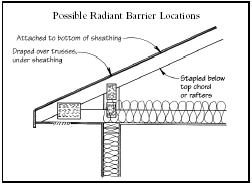
Properly installed. For attics, staple the barrier beneath the rafters, drape it over the roof trusses before the decking goes on, or staple it directly to the bottom of the roof decking — shiny side down in all cases (see illustration at left). Make sure you vent the attic, since this is the best way to cool this space. Research shows that laying a radiant barrier flat over horizontal attic insulation can cut radiant barrier performance by up to 50% after five years due to dust buildup.
Cost. If you buy material directly from a manufacturer, expect to pay between 7¢ and 15¢ per square foot, depending on the quality of paper backing and fiber mesh reinforcement. These two features can dramatically reduce tearing during installation; test this by ripping up samples before you buy. According to the Florida Solar Energy Center, if a homeowner pays about 20¢ per square foot for the installed barrier, the simple payback will be as little as five years in a cooling climate (based on electricity costs of 8¢ per Kwh). The greater the cooling load and utility costs, the faster the payback will be.
Steve Andrews is a residential energy consultant and freelance writer in Denver, Colo.
Q&A: Do Radiant Barriers Work?
Expert advice on the tough calls faced by energy-minded builders
2 MIN READ