Download PDF version (505.6k) Log In or Register to view the full article as a PDF document.

Image

Many states have recently increased the stringency of their residential energy codes, forcing builders to rethink long-established construction practices. In some areas, contractors who have always built houses with 2x4 walls and uninsulated basements are waking up to new regulations requiring basement wall insulation and much higher R-values for above-grade walls. Elsewhere, building officials have begun checking the U-factors on window labels for the first time.

Energy codes vary widely from state to state. While many states require residential builders to comply with the Inter-national Energy Conservation Code (IECC), the successor to the old Model Energy Code (MEC), other states — including Alabama, Arizona, Colorado, Illinois, Mississippi, Missouri, and South Dakota — have no statewide residential energy code.

Even when a state decides to adopt the IECC, however, plenty of opportunities for confusion remain. At least five different versions of the IECC are currently being enforced in the United States. The most recent version, the 2006 IECC (adopted by Iowa, Louisiana, Pennsylvania, and Utah), is radically different from earlier versions of the IECC enforced in several other states.

Moreover, a number of states have adopted the IECC with state-specific modifications. For example, New Jersey's code permits builders to omit basement wall insulation in any home equipped with a 90 percent AFUE (or better) furnace; New York, on the other hand, specifically prohibits any design with a trade-off that eliminates basement wall insulation.

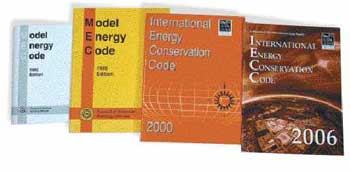
Several model residential energy codes are currently in print, including the 1992 and 1995 MECs, and the 2000, 2003, and 2006 IECCs; code books are available at prices from $11 to $31 from the International Code Council (www.iccsafe.org).

Forty-four states now enforce an energy code based on either the MEC or a pre-2004 version of the IECC (see "Residential Energy Codes by State"). These codes allow builders to choose from three compliance options: a prescriptive path, a component trade-off path, and a systems analysis path.

Image

The Prescriptive Path

Dubbed the "cookbook" path in Minnesota, the prescriptive path is the simplest — though not necessarily most cost-effective — way for builders to meet energy-code requirements. Prescriptive-path requirements usually include minimum R-values for insulation, with different R-values specified for walls, ceilings, floors, basement walls, and slab edges. Some prescriptive codes also specify a maximum U-factor or a maximum solar heat-gain coefficient (SHGC) for windows.

Prescriptive-code requirements are usually shown in a table (for example, Table 602.1 in the 2000 IECC; see below) that specifies minimum R-values, maximum U-factors, and maximum SHGC values; these prescribed values typically vary by climate zone or by the number of heating degree days at the building site.

Image

Prescriptive tables, like this one in the 2000 IECC, provide a cookbook approach to energy design but may not result in the least expensive building.

Windows from major manufacturers are labeled with U-factor and SHGC values calculated according to procedures established by the National Fenestration Rating Council (NFRC). If a window lacks an NFRC label, builders must use code-specified "default values" when demonstrating code compliance; for example, a vinyl window with double glazing is assigned a default U-factor of 0.55.

In some regions of the country, the best available default window U-factors or SHGC values aren't low enough to satisfy the prescriptive code, so NFRC-labeled windows are the only option open to builders following the prescriptive path.

In pre-2004 versions of the IECC, builders following the prescriptive path need to calculate the home's window-to-wall ratio (WWR). Homes with a WWR of 15 percent or less should follow the prescriptive tables in Chapter 6 of the code, and homes with a WWR of more than 15 percent need to follow the prescriptive tables in Chapter 5. Builders must include rim joist areas in wall-area calculations; window areas are based on rough-opening areas.

The idea of the WWR originated in the original 1992 MEC (see "Making Sense of the Model Energy Code," 11/99). In pre-2004 versions of the IECC, all three compliance paths require builders to calculate the WWR. (In Washington state, the residential energy code requires builders to calculate a different ratio, the window-to-floor-area ratio.)

The Component Trade-Off Path

Because the prescriptive path is inflexible, its use often results in a house that costs more to build than a house that follows the component trade-off path. Builders who choose the component trade-off path are able to adjust several variables — such as insulation thickness, window area, or furnace efficiency — in search of the most cost-effective way to comply with energy-code requirements. In pre-2004 versions of the IECC, the component trade-off path is found in Chapter 5.

In some states, the component trade-off path is called the component performance path or — somewhat confusingly — the performance calculation path. However, this path does not involve a full-fledged calculation of a home's energy performance; rather, it involves a simplified performance calculation based on a limited number of trade-offs.

For example, many state energy codes allow a house equipped with a high-efficiency furnace to skimp on wall or ceiling insulation. The rationale behind such a trade-off is simple: Although the resulting house has different specifications than a house following the prescriptive path, the two houses cost about the same to heat.

"The energy codes don't really require minimum levels of insulation," says Joe Nagan, technical director for Wisconsin Energy Star Homes. "For example, in their prescriptive insulation tables, the codes generally assume that you have a 78 percent AFUE furnace. But as long as your trade-off gives you a heat loss that is less than the maximum allowable heat loss, you pass. If you don't pass, you can either beef up the walls or you can go to a more efficient furnace."

In states with an energy code based on the 2004 IECC or earlier model codes, adjustments in window area can be used as a trade-off. For instance, thicker attic insulation or better-performing windows can be used as a trade-off for a high window-to-wall ratio; conversely, a low WWR may allow builders to skimp on insulation.

The easiest way to follow the component trade-off path is to use computer software — for example, a free program called REScheck — to fine-tune a home's specifications. Although first-time users of REScheck may be intimidated by the software, most builders soon navigate the program with ease (see "Using REScheck").

REScheck is a software tool used to demonstrate that a house design complies with residential energy codes. The program was developed by the U.S. Department of Energy, and can be downloaded at no charge from www.energycodes.gov.

Not all states allow the use of REScheck for demonstrating energy-code compliance, so it's important to check local code requirements before deciding to use REScheck. Florida builders usually show code compliance with EnergyGauge software, while California energy consultants use one of several California-specific software tools to meet the state's Title 24 requirements. Among the states that do allow the use of REScheck are Arkansas, Georgia, Massachusetts, Minnesota, New Hampshire, New Jersey, New York, Vermont, and Wisconsin.

Once you have REScheck loaded on your computer, you're ready to see if your house design meets code. At the "Code" tab, choose the code you will be complying with — for example, MEC or a particular version of the IECC. If you live in a state with a state-specific code, it's important to indicate (at the "Code" tab) the state where the house is being built.

The program has five main tabs to click: "Project," "Envelope," "Mechanical," "Loads," and "Energy Star." Under each tab are boxes where the user enters information about the house in question. Probably the most time-consuming step is calculating the area of the home's components, including floor areas, wall areas, ceiling areas, and window areas.

Image

Image

In this example, a simple 30-foot-by-40-foot ranch house has R-19 wall insulation, R-38 ceiling insulation, R-5 basement wall insulation, and windows with a U-factor of 0.34. If the house is equipped with a 78 percent AFUE furnace, it does not pass Wisconsin code. On the REScheck program, the line at the bottom of the screen indicates code compliance or failure; in this case, it indicates "Fails" and "9.2% Worse Than Code."

After entering the required information, including the insulation R-values, it's time to click the "Check compliance" button in the lower left-hand corner. The program then indicates whether your design "Passes" or "Fails," and displays the percentage by which it either exceeds or falls short of your energy code (for example, "Your UA is 2.6% better than code," or "Your UA is 16.2% worse than code"). By changing the home's insulation values or window sizes, an out-of-compliance home can be brought into compliance (see screen shots).

Image

Image

The same ranch house in Wisconsin becomes code-compliant when the basement wall insulation is increased to R-10. The REScheck program indicates "Passes" and "4.6% Better Than Code."

Image

Image

Instead of increasing the thickness of the attic and basement wall insulation, a builder could swap the 78 percent AFUE furnace for a 92 percent AFUE furnace. That upgrade results in a house that is 7.4 percent better than code — even with the original R-5 basement wall insulation.

In most cases, REScheck determines code compliance by calculating the home's UA. (UA is the overall average heat transmission of the area of a building's exterior envelope; that is, the average U-factor of the envelope times the area of the entire envelope.)

If the home includes high-efficiency hvac equipment, REScheck can (in certain states, or for some model codes) perform a limited-scope performance analysis. However, use of the performance path is not always advantageous to a builder. Under the 2006 IECC, the performance path calculation considers glazing area and orientation, so a home that is not advantageously oriented (from a solar perspective) may fail worse when following the performance path than it did using the prescriptive path.

Here, then, are a few facts to remember:

• When entering wall areas into REScheck, use gross wall areas (including band-joist areas), not net wall areas. REScheck automatically subtracts the area of the windows and doors to calculate net wall areas.

• When entering window areas, enter either the rough opening area or the window frame area, not the sash area or the glass area.

• REScheck automatically adjusts R-values as required to account for drywall, air films, and the like, so enter only the R-value shown on the insulation label.

• If you are passing code by means of the UA calculation method, you don't need to enter information on the home's hvac system.

• If you are complying with the 2006 version of the IECC, some compliance paths require specifying the orientation (north, south, east, or west) of the windows and walls.

• REScheck has certain inherent limitations; for example, it is unable to handle a house with more than one heating system.

Anyone with questions about REScheck should explore the resources available online at www.energycodes.gov. They include the REScheck Software User's Guide.

While the component trade-off path is popular in northern states, southern builders often stick with the prescriptive path. "Where the prescriptive codes most align with current building practice, builders tend to use the prescriptive codes," says Mike DeWein, technical director for the Building Codes Assistance Project in Washington, D.C. "That tends to be in the warmer climate zones. Where current practice varies from the prescriptive requirements, builders usually want to use the trade-off or the performance method. In a good chunk of the northern half of the country, builders and design professionals are very comfortable with REScheck."

Builders should remember that some trade-off strategies, though code-compliant, may result in an uncomfortable building. For example, many state energy codes allow builders to trade thicker attic insulation for cheaper windows. While the resulting house may satisfy the energy code, high U-factor windows may lead to comfort complaints.
The Systems Analysis Path

Sophisticated energy modeling software is needed for the systems analysis path. Depending on the state, the systems analysis path may be called the systems performance path, the simulated performance alternative, or whole-house performance analysis. It's found in Chapter 4 of pre-2004 versions of the IECC. In general, builders following this path must show that a proposed house design has an annual energy budget less than or equal to a similar house that complies with the code's prescriptive requirements.

While REScheck is perfectly adapted to calculating the effects of component trade-offs, it cannot be used for the systems analysis path. Builders following the systems analysis path need to use a program like DOE-2 or REM/Rate, the software used by consultants who rate a home using the Home Energy Rating System (HERS) index. Whereas the REScheck program has no way for a builder to input a home's air infiltration rate, REM/Rate does — so that a very tight home can obtain credit for its superior performance compared with a typical, somewhat leaky home.

If a builder follows the systems analysis path for code compliance using an air-infiltration rate that is lower than the code-specified default value, the code stipulates that a blower-door test must be performed to verify that the home meets its tightness goal. In theory, a builder who cannot provide blower-door results under these circumstances can be denied a certificate of occupancy.

Systems analyses are usually performed by an energy consultant, HERS rater, architect, or engineer. A systems analysis is the only way a builder can get full credit for certain energy-efficiency features that are not otherwise required by code — window orientation optimized for passive solar heating, for example, or a sealed and tested duct system.

Following the systems analysis path makes sense for homes that have unusual design or energy-efficiency features. Because the systems analysis path usually requires the assistance of an energy consultant, it is rarely used for residential construction.

Mandatory Requirements

In addition to offering three compliance paths, residential energy codes impose additional mandatory requirements. For example, pre-2004 versions of the IECC require attics to be equipped with permanent insulation depth markers.

Mandatory requirements also vary from state to state; for instance, Washington state requires all homes, regardless of which path is used for code compliance, to be equipped with a whole-house ventilation system and equipment to provide combustion air for solid-fuel appliances.

Getting Your Permit

In most jurisdictions, a building permit will not be issued until the builder has submitted documentation — such as a REScheck report — showing that the design complies with the local energy code. Energy code documents are prepared by a range of service providers, including builders, engineers, architects, energy consultants, lumberyards, and heating contractors.

Although REScheck reports are routinely prepared by builders in many areas, a few jurisdictions — including some New Jersey municipalities — require REScheck calculations to be submitted by a licensed engineer. California's energy code, called Title 24, is unique. Because of the code's complexity, California builders usually demonstrate code compliance by hiring an energy consultant familiar with the use of Title 24 software.

Many builders are happy to hand off responsibility for code-compliance paperwork. "In Wisconsin, the overwhelming number of REScheck reports are done by the lumberyard or the heating contractor," reports Nagan.

What About Airtightness?

Since many attributes of home performance are not regulated by code, complying with the energy code, though necessary, is not sufficient to guarantee that a house will be energy-efficient. For example, the prescriptive and component trade-off paths do not directly address a home's air-leakage rate. As Nagan notes, "REScheck can perform trade-offs between heating equipment and insulation levels, but REScheck knows nothing about infiltration."

In some countries, such as Sweden, a new home must pass a blower-door test before it can be issued an occupancy permit. U.S. codes, however, show no sign of following Sweden's lead. "The 2006 IECC is better at calling out how one deals with air leakage and duct sealing," notes DeWein. "But there is still no performance metric for it, unless you go to the full performance methodology."

The 2006 IECC requires submitted plans to indicate air sealing details (104.2); it also specifies that "the building thermal envelope shall be durably sealed to limit infiltration" (402.4.1). Some state codes, including the Minnesota, New York, and Oregon residential energy codes, have similar mandatory requirements intended to improve the airtightness of a home's envelope. Oregon's provisions are subject to interpretation by local building officials: "All exterior joints around windows, around door frames, between wall cavities and window or door frames, between wall and foundation, between wall and roof, and other openings in the exterior envelope shall be sealed in a manner approved by the building official."

A house that complies with the energy code does not necessarily include all cost-effective efficiency measures.

"Most Wisconsin builders install one inch of foam on the exterior of their basement walls," says Nagan. "When we do our REM/Rate action reports to evaluate a house for an Energy Star builder, overwhelmingly the reports show that the foundation is the largest contributor to the heating cost. Even Energy Star builders are using just one inch of foam, so these buildings still have a very weak link. These homes could be cost-effectively upgraded, with no more labor, just by going from one inch of foam to two."

Besides being 150 pages shorter than the previous edition, the 2006 IECC incorporates radical code revisions. The changes were promoted by the U.S. Department of Energy in response to critics who complained of code complexity.

The rewriting of the IECC was intended to be "stringency neutral" — that is, to result in houses that are just as efficient as houses built to earlier versions of the code.

Image

Among the most important changes to the 2006 IECC are the following:

• The number of climate zones has been reduced from 19 to eight, and all references to heating degree days have been eliminated.

• All references to the WWR have been eliminated.

With the elimination of window-to-wall area restrictions, the 2006 IECC no longer penalizes a house with a large WWR. Although builders will probably welcome the chance to jettison WWR calculations, anyone accustomed to building houses with few windows may be surprised to learn that some house designs that formerly met code may no longer comply. The reason is that the 2006 IECC no longer allows builders to get credit for a low WWR as a trade-off for lower insulation levels in 2x4 walls.

"The intent of the code was never to create caves with no windows," says DeWein. "The intent was to try to do a static heat-loss analysis and to compare the home with some baseline. With the older versions of the IECC, when you had designs with low window areas, they scored a little better overall. With the new code, that's no longer the case."

Like the earlier versions of the code, the 2006 IECC has three compliance paths. Builders who choose the prescriptive path must follow the requirements of Table 402.1, which specifies the maximum window U-factor, maximum skylight U-factor, maximum window SHGC, and minimum R-values for ceilings, walls, floors, basement walls, crawlspace walls, and slabs. These specifications vary by climate zone. Table 402.1 allows lower R-values in walls with high thermal mass — ICF walls, for example — than in wood-frame walls.

Builders who choose the component trade-off path (which the 2006 IECC calls "the U-factor alternative") must follow the requirements of Section 402.1.2. The easiest way to comply with this path is to use REScheck software.

The requirements for the systems analysis path (which the 2006 IECC calls "the simulated performance alternative") can be found in Section 404 of the 2006 IECC. While earlier versions of the IECC base systems analysis comparisons on a home's annual energy budget as measured in Btus or kilowatt-hours, the 2006 IECC requires that the comparison be based on the dollar cost of the energy used.

The 2006 IECC includes several new mandatory provisions, including a requirement (403.2.2) for R-8 insulation on ducts located outside the thermal envelope, and a requirement (401.3) for posting a "panel certificate." This document — which must be permanently affixed to the electrical distribution panel — must list the home's insulation R-values, window U-factors, window SHGC values, water-heater efficiency, and furnace or boiler efficiency.

The latest version of REScheck includes a new clickable button that automatically generates and prints a panel certificate.

Here are a few more noteworthy provisions of the 2006 IECC:

• The code waives SHGC requirements for windows in the special marine zone along the Pacific coast, where cooling loads (and therefore solar-gain concerns) are low.

• The code (402.2.1) allows builders who use raised-heel trusses to reduce the thickness of attic insulation, as long as the insulation covers wall plates at the eaves.

• The code (402.2.2) allows builders in climate zones where R-38 ceiling insulation is normally required to install R-30 insulation in a cathedral ceiling if that's all that will fit, as long as the area of the cathedral ceiling doesn't exceed 500 square feet.

Code Compliance Varies

Several studies have documented the fact that in many areas of the country, energy code provisions remain largely unenforced. For example, a 2001 study in Fort Collins, Colo., investigated duct tightness in new homes. In spite of a local code provision that required ducts to be "substantially airtight," performance testing in new homes revealed that hvac systems had duct leakage averaging 75 percent of system airflow.

Similarly, a 2001 study of 186 new Massachusetts homes found that only 46 percent of the homes met minimum code requirements for UA (building envelope U-factor), and only 19 percent met code duct-sealing requirements.

Building officials rarely bring along a home's REScheck report during site inspections. Although all residential energy codes except the 2006 IECC impose window-area limits, "there is not a single jurisdiction in the country that goes out and measures window areas on site," says Craig Conner, a former engineer at the Pacific Northwest National Laboratory in Richland, Wash.

Some states, including Vermont, have a mandatory energy code but no system of enforcement. "In Vermont, compliance with the energy code requires filing a copy of the documentation report with the local town clerk," says Richard Faesy, a senior energy analyst for Vermont Energy Investment Corp. in Burlington. "As far as I know, fewer than 10 percent of new houses are in compliance with the code. There's no enforcement infrastructure."

Many builders see lax code enforcement as a blessing. The trouble with uneven enforcement, however, is that a builder can never be sure when a new building official will begin enforcing long-ignored regulations. Builders intent on following the code as written should be aware of the following rarely enforced provisions:

• Some codes (for example, in Massachusetts and California) include duct-tightness requirements.

• Many codes (IECC 102.2, for instance) include a provision requiring all materials, systems, and equipment to be installed according to manufacturers' installation instructions. According to this provision, fiberglass batt insulation must be installed without voids or compression. Moreover, housewrap must be carefully lapped at horizontal seams, and some brands of housewrap must have taped seams.

• Many energy codes (such as IECC 803.2.1.1) require "right sizing" of hvac equipment; according to this requirement, oversized furnaces, boilers, and air conditioners violate the code.

Every builder needs to know what documents are required by the local building official to demonstrate compliance with local energy codes. A wealth of resources is available to builders looking to learn more, including the following:

• The local code authority

• The Web site of the state energy office

• A useful Web page maintained by the Pacific Northwest National Laboratory at resourcecenter.pnl.gov

• The Web site of the Building Codes Assistance Project at www.bcap-energy.org

• Model residential energy code books available from the International Code Council at www.iccsafe.org

• The Code Notes Web page maintained by the DOE's Building Energy Codes Program at www.energycodes.gov/support/code_notes.stm

• Free online training (Webcasts) for REScheck users available through www.energycodes.gov

• A very useful book, Field Guide to Residential Construction, produced by the Conservation Services Group; state-specific versions of the book (available for Connecticut, Idaho, Maryland, Massachusetts, Montana, New Hampshire, New Jersey, New York, Oregon, Rhode Island, Vermont, and Washington) are distributed through each state's Energy Star Homes program.

Martin Holladayis the editor of Energy Design Update.